Unsolicited Proposals: What Foundation Grant Statistics Really Mean


Quick Takeaway

Candid reports that only 23% of foundations accept unsolicited proposals, but this statistic is based on checkboxes foundations mark on tax forms—often for administrative convenience rather than actual practice. Additionally, when foundations report low acceptance rates (like 10%), that includes the 80-90% of applications that are immediately rejected for being poorly written or misaligned. For well-prepared, mission-aligned nonprofits, your actual odds are much higher than the statistics suggest. Focus on relationships, not percentages.

Imagine This: The Dating Profile Analogy

You're scrolling through dating profiles and see someone who's marked themselves as "single" and "open to meeting people." Does that mean you should show up at their house unannounced with flowers?

Of course not. "Open to meeting people" might mean:

  • "Message me first so we can chat before meeting" (letter of interest required)

  • "I only go on dates during summer when work calms down" (specific application windows)

  • "I prefer meeting through mutual friends" (invitation-only grantmaking)

That's exactly what it's like when Candid reports that only 23% of foundations "accept unsolicited proposals."

What Candid's Data Says—and What It Doesn't

The Statistic: Candid's recent report notes that roughly 23% of foundations accept unsolicited proposals.

What People Think It Means: Only one in four funders are open to new applicants.

What It Actually Means: Only 23% of foundations have documented their detailed grantmaking procedures on a public tax form. The other 77% may still consider applications—they just didn't want to provide all the details on their IRS Form 990-PF.

As Candid itself points out, the data is easily misunderstood. The statistic doesn't mean that 77% of funders are off limits—it means that many prefer a relationship first, invite proposals through specific channels, or simply didn't complete the detailed disclosure section of their tax form.

What "Unsolicited" Actually Means on the IRS Form—and Why the Data May Be Unreliable

Here's where it gets complicated: foundations check a box on their IRS Form 990-PF that asks, "Do you accept unsolicited requests for funds?"

But this is a compliance question on a tax form, and the answer may have more to do with paperwork than actual practice.

The Tax Form Shortcut

The IRS requires Form 990-PF to ensure transparency and accountability of private foundations. This transparency helps donors, beneficiaries, and other stakeholders assess how the foundation operates and manages its resources. In Part XV of the form, foundations must disclose their grantmaking procedures to help potential grant applicants understand how to approach them.

Here's the catch: If a foundation checks the box saying they "only make contributions to preselected charitable organizations and do not accept unsolicited requests for funds," they're done. They can skip the rest of the section.

But if they leave that box unchecked, they must provide detailed information:

  • The name, address, and contact information of the person handling applications

  • The required form and materials applicants should submit

  • Submission procedures and deadlines

  • All restrictions and limitations on awards (geographic areas, funding priorities, organization types, etc.)

Why Foundations Might Check the "No Unsolicited Requests" Box

That's a lot of work on an already lengthy tax form. Foundations might check that box not because they refuse to consider new organizations, but because:

  • They have informal or evolving processes that are hard to document

  • They're a small operation without dedicated grant management staff

  • They change priorities year to year and don't want to commit to specific procedures publicly

  • They want flexibility to fund opportunistically

  • It's simply easier than completing several detailed fields

...checking that box and skipping the detailed disclosures is the path of least resistance.

The result? Many foundations may check "no unsolicited requests" not because they refuse to consider new organizations, but because explaining their actual process is more administrative burden than they want to take on. Some might:

  • Accept applications but only during certain windows (which change)

  • Prefer a letter of inquiry first (but not always)

  • Want to maintain flexibility in how they find grantees

  • Simply not want to commit their informal process to a public IRS document

This means the 23% statistic may be less about actual accessibility and more about which foundations are willing to document detailed procedures on a tax form.

It's like checking "prefer not to say" on a survey—not because you're hiding something, but because explaining is more work than skipping.

Why Award Percentages Are Equally Misleading

Some grant writing experts advise nonprofits to call foundations and ask, "What percentage of applications do you award?" The theory is that you shouldn't apply unless the acceptance rate meets a certain threshold.

This advice sounds logical, but it's fundamentally flawed—and here's why.

Most Applications Are Immediately Rejected for Basic Reasons

The acceptance percentage includes terrible applications. Research on grant proposals reveals a sobering truth: at the W.K. Kellogg Foundation, 80% of grant applications are immediately rejected because applicants didn't do their homework about the foundation's specific priorities. One foundation manager reported that 90% of the proposals they receive are badly organized and don't communicate well.

Think about what this means. If a foundation reports a 10% acceptance rate, that statistic includes:

  • Applications that don't match the funder's priorities at all

  • Proposals with poor writing and mechanical errors

  • Submissions that don't follow basic guidelines

  • Requests from organizations that aren't even eligible

Popular foundations get flooded with applications—most of them poor. Well-known foundations like Gates, Ford, or Kellogg receive thousands of applications. A significant portion come from organizations that haven't done basic research, don't fit the funding priorities, or submit substandard proposals. These low-quality applications drag down the overall acceptance rate, making the foundation appear more selective than it actually is for qualified applicants.

The Question You Should Actually Ask

The question you really want answered is different. What you actually need to know is: "What percentage of well-written, mission-aligned applications from strong organizations get funded?" That's a very different number—and one that foundations can't easily provide.

As Candid itself notes in its analysis: "How many grant proposals submitted by well-run, well-governed nonprofits that perform a valuable service with effective programs actually get funded? Our guess: most of them."

Why Relationships Matter More Than Statistics

The overall acceptance rate statistics are misleading because they don't account for relationship quality or application strength. Here's what the numbers actually mean for your organization:

Three Reasons Why Relationships Matter More Than Statistics:

1.     Overall statistic: Foundation funds only 5% of all applications Your reality: With an established relationship and board connection, your odds improve to approximately 50%—ten times better than the posted rate.

2.     Overall statistic: Foundation reports 25% acceptance rate Your reality: This number includes everyone. Cold applications from unknown organizations have nearly 0% success, while known partners have significantly higher odds.

3.     Overall statistic: 80% of applications rejected immediately for poor quality Your reality: Most rejections are for poor quality or misalignment. A well-researched, perfectly aligned proposal from a strong organization competes in an entirely different pool with much better odds.

The acceptance percentage tells you almost nothing about your chances—because your chances depend on the quality of your proposal, the strength of your relationship, and the alignment of your mission with their priorities.

Reframing the Statistic

Instead of reading, "Only 23% of foundations accept proposals," interpret it as:

"23% of foundations have publicly documented their detailed grantmaking procedures on a tax form—but that doesn't mean the other 77% won't consider your application."

Many of those 77% might be open to proposals—they just didn't want to spell out all the details on their 990-PF.


The Grant Writer's Secret Advantage: How to Read Between the Lines

Strong grant writers know that numbers don't determine access—relationships do.

6 Strategies That Work Better Than Statistics

1. Look beyond the form. Even if a funder "doesn't accept unsolicited proposals," a thoughtful email, board connection, or participation in their initiatives can open doors.

2. Track actual funder behavior. Use tools like Instrumentl or Foundation Directory Online to see:

  • Who they've funded in the past 2-3 years

  • Geographic giving patterns

  • Average grant sizes

  • Program areas that receive the most funding

3. Build trust before you ask.

  • Attend foundation-hosted webinars

  • Comment thoughtfully on their impact reports

  • Share success stories that align with their mission

  • Connect on LinkedIn (appropriately)

4. Time it right.

  • Respect application deadlines

  • Lead with letters of inquiry if preferred

  • Apply during their active funding cycles

5. Do your homework. The vast majority of rejected applications fail not because they're bad programs, but because applicants didn't dig deep enough into the funder's specific priorities and initiatives.

6. Don't be afraid to have a conversation. Sometimes guidelines seem to disqualify you—but a phone call can reveal unexpected opportunities.

Real-World Grant Writing Example: When Guidelines Don't Tell the Whole Story

The Boeing Foundation changed its funding priorities one year, shifting from providing direct grants to early learning nonprofits to funding only early learning coalitions—regional networks of providers working together.

At first glance, this seemed to disqualify my client, a small early learning provider on an island of just 10,000 people. They weren't a coalition, and they certainly weren't a region. By the letter of the guidelines, they appeared ineligible.

But my client had already been collaborating informally with other early learning providers on the island, identifying gaps in services and working to better serve their community. We had the collaborative spirit Boeing was looking for—we just didn't fit the geographic definition of a "region."

Instead of simply not applying based on the guidelines, I picked up the phone and called the program officer. I explained our situation: we were an island with no access to the mainland except by ferry. In essence, we were a region unto ourselves, with our own unique needs and challenges. We were already doing the collaborative work Boeing wanted to support—just on a smaller geographic scale.

The program officer understood. Not only were we invited to apply, but we also received a substantial grant.

The lesson: relevance and relationships outweigh statistics every time.

Frequently Asked Questions About Foundation Grants and Unsolicited Proposals

Should I apply to a foundation that doesn't accept unsolicited proposals?

Not directly—but don't write them off entirely. First, try submitting a brief letter of inquiry asking if you may apply. Request a conversation with a program officer to discuss your project and their current priorities. Seek an introduction through a board member or mutual contact. Attend their public events or webinars to begin building a relationship. Many foundations marked as "invitation only" will invite you to apply after these preliminary steps demonstrate your alignment with their mission.

Should I avoid foundations with low acceptance rates?

No. Low acceptance rates—like 5% or 10%—are misleading because they include the 80-90% of applications that are immediately rejected for poor quality, misalignment, or not following basic guidelines. If your organization is well-run, your proposal is excellent, and your mission aligns perfectly with their priorities, you're not competing against all those applications—you're competing in a much smaller pool of serious contenders. A foundation that funds "only 5% of applications" might actually fund 40-50% of well-prepared, mission-aligned proposals. Focus on fit and quality, not overall statistics.

How do I know if a foundation is really open to new applicants?

Look beyond the checkbox on their 990-PF and examine their actual behavior. Do you see any new organizations in their recent grants list—organizations they've never funded before? Are they funding in your geographic area? Do they fund organizations your size? Does their website information contradict or clarify the 990-PF data? When in doubt, call and ask directly about their openness to new applicants in your program area.

What percentage of grant applications actually get funded?

This varies widely by foundation, but overall statistics are misleading. While many foundations fund only 10-20% of applications, 80-90% of applications are immediately rejected for poor quality, misalignment, or failure to follow guidelines. For well-prepared, mission-aligned organizations, the real success rate is much higher. You're not competing against all applications—you're competing against the small subset that cleared basic quality hurdles.

How can I increase my chances of getting a grant?

Focus on perfect alignment—only apply when your mission clearly matches their priorities. Do deep research beyond the guidelines to understand their recent funding patterns. Build relationships with the foundation before applying. Submit a letter of inquiry first to test the waters. Follow every instruction exactly. Write clearly and compellingly. Demonstrate strong impact with solid outcomes data. These strategies matter far more than acceptance rate statistics.

Can I contact a foundation before submitting an application?

Yes, and in most cases this is encouraged! Appropriate pre-application contact includes calling to verify your eligibility and fit, asking clarifying questions about guidelines, requesting feedback on a preliminary idea, and submitting a letter of inquiry. What to avoid: don't ask them to read your draft proposal, don't be pushy or demanding of their time, and don't ignore stated preferences (if they say "no phone calls," respect that).

How long does it take to build a relationship with a foundation?

Building a meaningful relationship typically takes a minimum of six to twelve months for initial recognition and trust, one to two years for a strong relationship that improves funding odds, and three or more years for deep partnership and multi-year funding. You can accelerate relationship building by attending their events, sharing relevant success stories without asking for anything, demonstrating mission alignment through your work, and making connections through board members or current grantees.

Key Takeaways: What Grant Writers Need to Know

Your Action Plan

✓ Research funders based on their actual giving patterns, not their 990-PF checkboxes
✓ Start with a letter of inquiry or phone call—even to "invitation only" foundations
✓ Build relationships over time through authentic engagement
✓ Only apply where there's strong mission alignment
✓ Make your proposal exceptional—eliminate yourself from the 80% who get immediately rejected
✓ Be patient and strategic, not desperate and scattered

The Bottom Line

Candid's data isn't wrong—but the way it's collected and read often is. The 23% statistic is based on checkboxes on tax forms, where foundations may be choosing the easiest path rather than accurately describing their practices. Numbers can inform your strategy, but they shouldn't define it. Behind every statistic is a story of people, values, and alignment.

The "23% accept unsolicited proposals" figure is like someone checking "single" on a form. It's technically accurate, but it doesn't tell you how to actually connect with them—and it might not even reflect their real openness to meeting new people.

Don't let acceptance percentages scare you away from strong prospects. A 10% overall acceptance rate means very little if your organization is well-run, your proposal is excellent, and your mission aligns perfectly with their priorities. You're not competing against all applicants—you're competing against the small subset of qualified, well-prepared organizations.

And sometimes, you're not competing at all—you're having a conversation that opens a door you didn't even know existed.

Grant writing isn't about chasing odds—it's about building trust, one relationship at a time.

This post responds to insights from Candid's recent analysis: Do foundations accept unsolicited requests for funds from nonprofits?

About the Author

Allison Jones, CEO and Founder of Spark the Fire Grant Writing Classes, LLC, built one of the highest-rated grant writing education programs in the world, recognized for four consecutive years. She holds the Grant Professional Certified (GPC) credential, is one of only 30 nationally approved trainers by the Grant Professionals Certification Institute, and has trained over 5,000 grant writers. Her book Meaningful Work is forthcoming in 2026.

Now I Want to Hear from You

Did this article resonate with you? Why or why not?


How Grant Consultants Can Give Constructive Criticism Without Losing Trust

 
A man participating in a trust-building exercise, symbolizing how grant consultants strengthen client relationships and build trust in the grant writing process.

As grant consultants, we often face a delicate challenge: we see organizational gaps right away—websites that don’t inspire credibility, outreach that misses whole audiences, or budgets that simply don’t add up. But how do you tell a client this without sounding critical of their “baby”?

Constructive criticism is part of our job. Yet it can feel risky, especially when working with founders or leaders deeply attached to their work. The solution isn’t about softening the truth—it’s about changing how we deliver it.

Two Common Scenarios Consultants Face

Imagine this: You’re working with a founder who started a nonprofit after the tragic death of their child. In the early years, that story was central to the organization’s mission, and it remains deeply personal for the founder. But now, a decade later, the nonprofit has grown and is making a significant impact in its field—an impact no longer directly tied to that original story. The organizational description, however, still leans heavily on the founder’s personal tragedy. As a consultant, you can see the disconnect right away: funders want to understand the organization’s current reach and measurable results, not just its origin story. But how do you say that without diminishing the founder’s grief, or the powerful legacy they’ve built?

Or here’s another example: An organization calls you up for help, and you go to their website to learn more. Immediately, you notice that the homepage is all about how to donate—but there’s almost nothing about what the organization actually does. You know funders will be frustrated by this lack of clarity, but telling the organization flat-out could raise their defenses rather than helping them move toward providing a clearer picture of the value of the organization.

Two powerful frameworks can help: motivational interviewing and appreciative inquiry. These approaches help clients discover their own insights, making feedback feel like a partnership instead of judgment. They also position you as an ally and thought-partner rather than the enemy, which is critical in the early weeks of a consulting relationship. Establishing yourself this way signals that you’re not just there to take orders or nod along—you’re there to bring expertise, perspective, and candor in service of the organization’s growth. In other words, you want to show up as a consultant and thought leader, not as a lackey or yes-person.

Why Feedback Feels So Hard in Grant Consulting

Most of us have been there: a new client is excited about funding opportunities, but within minutes you notice red flags—an unclear mission, no evaluation plan, or communication channels that exclude whole populations. You know these issues will block them from winning grants, but blurting that out can backfire.

The tension is real:

·       Clients are proud of their organizations.

·       Funders expect professionalism and readiness.

·       Consultants are caught in the middle.

That’s why techniques that focus on curiosity, reflection, and respect are so valuable. Instead of “criticizing,” we can invite clients to think differently about grant readiness and their communication with funders.

Motivational Interviewing in Grant Consulting: Moving Through Ambivalence

Motivational interviewing was developed in the 1980s by psychologists William R. Miller and Stephen Rollnick, initially as a counseling approach for addiction treatment. Since then, it has been widely adapted for health, education, leadership, and coaching—anywhere people face resistance to change.

In fact, motivational interviewing has made its way into the business and leadership shelves of major bookstores. Miller and Rollnick’s Motivational Interviewing: Helping People Change (a perennial bestseller in psychology and coaching) lays the foundation. Other leadership-oriented works, like John Whitmore’s Coaching for Performance and Michael Bungay Stanier’s The Coaching Habit, echo motivational interviewing’s emphasis on open-ended questions and drawing out solutions rather than prescribing them.

In leadership contexts, motivational interviewing has been used to help executives navigate resistance to change, build teams’ intrinsic motivation, and align personal values with organizational goals.

For grant consultants, the lesson is clear: we can borrow from these proven leadership practices. Instead of telling clients what’s wrong, we invite them to reflect on what they want funders to see, how their current systems measure up, and what changes they’re willing to make.

Core Principles of Motivational Interviewing

Motivational interviewing rests on four core principles that translate beautifully into consulting. At its heart, it is about expressing empathy—listening without judgment so clients feel heard rather than corrected. It also emphasizes developing discrepancy, or what I like to call dissonance -- gently helping people see the gap between where they are and where they want to be. Rather than confronting resistance, motivational interviewing encourages us to roll with it, treating pushback as a signal to explore further rather than to argue. Finally, it underscores the importance of supporting self-efficacy, reinforcing the client’s belief that they are capable of making meaningful changes.

The OARS Technique

One of the most practical ways to put these principles into action is through what practitioners call the “OARS” technique:

  • Open-ended questions

  • Affirmations

  • Reflective listening

  • Summaries

Motivational Interviewing Example in Practice

These principles may sound abstract, but they come to life in everyday consultant communication. The key is shifting from statements that tell clients what’s wrong to questions that invite them to reflect on what they want and how well their current systems align with those goals. By phrasing feedback as curiosity instead of critique, motivational interviewing helps clients uncover the gaps themselves—making them far more open to change.

Instead of saying:

“Your website is too cluttered for funders.”

You might ask:

“When a funder visits your site, what do you most want them to notice first? How well do you think your current design supports that?”

This gentle reframing helps the client articulate the problem themselves—and people are much more likely to act on their own insights.

Appreciative Inquiry in Grant Consulting: Building on Strengths

Appreciative inquiry was created in the mid-1980s by organizational scholars David Cooperrider and Suresh Srivastvaat Case Western Reserve University. It emerged as an alternative to traditional “problem-solving” models of organizational development, focusing instead on amplifying what works.

Over time, appreciative inquiry has shaped the field of organizational change and leadership. Cooperrider’s book Appreciative Inquiry: A Positive Revolution in Change helped popularize the method, and Diana Whitney and Amanda Trosten-Bloom’s The Power of Appreciative Inquiry has become a go-to resource for leaders and consultants looking to create energizing, strengths-based cultures.

In practice, AI is used in:

·       Strategic planning – guiding teams to dream big and design based on strengths.

·       Leadership development – helping leaders focus on what brings life to their organizations.

·       Culture change – shifting from deficit-based conversations (“what’s wrong here?”) to generative ones (“what gives this team energy?”).

For grant consultants, the lesson is that we can frame our feedback in ways that celebrate and extend existing strengths. By spotlighting what’s already effective, we help organizations build confidence while also inspiring practical improvements.

The 5-D Cycle of Appreciative Inquiry

Appreciative inquiry is often practiced through what’s known as the 5-D Cycle, a process that guides organizations from reflection to action. It begins with Define, clarifying the focus of inquiry and setting the stage for what the group wants to explore. From there, the Discover phase invites participants to share stories and insights about what already works well. Building on those strengths, the Dream phase encourages people to imagine what could be possible if the organization were at its best. Next comes Design, where the group begins shaping practical strategies and structures to bring that vision to life. Finally, the Destiny (or Deliver) phase focuses on sustaining momentum and embedding the changes into daily practice.

Appreciative Inquiry Example in Practice

For example, imagine working with a nonprofit board that feels discouraged after several declined grant applications. Using the 5-D Cycle, you might start by helping them define the focus of your conversation—perhaps strengthening their overall grant readiness. In the discover phase, you’d ask them to recall a time when their organization successfully built a strong partnership or secured funding, and explore what made that work well. Then, in the dream phase, you’d invite them to imagine what it would look like if every funder relationship felt that strong. Moving into design, the group could brainstorm concrete practices—such as clearer impact reporting or stronger community engagement—that would move them closer to that vision. Finally, in the destiny/deliver phase, you’d help them commit to small, sustainable steps to carry the momentum forward.

Instead of saying:

“You’re missing a lot of your audience by only using social media.”

You could say:

“Your social media presence is vibrant and engaging. How could we build on that same strength to reach people who aren’t online?”

Appreciative inquiry reframes the conversation as an opportunity rather than a deficiency.

Motivational Interviewing vs. Appreciative Inquiry

Comparison table showing motivational interviewing versus appreciative inquiry in grant consulting.

 Both approaches rely on open-ended questions, consultant communication skills, and respect for clients—but they shine in different settings.

From Criticism to Curiosity: Practical Examples

Here’s how feedback can shift when reframed through motivational interviewing or appreciative inquiry:

Table with practical examples of consultant feedback reframed using motivational interviewing and appreciative inquiry.

Case Story: The New Nonprofit

A consultant I worked with recently faced a dilemma: her client, a nonprofit less than a year old, wanted her to write major grant proposals. Her instinct was to say, “You’re not ready.”

Instead, she asked:

“If a funder awarded you $50,000 tomorrow, how would you track the money, report outcomes, and share results with your board?”

The board realized immediately that they lacked systems for accounting, data collection, and evaluation. The conversation ended not with defensiveness but with a shared commitment to building infrastructure first.

That’s the power of asking the right question.

Case Story: The Donation-Heavy Website

Earlier, we considered an organization whose homepage was dominated by donation appeals but offered little explanation of its programs. One consultant I know faced this exact situation.

Rather than bluntly saying, “Funders won’t understand what you do,” she asked: 

“If a grantmaker landed here today, what would they learn about your mission and results?”

That simple question flipped the conversation. The organization quickly saw the issue themselves and shifted to presenting a clearer picture of their impact.

Consultant Takeaways

·       Clear is kind. Avoiding feedback helps no one. Being vague or withholding tough observations only delays growth. Clients appreciate honesty when it’s delivered with care and respect.

·       Choose your approach: use motivational interviewing when resistance is high, and appreciative inquiry when momentum is needed. Motivational interviewing helps navigate defensiveness in one-on-one settings, while appreciative inquiry energizes teams when it’s time to envision a stronger future.

·       Keep clients in the driver’s seat—insight sticks when it’s theirs. Change is most sustainable when clients feel ownership of the solution. Guide them with questions that let them see the gaps and opportunities themselves.

·       Frame feedback as partnership: you’re helping their baby grow, not tearing it down. Position yourself as an ally and thought-partner, building trust and credibility early in the consulting relationship.

FAQs

What’s the difference between motivational interviewing and appreciative inquiry?
Motivational interviewing focuses on resolving ambivalence and guiding individuals toward change. Appreciative inquiry emphasizes strengths and collective visioning. Both use curiosity and open-ended questions but in different contexts.

How do I give feedback without offending my client?
Reframe feedback as a question. Instead of pointing out flaws, invite reflection: “What would you want a funder to see first?” or “How might we extend what’s already working?”

What is a grant readiness checklist?
A grant readiness checklist is a tool consultants use to assess whether an organization has the systems, documents, and capacity needed to apply for and manage grants effectively. It covers governance, finances, program evaluation, and communication.

What is an example of motivational interviewing in consulting?
Asking a client, “When a funder visits your site, what do you want them to notice first?” instead of telling them their website is confusing is a practical application of motivational interviewing in grant consulting.

What are examples of appreciative inquiry questions for nonprofits?
Some appreciative inquiry questions that work well with nonprofit boards or staff include: “When has our organization been at its best, and what made that possible?” “What strengths do we bring to partnerships that funders value most?”and “What would it look like if our impact were even greater five years from now?” These questions keep the focus on strengths while sparking ideas for future growth.

How do consultants use motivational interviewing in leadership coaching?
In leadership coaching, consultants use motivational interviewing to help leaders explore resistance to change, clarify their goals, and build confidence in their ability to act. For example, instead of prescribing solutions, a consultant might ask: “What kind of leader do you want to be seen as during this transition?” or “What do you think your team needs most from you right now?” This approach deepens reflection and helps leaders commit to their own strategies for growth.

Final Thoughts

Constructive criticism doesn’t have to feel harsh. By drawing on motivational interviewing and appreciative inquiry, consultants can ask powerful questions that help clients discover their own gaps and strengths. Feedback becomes less about judgment and more about partnership.

At the end of the day, clients hire us not just to write grants, but to help them grow into stronger, more fundable organizations. That’s the real work—and it starts with the right questions.

Call to Action

At Spark the Fire Grant Writing Classes, we don’t just teach you how to write grants—we prepare you to thrive as a confident, trusted consultant.

If your priority is to master proposal writing with hands-on feedback, the Certificate in Grant Writing will take you from blank page to fundable proposal while also giving you the confidence to handle tough conversations with funders and colleagues.

If you’re ready to grow your consulting practice and position yourself as a thought-partner rather than a “yes-person,” the Business of Freelance Grant Writing course will show you how to set boundaries, build trust, and step into your role as an expert.

And if you want both—the technical skills to deliver winning proposals and the consulting skills to grow your influence—you can enroll in our bundle option to get both courses at a reduced rate. Don’t just write stronger proposals—become the kind of consultant nonprofits and funders rely on.

Further Reading for Grant Consultants

If you’d like to dive deeper into motivational interviewing, appreciative inquiry, and how they apply to leadership, coaching, and consultant communication, here are a few classic resources:

·       William R. Miller & Stephen Rollnick, Motivational Interviewing: Helping People Change – The definitive guide on motivational interviewing, with practical tools for guiding conversations toward change.

·       Michael Bungay Stanier, The Coaching Habit – A bestselling leadership book built on the power of asking better questions.

·       John Whitmore, Coaching for Performance – A foundational text on coaching that echoes many motivational interviewing principles.

·       David Cooperrider & Suresh Srivastva, Appreciative Inquiry: A Positive Revolution in Change – The original work introducing appreciative inquiry as a framework for positive organizational change.

·       Diana Whitney & Amanda Trosten-Bloom, The Power of Appreciative Inquiry – A practical handbook for applying appreciative inquiry in leadership, strategy, and team development.

At Spark the Fire Grant Writing Classes, we draw inspiration from these frameworks to help grant writers and consultants go beyond proposal mechanics. By practicing how to give and receive feedback with empathy, curiosity, and clarity, our students not only finish with fundable proposals but also develop the confidence to lead tough conversations as trusted thought-partners.

About the Author

Allison Jones, CEO and Founder of Spark the Fire Grant Writing Classes, LLC, built one of the highest-rated grant writing education programs in the world, recognized for four consecutive years. She holds the Grant Professional Certified (GPC) credential, is one of only 30 nationally approved trainers by the Grant Professionals Certification Institute, and has trained over 5,000 grant writers. Her book Meaningful Work is forthcoming in 2026.

Now I Want to Hear from You

 What resonated with you in this article? I’d love to hear from you! Comment below.


The Taxonomy Tangle: Why Grant Database Categories Need Better Alignment

 
Smiling grant writer outdoors with tangled hair blowing in the wind, representing the taxonomy tangle of grant database categories

Fair warning: we're about to dive into something decidedly nerdy. But if you're a grant professional who has used multiple grant research databases and felt confused about the terminology differences, this matters more than you might think.

What's Taxonomy Got to Do With It?

In grant research databases, taxonomy is the classification system used to categorize funding opportunities. Think of it as the organizational framework that determines whether a grant for "community health education" gets filed under "health," "education," or "community development." A well-designed taxonomy acts as your search compass, helping you navigate efficiently toward relevant opportunities.

When database providers use different terminology and categorization schemes, grant professionals need to adjust their approach for each platform. What should be intuitive navigation becomes a translation exercise—like needing different lightbulbs for different lamps.  Each database illuminates the grant landscape, but you need to understand which "bulb" fits which "fixture" to get the best results.

The Great Divide: How Three Major Databases Categorize the Same World

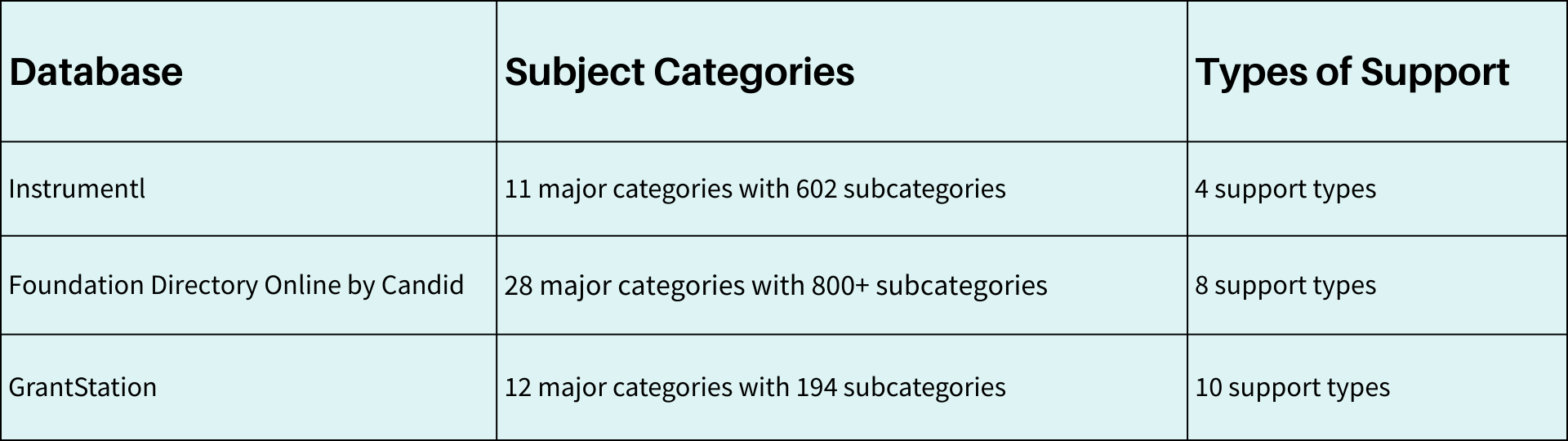
To illustrate these challenges, let's examine my three favorite databases: Instrumentl, Foundation Directory Online by Candid (FDO), and GrantStation. I’ve used all three extensively and seen firsthand how their differences can cause confusion.

Each platform's taxonomy reflects different specializations. Instrumentl's categories are heavily weighted toward community services and sciences, reflecting its unique inclusion of research grants.  FDO's categories allow precise targeting and broader exploration. GrantStation's categories streamline groupings for intuitive navigation.

"Types of support" classifications reveal similar specializations. All three recognize fundamental categories like general operating and capital support, but their granularity differs. For example, Instrumentl’s "education/outreach" is FDO's "policy, advocacy and systems reform," and GrantStation’s "advocacy."

What Makes Each Database Special

·      Instrumentl takes a broader approach to avoid over-filtering opportunities classified differently by funders. It also includes scientific research grants and integrates project management capabilities alongside grant discovery.

·      FDO offers an extensive corporate foundation database, capturing corporate giving programs that often fly under the radar. It also features "regranting" and "participatory grantmaking" as specific support types, increasingly important funding mechanisms.

·      GrantStation includes giving circles as a funder category, Canadian funding opportunities alongside US sources, and events/sponsorships as a support category, valuable for conferences, galas, or community events funding. Their accessible pricing makes comprehensive grant research possible for smaller organizations.

A Call for Common Ground

Database providers have an opportunity to better serve the grant community by working toward greater taxonomic alignment. This doesn't require abandoning unique strengths—the goal is interoperability, not homogenization. In other words, coordination, not conformity. It’s not about being the same, it’s about working in sync.

Academic databases share subject headings, and library systems use common classification schemes. Coordination can enhance rather than diminish individual platform value. A shared taxonomy framework would allow grant professionals to develop transferable search expertise and conduct more comprehensive research without getting lost in terminological translation.

Honoring the Hunt

Grant professionals deserve recognition for the detective work they perform daily. They navigate not just the substance of grants, but the structural inconsistencies that make comprehensive research more challenging than it needs to be.

By acknowledging and addressing taxonomic disconnects, database providers can honor the expertise of grant professionals while making their essential work more efficient. Sometimes the most powerful changes happen not in the spotlight, but in the infrastructure that makes everything else possible.

About the Author

Allison Jones, CEO and Founder of Spark the Fire Grant Writing Classes, LLC, built one of the highest-rated grant writing education programs in the world, recognized for four consecutive years. She holds the Grant Professional Certified (GPC) credential, is one of only 30 nationally approved trainers by the Grant Professionals Certification Institute, and has trained over 5,000 grant writers. Her book Meaningful Work is forthcoming in 2026.

Now I Want to Hear from You

Do you think database providers should collaborate on common taxonomy standards? How would you make the case that this helps the entire grant community?


How to Write a Cover Letter for Grants: A Complete Guide

 
A professional woman pointing an arrow in the right direction, symbolizing how a grant cover letter guides funders toward the full proposal by highlighting eligibility, alignment, and impact.
 

Grant applications come in many shapes and sizes. Some are completed entirely online through a foundation’s portal. Others are emailed as PDF attachments. And yes—sometimes, they’re still sent by good old-fashioned snail mail.

In fact, some funders still require highly traditional processes. For example, there is one foundation where you must physically mail paper copies of your full proposal and your organization’s 990 tax return to each board member individually—scattered across different states. What?! Imagine the time, expense, and logistics of preparing multiple binders, shipping them to five or ten addresses, and making sure each one arrives on time.

No matter the format, one common element you may be asked for is a grant cover letter. After you’ve described your community impact throughout the proposal, you may wonder: how can you say it again—without repeating yourself—in the cover letter? The key is remembering that the cover letter is not a duplicate of your proposal but a high-level introduction. Think of it as your executive summary: a concise overview of your proposal with all the basic information front and center—who you are, what you’re asking for, and why it matters—so reviewers can easily see the big picture before diving into the full application. Done well, your cover letter becomes a roadmap that guides them into the heart of your proposal with confidence and interest.

Cover Letter vs. Letter of Inquiry: Know the Difference

Before diving into structure, it’s essential to clear up a common source of confusion. A cover letter is not the same thing as a letter of inquiry (LOI). Many organizations mix these up, which can lead to sending the wrong document and weakening your application.

Letter of Inquiry or Letter of Interest (LOI)

An LOI is a stand-alone request you submit before being invited to submit a full proposal. Typically one to three pages long, it’s designed to give a funder enough detail to decide whether your organization and project are a potential fit. Think of it as an audition: if they like what they read, they’ll invite you to send a full proposal.

Grant Cover Letter

A cover letter, on the other hand, accompanies a full proposal that you have already been invited to submit or that did not require an initial screening. It’s much shorter—no more than one page and ideally just three short paragraphs. Its purpose is to introduce your organization, summarize your request, and frame your proposal in the best possible light.

Keeping these distinctions clear is critical. An LOI is about securing permission to apply, while a cover letter is about making your formal proposal shine from the start.

What to Include in a Grant Cover Letter

A strong cover letter should be no longer than three to four paragraphs, and each one has a clear purpose. Resist the urge to restate your entire proposal—brevity shows clarity and professionalism.

Paragraph One: Introduction

State who you are, where you are located, and what your organization does. Note the name of the project, the specific grant you are applying for, the deadline you are submitting to, and the amount you are requesting. This paragraph should give the reviewer all the essentials in one clear snapshot.

Paragraph Two: The Fit and the Impact

Show how your request fits the funder’s priorities and the difference your project will make. Explain briefly how your project aligns with the funder’s stated priorities. Emphasize one or two key outcomes that demonstrate community benefit. Remember, grantmakers fund causes, not organizations.

Demonstrate that you have thoroughly researched the organization—if possible, include a reference to something recently in the news about the funder or their leadership. This shows you are up to date, care about their work, and see your project as part of their larger mission.

Paragraph Three: Eligibility and Contact Information

If there’s any possible eligibility confusion, address it right away. For example, if the guidelines say they do not fund individual schools and your nonprofit is called “Evergreen Academy,” clarify: “While our name includes ‘Academy,’ Evergreen Academy is a 501(c)(3) nonprofit organization, not a private school, and is therefore eligible under your guidelines.” This ensures your application isn’t disqualified before anyone reads it.

Close with gratitude, a note that you look forward to the opportunity, and contact information. The closing should invite them to review the proposal and provide complete contact information (name, title, phone number, website, and email address). You'd be surprised how many grant proposals forget to include where to send the check!

Example Grant Cover Letter (Three Paragraphs)

Dear [Funder’s Name],

 Washington Youth ChalleNGe Academy, a 501(c)(3) nonprofit in Bremerton, WA, provides a highly disciplined, safe, and professional learning environment that empowers opportunity youth to improve their educational level and employment potential. We are pleased to submit this proposal, due September 30, requesting $50,000 in support of our Academic Success and Readiness Project, which will provide books, updated computers, and equipment such as 3D printing machines to ensure students are prepared for higher education and workforce readiness.

 This project directly aligns with the [Foundation’s Name]’s commitment to advancing youth education and career development. We were especially encouraged by the Foundation’s recent announcement of increased investment in workforce pipelines, and we see this project as a natural extension of those priorities. By equipping opportunity youth with the tools and resources they need for success, we are building confidence, skills, and opportunity for the next generation.

 While our name includes “Academy,” please note that we are not an individual school but a nonprofit organization eligible under your guidelines. Students return to their own high schools after participating in this six-month program to graduate with their peers. Thank you for considering our request. Should you have any questions, please contact me at (555) 555-5555 or director@wyca.org. I look forward to the opportunity to partner with you in preparing Washington’s youth for a stronger future.

 Sincerely,
[Name, Title]
Address
Website

Quick Tips for Strong Grant Cover Letters

  • Keep it to 3–4 paragraphs, one page max (unless instructions say otherwise). Reviewers don’t want to read a second proposal.

  • Address match upfront. Explain how your proposal aligns with what the funder wants to support - remember, funders invest in causes, not organizations.

  • Customize for each funder. Don’t reuse the same letter word-for-word; align with their mission and reflect their language.

  • Use confident, professional language. Avoid sounding desperate—funders want to invest in strength.

  • Proofread meticulously. A polished letter demonstrates attention to detail and credibility, while typos can undermine credibility.

  • Include full contact information. Make it easy for funders to reach you.

Frequently Asked Questions About Grant Cover Letters

What is a grant cover letter?

A grant cover letter is a one-page document or short email that accompanies a full proposal. In three to four short paragraphs, it introduces your organization, states the funding request, shows alignment with the funder’s priorities, and provides eligibility and contact information.

Do funders always read the cover letter first?

Often, yes. The cover letter is typically the first page in your submission, whether online or mailed. Reviewers may skim it before diving into the proposal, which is why clarity and professionalism are essential.

Should I use letterhead for a grant cover letter?

Yes, unless the cover letter is replaced by the email you send with your application in PDF form. In that case, the email itself functions as the cover letter. If it is a digital or paper document, always use your organization’s letterhead. This reinforces credibility, makes the letter look professional, and ensures your contact information is prominently displayed.

How formal should the tone be?

Keep the tone professional but approachable. Avoid jargon and overly complex sentences. Think of it as a conversation with a potential partner, not a legal contract.

Do all grants require a cover letter?

No. Some funders ask for them, while others don’t. Always follow the application instructions. If it isn’t required, don’t include one—unless the email accompanying your proposal serves as the cover letter. In that case, the email itself becomes the cover letter.

Can I reuse the same cover letter for multiple funders?

Not exactly. You can reuse a template, but each cover letter should be customized for the funder. Swap in their mission language, priorities, and focus areas to show you’ve done your homework.

How long should a grant cover letter be?

Keep it to one page. Three short, purposeful paragraphs are ideal. Anything longer risks repeating the proposal or overwhelming the reviewer.

Final Thoughts

A grant cover letter is short, but it carries outsized importance. In just three or four paragraphs, you can establish your credibility, highlight alignment with the funder’s priorities, clarify eligibility, and provide all the essential details upfront. Most importantly, it frames your proposal as worth reading and positions your organization as a strong, confident partner. When done well, your cover letter is not just a formality—it’s the first step in building a relationship with a funder that lasts.

 For more strategies on winning grants, explore our AI in Grant Writing Mini-Course and the Certificate in Grant Writing course.

About the Author

Allison Jones, CEO and Founder of Spark the Fire Grant Writing Classes, LLC, built one of the highest-rated grant writing education programs in the world, recognized for four consecutive years. She holds the Grant Professional Certified (GPC) credential, is one of only 30 nationally approved trainers by the Grant Professionals Certification Institute, and has trained over 5,000 grant writers. Her book Meaningful Work is forthcoming in 2026.

Now I Want to Hear from You

👉 What’s the biggest challenge you’ve faced when writing a grant cover letter—keeping it short, clarifying eligibility, or making it feel fresh after the full proposal?

Lifting Each Other Up: Building a Stronger Grant Writing Community


Last week, I received a call from someone who'd been referred by another grant writer. The caller had developed what he described as a "supercomputer that could scale up businesses fast" and was looking for help—though it wasn't entirely clear whether he needed a grant writer, a strategist, or something else entirely.

As he tried to explain his technology, I could hear his growing frustration. From his perspective, I just wasn't "getting it." The product sounded impressive in theory, but when I asked practical questions about applications and target markets, the answers got vague. Since for-profit grants aren't my specialty, I listened politely, thinking I might be able to refer him to someone with that expertise.

But the more he talked, the more familiar this conversation became. Here was someone with sophisticated technology—and genuine passion for what he'd built—but no clear understanding of how it solved real problems for real people. He wanted me to be impressed by the innovation itself, rather than its practical application.

His frustration seemed to stem from the fact that he had a solution looking for a problem, and he expected that I could somehow wave a magic wand to bridge that gap for him.

Sound familiar? We're seeing this same pattern more and more with technology companies targeting our profession. They develop impressive-sounding AI tools or databases promising to revolutionize grant writing, but when you dig deeper, it becomes clear they don't really understand how our work actually functions.

Building Each Other Up Through Action

But here's what I love about our profession: we know how to ask the right questions. We're skilled at digging deeper, evaluating claims, and making informed decisions. Of course we are—we're grant professionals! Research is literally what we do for a living. And we don't do it alone—we support each other through the process.

Take that phone call I mentioned. The referral came from a colleague who thought I might be able to help, even though it wasn't ultimately a fit. When I realized it wasn't my expertise, I listened anyway, hoping to connect him with someone better suited. That's what we do—we lift each other up and share opportunities.

This collaborative spirit shows up everywhere in our work. Just last month, a grant writing firm reached out asking if I had any new graduates to recommend. I did! But their question got me thinking—wouldn't it be valuable for our community to learn more about how grant writing firms operate? I quickly pulled together a webinar, and three firms jumped in to participate. The response was incredible, and we all learned something new about different business models in our field.

I see this same supportive energy when I recommend tools that are genuinely helping our profession. I love championing Grant Frog, new software built by fellow grant writer Hannah Wiginton, because she's created something practical while bringing humor and positivity to everything she does. I'm equally enthusiastic about partners like Instrumentl, whose prospect research tools have consistently delivered results for my clients and who've been genuinely collaborative to work with.

This is how our profession grows stronger—through genuine support, shared knowledge, and celebrating each other's successes rather than competing destructively.

Navigating New Technology Together

As more technology solutions emerge targeting our profession, this research expertise becomes even more valuable. We're seeing an explosion of AI-powered tools and databases promising to revolutionize grant writing, and our natural instinct to dig deeper serves us well.

The key questions we ask haven't changed: What problem does this actually solve? How does it work? What are the costs—not just financial, but in terms of professional relationships and ethics? Who benefits, and how? And here's a crucial one: Do they have grant professionals on staff from the start? Better yet, several with varying perspectives?

These aren't hostile questions—they're professional due diligence. When a new service launches, it's perfectly reasonable to ask about their business model, their data sources, their track record, and how they align with our professional standards. Companies that are genuinely committed to serving our profession should welcome these questions and answer them transparently.

I've noticed that the most successful technology partnerships in our field come from companies that take time to understand our work before trying to improve it. Take Instrumentl, for example—they regularly ask grant writers to weigh in on new features and treat us as the experts we are. They recognize that we're not just users—we're professional partners who bring valuable expertise to the relationship.

When we evaluate these tools collectively—sharing experiences in forums, discussing pros and cons at conferences, and asking the hard questions together—we make better decisions for ourselves and our clients. Our shared professional judgment is one of our greatest assets.

Professional Ethics and Trust

All of this collaborative evaluation happens most effectively when we have strong ethical foundations to guide us. The Grant Professionals Association's standards aren't just guidelines—they're our professional compass, helping us navigate complex decisions about partnerships, tools, and business practices.

I'm particularly encouraged by GPA's commitment to evolving and strengthening these ethical guidelines. The organization's responsiveness to our profession's changing needs shows real leadership. When new challenges emerge—whether from technology, business models, or industry practices—GPA continues to refine its guidance to serve us better.

This is also why I pursued and obtained my GPC (Grant Professional Certified) credential this year. Did I need it after years in this profession? Not technically. But literally anyone can hang out a shingle and call themselves a grant writer. It's only through this kind of certification that we maintain our standards and distinguish between true professionals and those who have no idea what they're doing. The credential represents a commitment to ongoing education, ethical practice, and professional accountability.

But ethics standards only work when we have safe spaces to discuss them openly. Professional dialogue requires trust and confidentiality. We need to be able to ask difficult questions, share concerns, and seek guidance without fear that our private communications will be forwarded or used against us.

The strongest professional communities are built on this foundation of trust—where members can engage in good-faith discussions about challenges, share experiences honestly, and support each other through complex decisions. When that trust is respected, we all benefit from shared wisdom and collective problem-solving.

Transparency in Professional Relationships

This foundation of trust extends to how we handle business relationships within our professional community. Transparency isn't just good ethics—it's good business. When we're open about our partnerships, affiliate relationships, business models, and potential conflicts of interest, we strengthen rather than undermine our professional credibility.

I'm always upfront when I recommend tools I use and believe in, like Instrumentl or Grant Frog. If I'm genuinely enthusiastic about something because it works well, I explain why. This transparency allows my colleagues to evaluate my recommendations appropriately and builds trust over time.

The same principle applies to any service provider in our space. Companies that are transparent about how they operate, who they partner with, and how they generate revenue make it easier for grant professionals to make informed decisions. Those who are secretive, evasive, or defensive about legitimate professional questions raise red flags.

We have a right to know if someone promoting a service has a financial stake in it. We have a right to understand business models that might affect our work or our clients. We have a right to ask these questions without facing legal threats or professional retaliation.

When transparency is the norm, everyone benefits. Grant professionals make better decisions, ethical companies thrive, and our entire profession maintains its integrity and trustworthiness.

Choosing to Lift Up, Not Tear Down

How we handle disagreements and challenges says everything about our professional character. I've noticed some practitioners in our field take a different approach—building themselves up by putting competitors down, even naming them specifically when comparing grant training services or approaches. But I believe we're stronger when we focus on lifting each other up instead of tearing each other down.

So what does lifting each other up look like in practice? It means celebrating colleagues' successes genuinely. When someone launches a new service, wins a major grant, or achieves a professional milestone, we cheer them on. It means sharing opportunities—like when that firm called looking for new graduates, or when I see a perfect job posting for someone's skill set.

It means offering constructive feedback when asked, and giving credit where it's due. Most importantly, it means responding to challenges with grace and professionalism. There's not one grant writing class that is the best fit for everyone, and I'm truly impressed with some of the new things that my colleagues are coming up with to make their work more sustainable while also helping people learn grants. That's my lane, my passion, and I love seeing the creativity and innovation happening in grant writing education. When students want to deep dive into federal grants, I refer them to Diane Leonard's federal grant training because that's her expertise.

The grant writing world is big enough for all of us to succeed—when we focus on serving our clients excellently and supporting our colleagues generously.
— Allison Jones, Spark the Fire

The grant writing world is big enough for all of us to succeed—when we focus on serving our clients excellently and supporting our colleagues generously. Amanda Pearce at Funding for Good is exceptional at uplifting others. She even has a conference for grant consultants and a great Boot Camp program—and no, I'm not a business affiliate, I just genuinely like what she's doing.

Moving Forward Together

As our profession continues to evolve, we have incredible opportunities ahead of us. New technologies will emerge, business models will shift, and fresh challenges will test our professional standards. But I'm optimistic about our future because I see how we support each other every day.

And if you're a tech company out there genuinely looking to solve problems in our field, here are some real issues that need addressing: We need common grant applications—or at least standardized sections—so we don't have to retype basic organizational information dozens of times. We need grant applications available in advance in Google Docs and MS Word formats—not PDFs—so we can draft them on our desktops first. We need clear, consistent instructions from funders.

Notice what these have in common? They're all about grantmakers improving their processes, not grant professionals needing AI assistance. Grant professionals know what we're doing—especially if they take quality training, like ours at Spark the Fire. It's not that we need AI to find grant prospects for us; we need foundations to get clearer about what they want to fund. It's not that we need AI to help us write grant applications; we need grantmakers to streamline their questions and requirements.

It’s not that we need AI to find grant prospects for us; we need foundations to get clearer about what they want to fund. It’s not that we need AI to help us write grant applications; we need grantmakers to streamline their questions and requirements.
— Allison Jones, Spark the Fire

We're a profession built on research, relationship-building, and service to our communities. These core strengths serve us well whether we're evaluating a new AI tool, mentoring a colleague, or navigating industry changes. When we stay true to these values—asking good questions, maintaining transparency, and lifting each other up—we create a professional environment where everyone can thrive.

The conversations we have in forums, at conferences, and in informal networks shape our profession's future. Every time we choose collaboration over competition, transparency over secrecy, and professional growth over personal attacks, we strengthen the entire grant writing community.

I'm committed to continuing this work—through my teaching, my writing, and my daily interactions with colleagues. Whether you're just starting your grant writing journey or you're a seasoned professional exploring new directions, there's a place for you in this supportive community.

Together, we can ensure that grant writing remains a profession marked by integrity, excellence, and genuine care for the causes we serve.


Grant Writer Burnout: Why It Happens and How to Move Forward


Grant writer burnout is one of the most pressing issues in the nonprofit sector today. Many professionals enter the field with excitement—after all, grant writing careers promise meaningful work, writing for impact, and the ability to secure critical funding. But the reality is that too many grant writers are exhausted, underpaid, and questioning whether they can continue.

If you’ve been Googling “why grant writers quit” or asking ChatGPT how to survive in this field, you’re not alone.

Why Burnout is So Common in Nonprofit Grant Writing

  1. Scarcity mindset. Many nonprofits operate with a constant sense of not having enough. Even with budgets, staff, and priorities clearly defined, grant professionals are asked to “do more with less.” Story: Maria, a mid-career nonprofit grant writer, secures one award only to be told to find more. The cycle never ends, leaving her drained and discouraged.

  2. Low pay and undervaluation.  Compensation often doesn’t match the expertise needed for successful grant writing jobs. In rural areas, pay is even lower and funding opportunities scarcer. Story: James transitioned from publishing into a grant writing career he loved—only to find himself burned out after years of low pay and no benefits.

  3. Leadership gaps. Poor management or unrealistic goals often leave grant writers unsupported. Story: Danielle’s annual target was raised from $300K to $600K without staff help. Her grant writer job description changed constantly, and burnout soon followed.

  4. Ever-changing demands. Federal NOFOs get pulled, foundations shift priorities, and requirements grow while resources shrink. Story: Malik worked nights and weekends on a large federal grant application—only to have the opportunity withdrawn. His exhaustion turned into despair.

  5. Bigger questions. Many grant professionals are now asking: Why should essential programs depend on philanthropy at all? The existential weight of this question adds to grant writer burnout.

The Human Toll of Burnout in Grant Writing

Burnout doesn’t just affect job performance—it impacts health, relationships, and a sense of purpose. Many grant professionals describe:

  • Difficulty motivating themselves for one more proposal.

  • Grief when strong applications are rejected.

  • Stress symptoms tied to workload and uncertainty.

  • Feeling trapped after years in the grant writing field with limited career mobility.

If you recognize yourself in these stories, you are not alone.

Finding a Way Forward: Real Solutions for Grant Writers

Here are six concrete strategies to reduce grant writing stress and rebuild energy:

  1. Set boundaries. If you’re a freelancer, your contract is your first line of defense—spell out scope, response times, and revision limits. Learn more in Spark the Fire’s Business of Freelance Grant Writing course. If you’re employed, enforce work hours (no more 10 p.m. emails) and align expectations with your supervisor.

  2. Seek community. Isolation fuels burnout. Join Spark the Fire’s private grant writing community, Spark the Fire Grant Writer Collective, or professional groups like the Grant Professionals Association (GPA). Peer support transforms how you experience your work.

  3. Advocate for change. Be part of reshaping the field. Follow Vu Le’s list of “crappy funding practices,” contribute reviews on GrantAdvisor.org, and raise your voice about funder behaviors that fuel nonprofit burnout.

  4. Expand your skills. Adding new tools makes you more marketable. Try Spark the Fire’s Certificate in Grant Writing course, webinars,mini-courses, or blog resources for practical, on-demand professional development. If you’re Googling “how to become a grant writer,” this is where to start.

  5. Rest when needed. Plan a “grant detox week” when possible. Build small daily rituals—walks, meditation, journaling—that remind you that you are more than your productivity.

  6. Protect your financial well-being. Freelancers: switch to retainer-based or project-based pricing instead of hourly billing. Employees: explore the Spark the Fire Grant Writer Job Board, where listings are required to include pay rates, so you can see upfront if a position values your expertise.

Choosing Hope in the Grant Writing Profession

Despite the challenges, many grant professionals remain because they believe in the missions they serve. Some see grant writing careers as harm reduction—imperfect but essential. Others find renewed energy through grant writing support communities where colleagues encourage one another.

Story of renewal: Lauren nearly left the field after years of burnout. Instead, she found a supportive peer group, learned to set healthier boundaries, and reframed her role. Today, she feels energized again and proud of the work she contributes.

That’s why creating supportive spaces matters so much.

At Spark the Fire, we’ve built a grant writing community where professionals can share experiences, find encouragement, and access training. Whether you need strategies for managing workload, want to strengthen your grant writing skills, or just need a safe place to be heard, you don’t have to face burnout alone.

👉 Join Spark the Fire’s Community of Grant Writers and connect with others who understand both the challenges and joys of this work.

Together, we can do this work with more resilience, hope, and strength.

What strategies have you found helpful for managing burnout as a grant writer? Share your experiences in the comments—we’d love to learn from you. 

Grant Writing 101: How to Get Started the Right Way - The Complete Beginner's Guide


Introduction: Why Grant Writing Matters (And Why You Should Care)

Grant writing isn't just a nice-to-have skill for nonprofits and organizations—it's absolutely essential for sustainable growth and impact. If you've ever wondered what is grant writing or frantically searched for grant writing for beginners resources at 2 AM (we've all been there), you've come to the right place. This comprehensive guide will give you the foundational knowledge you need to begin your grant writing journey with confidence.

Here's the truth that might surprise you: grant writing is completely learnable, even if you think you can't write your way out of a paper bag. You don't need a special degree, years of nonprofit experience, or a natural talent for spinning words into gold. What you do need is dedication, strategic thinking, and the right knowledge—all of which you'll gain from this guide and our proven training programs at Spark the Fire Grant Writing Classes.

Many people approach grants with the "free money" mentality, thinking they can simply ask for funding and receive it like some kind of philanthropic vending machine. (Spoiler alert: it doesn't work that way.) This misconception leads to frustration and failed applications. The reality is that successful grant writing is a strategic process that requires understanding funders, aligning missions, and presenting compelling cases for support—kind of like dating, but with more spreadsheets and fewer awkward dinners.

Throughout this guide, we'll bust common myths, provide actionable strategies, and give you the confidence to start your grant writing journey without hyperventilating. Whether you're a nonprofit staff member who just got voluntold for this job, a volunteer with good intentions, or an aspiring freelance grant writer ready to conquer the world, this foundation will serve you well—and our Certificate in Grant Writing course will take you even further.

What Are Grants? (And Why They're Not Free Money)

Before diving into how does grant writing work, it's crucial to understand what is a grant fundamentally. Think of a grant as a financial award given by an organization (the funder) to another entity (the grantee) to accomplish a specific purpose that aligns with the funder's mission and priorities. It's like a scholarship for your nonprofit's brilliant ideas.

Who gives grants varies widely, but think of it as a diverse ecosystem of do-gooders with checkbooks:

Types of Grants

Foundation Grants: Private foundations, family foundations, and corporate foundations distribute billions annually. These range from massive national foundations like the Gates Foundation (where the money flows like water) to scrappy community foundations serving specific geographic areas with the dedication of a small-town diner.

Corporate Grants: Companies provide grants as part of their corporate social responsibility initiatives. These often align with the company's business interests or community presence—because nothing says "we care" like strategically placed philanthropy.

Government Grants: Federal, state, and local government agencies offer grants for specific programs and initiatives. These tend to be highly competitive and have strict compliance requirements. Think of them as the overachieving students of the grant world—lots of rules, but the payoff can be substantial.

Tribal Grants: Charitable grants made from tribes to the community, funded through entrepreneurial income from tribal enterprises. These grants often support local community development, education, and cultural preservation initiatives.

Clubs and Associations: Organizations like Rotary clubs, Lions clubs, Kiwanis, and other civic associations provide smaller grants to support local community projects and initiatives. They're the friendly neighbors of the funding world—smaller checks, but often easier conversations.

Why Funders Give Money

Understanding funder motivations is key to successful grant writing—something we dive deep into in our Spark the Fire training programs (because knowledge is power, and power gets you funding). Funders don't give money out of generosity alone—they invest in organizations and projects that advance their mission and create measurable impact. They're looking for their money to work as hard as they do. They seek:

  • Mission alignment: Your project must clearly connect to their priorities (no square pegs in round holes, please)

  • Demonstrated capacity: Evidence you can successfully execute the proposed work without setting anything on fire

  • Measurable outcomes: Clear ways to track and report impact (because "trust us, it'll be great" isn't data)

  • Financial stewardship: Responsible use of funds with proper oversight (they want receipts, literally)

Common Restrictions and Reporting Requirements

Here's where grants get a little high-maintenance. They come with strings attached—more strings than a marionette convention. Common restrictions include:

  • Specific use of funds (no general operating support—sorry, you can't use it for pizza Fridays)

  • Geographic limitations

  • Population requirements (serving specific demographics)

  • Matching fund requirements (because they want you to have some skin in the game)

  • Detailed financial and programmatic reporting

  • Site visits and evaluations (yes, they might actually show up)

Understanding these requirements upfront helps you identify appropriate funding opportunities and avoid wasted effort on unsuitable grants. Our grant writing templates include checklists to help you navigate these requirements without losing your sanity.

What Is Grant Writing? (The Art of Professional Asking)

Grant writing definition: Grant writing is the process of researching, preparing, and submitting formal requests for funding to foundations, corporations, government agencies, and other grantmaking entities. It's far more than just writing—it's strategic project development, relationship building, and impact communication all rolled into one delightfully complex package.

Think of grant writing as pitching to funders rather than pitching to investors. While investors seek financial returns (show me the money!), funders seek social returns (show me the impact!). Your job is to demonstrate how their investment will create meaningful change aligned with their values and priorities.

How does grant writing work in practice? It's a systematic process that involves more moving parts than a Swiss watch:

  1. Research: Identifying appropriate funders and understanding their priorities (detective work, but less dramatic)

  2. Strategy: Aligning your project with funder interests (matchmaking for missions)

  3. Development: Creating compelling narratives and realistic budgets (storytelling meets spreadsheets)

  4. Writing: Crafting clear, persuasive proposals (where the magic happens)

  5. Submission: Meeting deadlines and requirements precisely (no room for "close enough")

  6. Follow-up: Building relationships regardless of funding outcomes (because rejection isn't personal, it's just business)

The goal isn't simply to get money—it's to create partnerships with funders who share your vision and want to support your success long-term. This strategic approach is exactly what we teach in our comprehensive Certificate in Grant Writing course, minus the overwhelming panic attacks.

Who Actually Writes Grants? (Spoiler: All Kinds of People)

Wondering about a grant writer career or considering a grant writer job? The field is more diverse than a college dining hall—and often just as surprising. Who writes grants includes:

Staff Grant Writers in Nonprofits

Many medium and large nonprofits employ full-time development staff who focus primarily on grant writing. These positions often combine grant writing with donor relations, event planning, and other fundraising activities. They're the Swiss Army knives of the nonprofit world.

Volunteers and Board Members

Smaller organizations often rely on volunteers with writing skills or board members with business backgrounds to handle grant applications. While passion is valuable (and we love passionate people), these volunteers benefit greatly from structured training like our Spark the Fire programs—because enthusiasm alone doesn't write budgets.

Freelancers and Consultants

Independent grant writers work with multiple organizations, bringing specialized expertise and fresh perspectives. This path offers flexibility and variety but requires strong business development skills—topics we cover extensively in our Business of Freelance Grant Writing course, because being brilliant at grant writing means nothing if you can't find clients.

Essential Skills for Success

Successful grant writers master several key competencies that would make a Renaissance person jealous:

Research Skills: Finding appropriate funders, understanding their guidelines, and staying current with funding trends (basically becoming a funding detective)

Storytelling Ability: Crafting compelling narratives that connect emotionally while providing concrete details (think Hemingway meets spreadsheet wizard)

Budget Development: Creating realistic, funder-aligned budgets that accurately reflect project costs (math that actually matters)

Project Management: Coordinating with team members, managing deadlines, and organizing complex information (herding cats, but professionally)

Relationship Building: Cultivating connections with funders and maintaining long-term partnerships (networking without the awkward small talk)

All of these skills are developed systematically in our Spark the Fire training programs, with hands-on practice and real-world application—because theory is nice, but practice pays the bills.

How to Learn Grant Writing (Without Going Broke or Insane)

Many beginners ask, "Do I need a grant writing degree to succeed?" The short answer is no. The long answer is also no, but with more explanation. While formal education can be helpful, it's neither necessary nor sufficient for grant writing success.

Are There Grant Writing Degrees?

Grant writing degrees are rarer than unicorns at a logic convention. Only one or two universities offer specific degree programs in grant writing. Most grant writers come from diverse educational backgrounds including nonprofit management, communications, business, social work, and liberal arts—proof that there are many paths to grant writing greatness.

Why You Don't Need a Degree to Succeed

Grant writing success depends more on practical skills than academic credentials. Funders care about results, not degrees. They want to know if you can deliver, not where you went to school. What matters is your ability to:

  • Understand their priorities (reading comprehension, but make it strategic)

  • Articulate compelling cases for support (persuasive writing that actually persuades)

  • Manage projects effectively (organization skills that would make Marie Kondo proud)

  • Build authentic relationships (human connection in a digital age)

The Spark the Fire Approach to Learning

At Spark the Fire Grant Writing Classes, we believe in practical, hands-on learning that gets results faster than you can say "fiscal year." Our approach includes:

Certificate in Grant Writing Course: Our comprehensive program provides everything you need to succeed, including:

  • Step-by-step training modules (no overwhelming information dumps)

  • Real-world templates and examples (because reinventing the wheel is overrated)

  • Interactive assignments with feedback (practice makes progress)

  • Ongoing community support (you're never alone in this journey)

  • Lifetime access to updates and resources (because learning never stops)

Grant Writing Templates: Professional-grade templates that save time and ensure you don't miss critical components (like spell-check, but for grant requirements)

Live Training and Webinars: Regular sessions covering current trends, new strategies, and Q&A with experienced grant writers (because staying current is staying competitive)

Expert Guidance: Learn directly from Allison Jones and other successful grant writing professionals who've been in the trenches and lived to tell about it

🎓 Mini FAQ: Grant Writing Education

Do you need a degree to be a grant writer? No. Skills, results, and experience matter far more than formal credentials. Funders care about what you can do, not where you learned to do it.

Are there degrees in grant writing? Yes, but they're extremely rare. Most successful grant writers have diverse educational backgrounds—which actually makes them better at understanding different types of organizations.

What's better than a degree? Practical training combined with hands-on experience writing real proposals—exactly what our Certificate in Grant Writing course provides, without the student loan debt.

Are there certifications? Yes, and our Certificate in Grant Writing course provides industry-recognized training that employers and clients value more than theoretical knowledge.

Grant Writing vs. Fundraising: What's the Difference? (And Why It Matters)

Understanding grant writing vs fundraising helps clarify where grant writing fits within the broader development landscape—think of it as understanding the difference between a violin and an orchestra.

What Fundraising Includes

Nonprofit fundraising encompasses all revenue-generating activities, like a greatest hits album of money-making strategies:

  • Individual donor cultivation and solicitation

  • Special events and galas (the fun stuff)

  • Capital campaigns (the big asks)

  • Corporate sponsorships

  • Planned giving programs (thinking long-term)

  • Online crowdfunding (the modern frontier)

  • Grant writing and foundation relations

How Grant Writing Fits Within Fundraising

Grant writing is a specialized subset of fundraising focused specifically on institutional funders. While individual donors might give because they love your mission or because your board member cornered them at a cocktail party, institutional funders typically have formal application processes, specific guidelines, and strategic priorities that would make a chess master proud.

Key Differences

Targeted Proposals vs. Broad Appeals: Grant writing involves highly customized proposals for specific funders (think bespoke suit), while other fundraising might use broader appeals to larger audiences (think off-the-rack that somehow fits everyone).

Formal Processes: Grants typically require structured applications with specific deadlines (no fashionably late submissions), while donor cultivation often happens on more flexible timelines.

Reporting Requirements: Grants usually include detailed reporting obligations (they want to know exactly what you did with their money), while individual donations typically require only acknowledgment and stewardship.

Shared Skills

Despite differences, grant writing shares crucial skills with other fundraising activities:

  • Research: Understanding prospects and their motivations (stalking, but professionally)

  • Storytelling: Communicating impact compellingly (making people care about your cause)

  • Relationship Building: Cultivating long-term partnerships (because it's all about who you know, and who knows you)

Our Spark the Fire training covers how grant writing integrates with your overall development strategy for maximum effectiveness—because synergy isn't just a buzzword when it actually works.

The Grant Writing Process: 7 Beginner Steps (That Actually Work)

Ready to learn how to write a grant proposal step by step? This grant writing process provides the proven Spark the Fire framework that's helped countless beginners avoid the most common pitfalls:

Step 1: Decode the Guidelines Carefully (Your New Bible)

Before writing a single word, thoroughly analyze the funder's guidelines like you're decoding ancient scrolls. Look for:

  • Eligibility requirements (can you actually apply?)

  • Funding priorities (what they care about)

  • Application deadlines (non-negotiable dates)

  • Required components (what they want to see)

  • Page limits and formatting requirements (yes, they count pages)

  • Budget restrictions (how much you can ask for)

  • Evaluation criteria (how they'll judge you)

Our grant writing templates include comprehensive checklists to ensure you address every requirement. Many proposals get rejected simply for failing to follow guidelines precisely—don't let yours be one of them.

Step 2: Build Your Narrative Skeleton (The Framework for Success)

Develop a clear structure before writing, like creating a blueprint before building a house. Most grant proposals include:

  • Executive Summary: Concise overview of your request (the movie trailer of your proposal)

  • Statement of Need: Compelling case for why the problem exists (break their hearts, then fix them)

  • Project Description: Detailed explanation of your proposed solution (your brilliant plan)

  • Goals and Objectives: Specific, measurable outcomes (what success looks like)

  • Methodology: How you'll implement the project (your roadmap)

  • Evaluation Plan: How you'll measure success (proving it worked)

  • Budget: Detailed financial breakdown (where every dollar goes)

  • Organization Capacity: Why you're qualified to do this work (your credentials)

Step 3: Rally Your Team and Gather Details (Herding Cats, Professionally)

Grant writing isn't a solo activity—it takes a village, and that village needs to be organized. Collaborate with:

  • Program staff who will implement the project (the doers)

  • Finance team for budget development (the number crunchers)

  • Evaluation specialists for outcomes measurement (the proof providers)

  • Communications team for supporting materials (the storytellers)

  • Leadership for strategic oversight (the decision makers)

Our project management templates help you coordinate team input efficiently and keep everyone on track without multiple nervous breakdowns.

Step 4: Develop a Realistic, Funder-Aligned Budget (Math That Matters)

Your budget should be like a well-tailored suit—perfectly fitted and impressive. It should:

  • Reflect true project costs accurately (no wishful thinking)

  • Align with funder restrictions and priorities (play by their rules)

  • Include appropriate indirect costs if allowed (don't leave money on the table)

  • Demonstrate fiscal responsibility (you're trustworthy with money)

  • Match the narrative description exactly (consistency is key)

Our budget templates and training modules walk you through this process step-by-step, including common budget categories like personnel, fringe benefits, travel, equipment, supplies, contractual services, and indirect costs.

Step 5: Write Your Narrative Fast and Furiously (Then Polish Until It Shines)

Get your first draft written quickly without worrying about perfection—perfectionism is the enemy of done. Focus on:

  • Clear, concise language (no academic jargon allowed)

  • Logical flow between sections (lead them by the hand)

  • Compelling storytelling with concrete details (make them care)

  • Alignment with funder priorities (speak their language)

  • Evidence-based arguments (facts are your friends)

Then revise extensively, focusing on clarity, persuasiveness, and adherence to guidelines. Our editing checklists help ensure nothing falls through the cracks.

Step 6: Prepare Attachments and Supporting Documents (The Supporting Cast)

Organize all required attachments like you're preparing for the most important presentation of your life:

  • IRS determination letter (proof you're legit)

  • Audited financial statements (financial transparency)

  • Board of directors list (your leadership team)

  • Letters of support from partners (your cheerleaders)

  • Staff resumes and biographies (your talent roster)

  • Organizational chart (who does what)

  • Case studies or success stories (proof of concept)

Step 7: Review, Edit, and Submit Early (The Final Sprint)

Final review should include everything and then some:

  • Proofreading for grammar and spelling (because typos kill credibility)

  • Checking all requirements against your checklist (cross every t, dot every i)

  • Ensuring attachments are complete and organized (no missing pieces)

  • Verifying submission method and deadline (double-check everything)

  • Creating backup copies (technology fails when you need it most)

Submit at least 24-48 hours before the deadline to avoid technical issues and last-minute panic attacks. We actually recommend submitting two weeks early, and we teach you how to do just that.

Essential Grant Writing Tips for Beginners (Wisdom from the Trenches)

These grant writing tips from Spark the Fire will help beginner grant writers avoid common pitfalls and accelerate their learning without pulling their hair out:

Start with a Real Project for Hands-On Learning

Theory only goes so far—you need to get your hands dirty. Apply your learning immediately by working on an actual grant proposal. This might be for your own organization or as a volunteer for a local nonprofit. Real deadlines and stakes accelerate learning dramatically—which is why our Certificate in Grant Writing course includes practical assignments that feel like the real thing because they are the real thing.

Treat It Like Project Management, Not Just Writing

How to start grant writing successfully requires understanding it's primarily project management with writing as one component. Develop systems for:

  • Research and prospect tracking (organized stalking)

  • Deadline management (calendar mastery)

  • Team coordination (herding cats effectively)

  • Document organization (finding things when you need them)

  • Relationship cultivation (professional networking)

Our comprehensive training includes project management tools and templates specifically designed for grant writers who want to stay sane.

Overcome Imposter Syndrome Through Practice

Every grant writer starts as a beginner, including the ones who seem to have supernatural powers. Don't let imposter syndrome prevent you from applying to opportunities or taking on challenging projects. Confidence comes through practice and success, not the other way around. Our supportive community and mentorship approach help you build confidence from day one—because everyone needs cheerleaders.

Think in Systems and Repeatable Processes

Develop templates, checklists, and standard operating procedures that would make a efficiency expert weep with joy. This saves time and ensures consistency across proposals. Create systems for:

  • Funder research and tracking

  • Proposal development workflows

  • Budget templates

  • Standard organizational information

  • Follow-up processes

All of these systems are included in our Spark the Fire training programs and template library—because why reinvent the wheel when you can improve it?

Don't Go It Alone—Join Our Community

Connect with other grant writers through our exclusive Spark the Fire community. When you join our Certificate in Grant Writing course, you gain access to:

  • Private online community of fellow students (your new best friends)

  • Regular Q&A sessions with Allison Jones (direct access to expertise)

  • Peer feedback on your proposals (fresh eyes catch what you miss)

  • Networking opportunities (because it's all about connections)

  • Ongoing support throughout your career (we're here for the long haul)

Learning from others' experiences accelerates your growth and provides ongoing support throughout your career—plus, grant writing is more fun with friends.

The Grant Funding Landscape: Where the Money Actually Lives

Understanding grant funding sources and nonprofit funding trends helps you make strategic decisions about where to focus your efforts—insights we regularly share in our Spark the Fire blog and webinars because knowledge is power, and power gets you funding.

How Much Nonprofit Revenue Comes from Grants

According to recent data, grants and government funding typically comprise 20-30% of total nonprofit revenue, though this varies significantly by organization size and sector. Foundation grants represent a smaller but crucial portion of this funding—think of it as the specialized tool in your fundraising toolkit.

Trends in Foundation Giving and Government Support

Current trends affecting the funding landscape include developments that would make a trend forecaster dizzy:

Increased Focus on Equity: Funders increasingly prioritize organizations and projects that address systemic inequities and center marginalized communities. Social justice isn't just trendy—it's funded.

Outcomes Measurement: Growing emphasis on measurable impact and evidence-based approaches. Numbers don't lie, and funders love data that proves their money is working.

Capacity Building: Recognition that organizations need infrastructure support, not just program funding. Sometimes you need to invest in the foundation before building the house.

Collaborative Funding: Multiple funders joining together to support larger initiatives. Team funding is becoming the new normal.

Technology Integration: Digital tools for application submission, reporting, and relationship management. The future is digital, and it's here now.

We keep our students updated on these trends through our regular webinars and blog posts—because staying current is staying competitive.

Why Grants Are Part of a Healthy Revenue Mix

Smart organizations diversify their funding sources rather than putting all their eggs in one basket. A balanced revenue portfolio might include:

  • Individual donations (40-50%)

  • Grants and foundation support (20-30%)

  • Earned revenue (15-25%)

  • Government contracts (10-20%)

  • Special events and other sources (5-10%)

Economic Shifts That Impact Grant Funding

External factors affecting grant availability include forces beyond anyone's control:

  • Economic recessions reducing foundation endowments

  • Political changes affecting government priorities

  • Corporate profits influencing business giving

  • Social movements shifting funder priorities

  • Natural disasters redirecting emergency funding

Understanding these cycles helps you plan strategically and adjust expectations accordingly—topics we explore in depth in our advanced training modules because preparation prevents panic.

Why Grant Writing Is a Valuable Career Skill (And Why You Should Care)

grant writing career offers unique advantages in today's nonprofit landscape that would make other professions jealous:

Rising Demand for Skilled Grant Writers

The nonprofit sector continues growing, with organizations increasingly recognizing that effective grant writing requires specialized skills—not just good intentions and a laptop. This creates opportunities for both staff positions and freelance work—career paths our graduates successfully pursue with confidence and competence.

Nonprofits Depend on Diverse Funding Streams

Organizations that successfully diversify funding sources are more resilient and sustainable than those putting all their eggs in one fundraising basket. Grant writing skills contribute directly to organizational stability and growth—making you valuable to any nonprofit worth its salt.

Career Options: In-House, Freelance, Consulting

Grant writing skills open multiple career paths that fit different lifestyles:

In-House Positions: Development coordinator, grants manager, director of development roles in nonprofits (steady paycheck, benefits, office friends)

Freelance Grant Writing: Working independently with multiple clients, offering flexibility and variety (be your own boss, set your own schedule)

Consulting: Providing strategic guidance on fundraising and development beyond just writing (high-level advisory work that pays well)

Hybrid Roles: Many positions combine grant writing with other responsibilities like donor relations or program management (variety is the spice of work life)

Our Certificate in Grant Writing course prepares you for all of these career paths with specialized modules for each track—because one size doesn't fit all careers.

Fulfillment: Advancing Community Impact Through Writing

Grant writing offers the satisfaction of directly contributing to positive social change without having to run a nonprofit yourself. Your words and strategic thinking help organizations secure resources to serve communities, address social problems, and create lasting impact—it's like being a superhero, but with better work-life balance.

How to become a grant writer with Spark the Fire offers:

  • Competitive preparation for salaries ranging from $35,000-$80,000+ depending on experience and location

  • Skills for flexible work arrangements (many positions allow remote work)

  • Continuous learning opportunities through our alumni network (intellectual stimulation)

  • Direct connection to mission-driven work (purpose-driven career)

  • Transferable skills valuable across sectors (flexibility for life changes)

Next Steps: Your Path Forward with Spark the Fire (The Fun Begins Here)

Ready to begin your grant writing journey without the overwhelming terror? Here's how Spark the Fire can accelerate your success:

Start with Our Certificate in Grant Writing Course

Our comprehensive Certificate in Grant Writing provides everything you need to succeed, like a Swiss Army knife for grant writers:

  • 8 comprehensive modules covering every aspect of grant writing (no stone left unturned)

  • Professional templates and tools that save hours of work (efficiency meets effectiveness)

  • Real-world case studies from successful proposals (learn from winners)

  • Interactive assignments with personalized feedback (practice with purpose)

  • Six months of focused access to course materials and updates (motivation meets mastery)

  • Exclusive community of fellow grant writers (your new professional family)

  • Direct access to instructor Allison Jones (expertise when you need it)

Access Our Professional Templates

Save time and ensure professional quality with our grant writing templates that work like magic:

  • Proposal templates for every section (starting points that actually start well)

  • Budget worksheets and calculators (math made manageable)

  • Research and tracking tools (organization that works)

  • Project management checklists (staying on track without stress)

  • Follow-up and stewardship templates (relationship building made easy)

Join Our Live Training Events

Stay current with monthly webinars covering topics that matter:

  • Latest funding trends and opportunities (insider information)

  • Advanced grant writing strategies (level up your skills)

  • Q&A sessions with experienced professionals (get your questions answered)

  • Guest experts from the foundation world (learn from the source)

  • Student success stories and case studies (inspiration and instruction)

Follow Our Blog for Ongoing Education

Our Spark the Fire blog provides regular insights that keep you sharp:

  • Grant writing best practices (tips that work)

  • Funder spotlights and opportunities (money maps)

  • Industry trends and analysis (staying ahead of the curve)

  • Success stories from our community (proof that it works)

  • Free resources and tools (value that keeps giving)

Get Started Today (No More Excuses)

Don't wait until you feel completely ready—you'll never feel completely ready, and that's perfectly normal. Start with our introductory resources and build from there:

1.     Read our blog for weekly tips and expert insights (knowledge that keeps you sharp)

2.     Review our full curriculum to see exactly what you'll learn (transparency builds trust)

3.     Join our email list for updates and announcements (stay in the loop)

4.     Enroll in our Certificate in Grant Writing course when you're ready to commit (transformation starts here)

5.     Join our community of successful grant writers (support that lasts)

Focus on continuous improvement rather than perfection—perfection is overrated anyway. Each proposal teaches valuable lessons, regardless of the outcome. Build on small successes to tackle increasingly complex and competitive opportunities.

✨ Bonus FAQ: Common Beginner Questions (The Real Talk Section)

Can Anyone Apply for a Grant?

Not exactly—grants aren't quite as democratic as voting. Most grants have specific eligibility requirements including:

  • Tax-exempt status: Many grants require 501(c)(3) status (the nonprofit golden ticket)

  • Geographic restrictions: Local, state, or regional limitations (location matters)

  • Population focus: Serving specific demographics or communities (target audience requirements)

  • Organizational capacity: Minimum budget, staff, or experience requirements (proving you can handle it)

  • Mission alignment: Working in funder's priority areas (shared values required)

Always review eligibility criteria carefully before investing time in an application—our research templates help you track these requirements efficiently without losing your mind.

How Long Does It Take to Learn Grant Writing?

With focused effort and practical application through our Spark the Fire programs, most people can develop basic grant writing competency in 3-6 months—faster than learning to drive stick shift, but about the same time commitment. Our Certificate in Grant Writing course is designed to get you writing competitive proposals within 90 days of starting the program.

Achieving advanced skills typically takes 12-18 months of consistent practice. However, learning continues throughout your career as you encounter new funders, program areas, and funding trends—which is why our alumni community and ongoing resources are so valuable. It's like continuing education, but actually useful.

Factors affecting learning speed include:

  • Prior writing experience (helps, but isn't required)

  • Nonprofit sector knowledge (useful background)

  • Time dedicated to practice (consistency beats intensity)

  • Quality of training and mentorship (that's where we excel!)

  • Opportunities for hands-on application (practice makes progress)

Is Grant Writing a Good Career?

Grant writing can be an excellent career for people who enjoy:

  • Research and analysis (detective work for good causes)

  • Strategic thinking and problem-solving (puzzles with purpose)

  • Writing and communication (words that work)

  • Mission-driven work (meaning in your Monday morning)

  • Project management (organized chaos)

  • Building relationships (networking with heart)

The career offers flexibility, competitive compensation, and direct contribution to social good. However, it also involves strict deadlines, competition, and dealing with rejection—kind of like dating, but with better long-term prospects. Our training prepares you for all aspects of the profession, including how to handle the psychological challenges without developing stress-related disorders.

How Much Do Grant Writers Make?

Grant writer salaries vary by factors that would make an economist happy:

  • Geographic location: Higher in major metropolitan areas (city living costs more, pays more)

  • Experience level: Entry-level vs. senior positions (experience pays)

  • Organization size: Larger nonprofits typically pay more (economies of scale)

  • Sector focus: Healthcare and education often pay premium salaries (specialization pays)

  • Employment type: Staff vs. freelance vs. consultant (different models, different money)

Salary Ranges:

  • Entry-level: $35,000-$45,000 (everyone starts somewhere)

  • Mid-level: $45,000-$65,000 (experience pays off)

  • Senior-level: $65,000-$85,000+ (expertise has value)

  • Director-level: $75,000-$100,000+ (leadership pays well)

Freelance rates typically range from $35-$125 per hour or $500-$5,000+ per proposal, depending on complexity and writer experience.

Our Business in Freelance Grant Writing course includes modules on pricing your services and negotiating fair compensation—because knowing your worth is step one to getting paid what you're worth.

What's the Hardest Part of Grant Writing?

Common challenges include obstacles that would test anyone's patience:

Tight Deadlines: Managing multiple proposals with overlapping deadlines requires excellent project management skills—which our templates and systems address so you don't lose sleep (or sanity).

Complex Guidelines: Deciphering funder requirements and ensuring compliance can be time-consuming and stressful—our research tools simplify this process without dumbing it down.

High Competition: Success rates for many grants are 10-20%, meaning rejection is common and normal. We teach resilience strategies and how to learn from every application—because rejection isn't personal, it's statistical.

Coordinating Teams: Gathering information from multiple stakeholders within tight timeframes tests patience and diplomacy—skills we develop through practical exercises that don't involve actual combat.

Staying Current: Keeping up with changing funder priorities and funding trends requires ongoing research and networking—provided through our community and ongoing education.

Despite these challenges, our students find the work rewarding and develop strategies to manage these difficulties effectively—plus, every job has challenges, but not every job funds good work in the world.

Conclusion: Transform Your Career with Spark the Fire Grant Writing Classes

Grant writing is both an art and a science—combining creative storytelling with strategic analysis, relationship building with technical writing, and passionate advocacy with rigorous project management. At Spark the Fire Grant Writing Classes, we've helped hundreds of students develop grant writing skills and launch successful grant writer careers through our proven training methods that actually work in the real world.

Whether you're seeking to enhance your current nonprofit role or exploring how to become a grant writer professionally, our Certificate in Grant Writing course provides the comprehensive foundation you need for success. You'll learn not just how to write grants, but how to think strategically about funding, build lasting relationships with funders, and create sustainable funding streams for the causes you care about—skills that will serve you for your entire career.

Remember that every expert was once a beginner who felt overwhelmed and slightly terrified. Allison Jones, founder of Spark the Fire, started her grant writing journey with curiosity and determination—the same qualities that will drive your success. With our structured training, professional templates, supportive community, and ongoing resources, you'll have everything needed to thrive in this rewarding field without the usual struggle and confusion.

Your grant writing journey doesn't have to be a solo struggle filled with Google searches at midnight. Join the Spark the Fire community and discover how our proven methods, practical tools, and expert guidance can accelerate your path to success while keeping your sense of humor intact.

Ready to get started? Visit our website to explore our Certificate in Grant Writing course, download free resources, and join the thousands of professionals who've transformed their careers through Spark the Fire Grant Writing Classes—because the world needs more skilled grant writers, and you could be one of them.

The nonprofit sector needs skilled, dedicated grant writers who can help organizations secure the resources necessary to create positive change in communities worldwide. Let us help you become one of them—with significantly less stress and considerably more success than figuring it out on your own.

How to Create Compelling Grant Writing Samples That Win Jobs and Clients

 
Grant writer with writing samples in briefcase walking on tight rope.
 

In the competitive world of grant writing, your portfolio can make or break your next opportunity. Along with professional certifications, writing samples are among the most requested materials for demonstrating your expertise. They showcase not just your technical skills, but your ability to craft persuasive narratives that reach what I like to call the "of course factor"—that moment when funders think "of course that makes sense" and "of course I want to fund that."

Why Writing Samples Are Essential

When potential employers or clients evaluate grant writers, they're looking for three critical elements: exceptional writing mechanics, strategic thinking, and the ability to tell a compelling story. While a certificate proves you've completed coursework and understand best practices, a writing sample proves you can deliver results.

Your samples demonstrate your command of grammar and spelling—the basic requirements for any professional writer. More importantly, they reveal your strategic approach to framing proposals. Can you position a project to align with a funder's priorities? Do you understand how to build a logical case that moves from problem identification through solution implementation? These sophisticated skills only become apparent through actual writing samples.

The challenge is that your best work often belongs to someone else.

Navigating Confidentiality Without Compromising Quality

Most grant writers face the same dilemma: their strongest proposals contain confidential organizational and financial information that can't be shared freely. The solution isn't to abandon these samples—it's to thoughtfully adapt them while preserving their impact.

Skip the Black Redaction Approach

Nothing kills readability like a document peppered with thick black rectangles. When large portions of text are blacked out, the writing loses its flow, and your potential employer can't assess your actual capabilities. You're essentially asking them to evaluate Swiss cheese.

Avoid Generic Placeholder Names

Don't fall into the "ABC Organization with DEF Program" trap. Acronyms without context force readers to work harder to understand your narrative. Human brains naturally seek stories and meaning—when you use meaningless placeholders, you're fighting against cognitive processing.

Instead, create realistic replacement names that maintain the proposal's authenticity. If you wrote for a youth mentoring nonprofit, rename it something like "Community Youth Connections" with a program called "Pathways to Success Mentoring Initiative." These names immediately convey the organization's mission and program focus, allowing readers to follow your narrative without mental gymnastics.

Handle Financial Information Strategically

Remove all budget figures, financial data, and funding amounts entirely. Don't replace them with placeholder numbers—simply delete them. Potential clients don't need to see dollar amounts unless they're specifically evaluating your budgeting accuracy. What they need to see is your ability to structure logical budget narratives, justify expenses, and demonstrate cost-effectiveness conceptually.

Creating Professional Sample Headers

At the top of each writing sample, include a brief header that serves multiple purposes. This header should contain:

  • A disclaimer that organization and program names have been changed for confidentiality

  • A note that all financial information has been removed for privacy purposes

  • A strategic statement explaining why you've included this particular sample and how it demonstrates your approach to matching proposals with specific grantmaker priorities

For example: "Organization and program names have been changed to protect confidentiality. All financial information has been removed for privacy purposes. This sample demonstrates my approach to private foundation grants, specifically how I align educational programming with the Robert Wood Johnson Foundation's commitment to building a culture of health through community-based initiatives."

This header immediately signals professionalism while giving context for your strategic thinking.

The Head and Heart Balance

Strong grant proposals engage both analytical and emotional decision-making. Your samples should demonstrate this dual approach:

The Head: Data-Driven Evidence Include proposals that showcase your ability to present compelling statistics, research findings, and measurable outcomes. Demonstrate how you use data to build credible arguments for funding necessity and program effectiveness.

The Heart: Human Stories Balance hard data with authentic storytelling. Include client testimonials, case studies, or narrative descriptions that help funders connect emotionally with your cause. Show how you bring abstract problems to life through concrete human experiences.

Curating Your Portfolio: Quality Over Quantity

You don't need an extensive collection—focus on strategic diversity. Aim for three distinct samples that demonstrate your versatility:

Government Grant Sample Choose a federal, state, or local government proposal that shows your ability to navigate complex application requirements and speak the language of public funding priorities.

Private Foundation Sample Select a foundation proposal that demonstrates your research skills and ability to align project goals with philanthropic giving strategies.

Corporate Grant Sample Include a corporate proposal that showcases your understanding of business priorities and corporate social responsibility objectives, as well as your ability to articulate the economic impact of the grant funding.

This trio proves you can adapt your writing style and strategic approach based on different funder types and their unique evaluation criteria.

The In-Person Portfolio Strategy

Resist the urge to email samples ahead of interviews. Instead, bring them as physical copies in a professional portfolio or folder. This approach serves multiple purposes:

You maintain control over your intellectual property while still demonstrating your capabilities. Present the samples during the interview, allow time for review and discussion, then take them with you when you leave.

This strategy also creates a more interactive interview experience. You can walk through your strategic decisions, explain your research process, and demonstrate your expertise in real-time rather than hoping your samples speak for themselves in someone's inbox.

For a complete guide to what materials to bring to grant writing interviews and how to present yourself professionally, check out our Business of Freelance Grant Writing course and Freelance Grant Writer Template Packet.

Planning for Future Success

Building a strong sample portfolio requires advanced planning. If you're early in your career or transitioning into grant writing, consider strategic volunteer opportunities—but only if you can negotiate sample retention rights upfront.

Before beginning any volunteer work, establish a clear agreement that you retain the right to use adapted versions of your writing for future portfolio purposes. This ensures you're building career assets while contributing to worthy causes.

For established professionals, regularly assess your current samples. Are they recent enough to reflect current best practices? Do they represent the types of clients or causes you want to attract? Your portfolio should evolve with your career goals.

Creating compelling writing samples requires balancing confidentiality, authenticity, and strategic positioning. By thoughtfully adapting your best work while preserving its impact, you can build a portfolio that opens doors to your next great opportunity.

Ready to strengthen your grant writing credentials? Learn more about our comprehensive Grant Writing Certificate Program to build the foundational skills that make samples shine.

What tips or questions do you have about writing samples for grant writing? We'd love to hear from you! Comment below.

Impact Words that Win Grants


The difference between "We help people" and "We serve 300 families annually" isn't just word choice—it's the difference between getting funded and getting overlooked.

Impact language is about precision, not complexity. Sharper, not longer. But exceptional grant writing goes beyond clarity—it transforms how you present both your work and the people you serve.

The Foundation: Action Verbs

Action verbs create immediacy and energy in your writing. Instead of passive phrases like "assistance is provided" or "services are offered," use active language: "we deliver," "we connect," "participants achieve." Action verbs make your work sound immediate and results-focused.

Compare these examples:

  • Passive: "Support is given to families"

  • Active: "We support families"

  • Action-focused: "Families build financial stability"

Notice how the progression moves from vague to specific to empowered.

The Next Level: Empowering Language

Empowering language positions program participants as the heroes of their own stories, not passive recipients of services. This approach recognizes people's inherent strengths, agency, and capacity for growth. Instead of describing what your organization does TO people, describe what people accomplish WITH your support.

Person-first language puts the person before their circumstances or characteristics. This means saying "adults experiencing homelessness" rather than "the homeless," or "young people ages 14-18" instead of "at-risk youth." Person-first language recognizes that circumstances don't define people—they're individuals with goals, dreams, and capabilities who happen to be navigating challenges.

Compare these approaches:

  • Service-centered: "We provide financial literacy classes to low-income families"

  • Person-centered: "Parents increase their savings and reduce debt through our financial coaching program"

The second version puts people first, uses empowering language about what they accomplish, and positions your organization as the supportive resource rather than the primary actor. This shift matters because funders increasingly want to see that organizations respect and recognize participants' agency and potential.

Here are 15 phrase upgrades that incorporate these principles and will make your next proposal more compelling and credible.

Problem Identification

1. Replace general populations with person-first, specific demographics

  • Weak: "Many seniors struggle with isolation"

  • Impact: "Over 2,000 adults ages 65+ in our county experience chronic isolation"

  • Why it works: Person-first language with specific numbers and demographics

2. Replace "struggle with" with empowering, action-oriented language

  • Weak: "Families struggle with food insecurity"

  • Impact: "Families work to overcome irregular meals and nutritional gaps"

  • Why it works: Acknowledges effort and resilience rather than depicting people as victims

3. Replace vague statistics with local, person-centered ratios

  • Weak: "Homelessness is a growing problem"

  • Impact: "1 in 8 students in our district seeks stable housing solutions"

  • Why it works: Shows agency while making the issue immediate and local

4. Replace "there is a need" with community-voiced evidence

  • Weak: "There is a need for mental health services"

  • Impact: "Community members report a 6-month wait for counseling services"

  • Why it works: Centers community voice rather than organizational assumption

Solution Positioning

5. Replace organization-centered language with participant achievements

  • Weak: "We provide job training"

  • Impact: "Participants achieve welding certification and connect to employers through our resources"

  • Why it works: Participants are the heroes; your organization provides support

6. Replace "program" with participant-focused descriptions

  • Weak: "Our youth program serves at-risk teens"

  • Impact: "Young people ages 14-18 build leadership skills through mentorship partnerships"

  • Why it works: Person-first language that focuses on growth, not deficits

7. Replace "we offer services" with what participants accomplish

  • Weak: "We offer comprehensive support"

  • Impact: "Participants navigate housing options, access benefits, and secure employment"

  • Why it works: Shows people taking active steps toward their goals

8. Replace "we will implement" with participant-centered outcomes

  • Weak: "We will implement evidence-based practices"

  • Impact: "Participants benefit from the nationally recognized Housing First approach"

  • Why it works: Centers the people who benefit rather than organizational actions

Outcome Description

9. Replace "will help" with measurable changes

  • Weak: "The program will help participants succeed"

  • Impact: "Participants increase their income by an average of 40%"

  • Why it works: Reviewers see concrete return on investment

10. Replace "better outcomes" with quantified improvements

  • Weak: "Students achieve better academic outcomes"

  • Impact: "Students improve reading levels by 1.5 grades in 6 months"

  • Why it works: Specific metrics demonstrate real progress

11. Replace future promises with past performance

  • Weak: "We expect to reduce recidivism"

  • Impact: "Our graduates show 15% lower re-arrest rates than county average"

  • Why it works: Track record beats promises every time

12. Replace "positive impact" with specific participant transformations

  • Weak: "Our work creates positive impact in the community"

  • Impact: "Families transition from emergency shelter to permanent housing within 90 days"

  • Why it works: Shows the human transformation and participant agency in achieving goals

Organizational Credibility

13. Replace "we believe" with "our experience shows"

  • Weak: "We believe in community-centered approaches"

  • Impact: "Our 15-year track record demonstrates that resident-led initiatives succeed"

  • Why it works: Experience carries more weight than philosophy

14. Replace "we are committed to" with "we have successfully"

  • Weak: "We are committed to serving diverse populations"

  • Impact: "We have successfully served clients speaking 12 different languages"

  • Why it works: Actions speak louder than intentions

15. Replace "we plan to" with current capacity

  • Weak: "We plan to leverage community partnerships"

  • Impact: "We currently collaborate with 15 local organizations"

  • Why it works: Shows existing infrastructure rather than future hopes

Character Count Reality Check

You'll notice that many of the improved examples are slightly longer than the originals. That's okay—and often necessary. The goal isn't fewer words; it's more impactful words.

Person-first language and specific details naturally require more characters, but they're worth every keystroke. "Adults ages 55+ earn welding certifications" uses more characters than "seniors get job training," but it's infinitely more compelling to funders.

The real test: Does each additional word work hard? If you're adding empty phrases like "innovative and comprehensive" or "cutting-edge approach," cut them. But if you're adding specifics, demographics, or empowering language that shows participant agency, those extra characters earn their place.

Put It Into Practice

Ready to transform your next proposal? Pick 3 phrases from your current draft and upgrade them using the principles above. Focus on replacing weak verbs with action verbs, and vague statements with specific, measurable language.

For grant writers who want to go deeper, our Action Words for Grant Writing e-book provides 200+ carefully selected verbs organized by program type—from direct service to advocacy to capacity building. It's designed specifically for nonprofit professionals who want to transform their proposal language from ordinary to outstanding.

The difference between a funded proposal and a rejection often comes down to these small but crucial word choices. Start with these 15 phrases, and watch your proposals become more compelling, more credible, and more successful.

Best Nonprofit Conferences for Grant Writers in 2025-2026

 
Diverse powerful people at a grant writing conference
 

At Spark the Fire, we believe that professional development should be both practical and meaningful. Conferences aren’t just about brushing up on skills—they’re about building community, nurturing your mission, and discovering the clarity to keep doing the work that matters.

Whether you're a grant writer, nonprofit leader, or community builder, the right conference can ignite new ideas and deepen your purpose. Below, we’ve curated our favorite 2025 and 2026 events with that in mind. These are the conferences we return to again and again—because they align with our values and deliver real impact.

🔥 1. GrantSummit | Grant Professionals Association (GPA)

We’re putting this one first—and yes, we’re a little biased. GrantSummit is the leading national conference dedicated solely to the grant profession. It’s four full days of learning, connection, and practical strategy for those who write, manage, or consult on grants.

The world of grants is constantly shifting—government priorities change, funders evolve, and new tools emerge. This conference is where you go to stay ahead of the curve. You’ll find expert-led sessions on everything from building a logic model to navigating the ethics of AI. It’s a space where you can explore business models for consulting, hear what’s working for peers across sectors, and gain insight into the challenges both funders and nonprofits are facing today.

One of the biggest draws is the people. GrantSummit is packed with professionals who care deeply about doing meaningful work. The networking happens not just in hallways and happy hours, but in the sessions themselves—collaborative, thoughtful conversations that spark new ideas and often lead to long-term partnerships.

Whether you're seeking strategies for managing lost federal revenue, designing more compelling budgets, or simply looking to feel reinspired, GrantSummit delivers. It’s a must-attend for anyone serious about mastering the art and practice of grant writing.

🔥 2. Nonprofit Storytelling Conference

This isn’t just another conference—it’s a masterclass in how to use storytelling to raise more money, deepen donor relationships, and inspire real change. The Nonprofit Storytelling Conference is known for its generous spirit, actionable content, and beautifully curated experience, welcoming approximately 1,200 individuals.

Over three days, you’ll explore how to craft messages that resonate—from donor appeals to case statements to campaign videos. You’ll walk away with practical tools to strengthen every piece of donor communication—and you'll see the difference in your results. Better responses. More gifts. And more confidence in your voice as a fundraiser or communicator.

This conference focuses on results, not just theory. Attendees consistently say it pays for itself—and then some. What sets it apart is the thoughtful attention to detail, including cozy touches like giving each attendee a blanket to keep warm in the session rooms. It's a small gesture, but it speaks volumes about how they value comfort, community, and care.

If you're looking to raise more money using story—and feel good about how you're doing it—this is the room to be in.


🔥 3. AFP ICON | Association of Fundraising Professionals

Known as the largest gathering of fundraising professionals in the world, AFP ICON offers something for everyone—from annual fund managers and grant writers to major gift officers, consultants, and nonprofit executives. What makes this conference stand out is its scale: more than 3,000 fundraisers from across the globe come together to learn, connect, and innovate.

The session lineup covers every aspect of fundraising, including grant writing, donor stewardship, campaign planning, corporate partnerships, and DEI in development. You’ll hear from some of the top voices in the field, engage in powerful panel discussions, and come away with tested strategies to grow your fundraising results.

It’s a large conference, but it doesn’t feel impersonal—especially if you carve out time to attend a smaller workshop or networking group. It’s also a great opportunity to earn CFRE credits while staying on top of trends shaping our field.

If you’re looking to sharpen your skills while gaining a wide-angle view of the fundraising landscape, AFP ICON is a solid investment.

  • Date: April 2026

  • Location: San Diego, CA

  • Cost: ~$1,500–$2,000 (early bird and member discounts available)

  • Websitewww.afpicon.com

🔥 4. Nonprofit Impact Conference | Nonprofit Association of Oregon (NAO)

This is NAO’s inaugural statewide conference—and they’re setting the bar high. What makes this event stand out? For starters, they pay their speakers. In a field where expertise is often undervalued, NAO offers honoraria ranging from $800–$1,500, depending on session length and format. It’s a meaningful commitment to equity, professionalism, and respect for the time and talent of presenters.

But this two-day experience is just as valuable for attendees. The Nonprofit Impact Conference brings together hundreds of nonprofit leaders from across the Pacific Northwest for a dynamic mix of breakout sessions, deep-dive workshops, field trips, networking activities, panel discussions, and expert “office hours.” The programming is designed to keep you engaged, inspired, and connected.

If you're looking for a conference that walks the talk—centering insight, innovation, and community impact—this is a strong new entry worth watching (and attending).


🔥 5. Nonprofit Consulting Conference | Funding for Good

This in-person event is one of the only conferences designed exclusively for nonprofit consultants—making it a perfect fit for grant writers transitioning to consulting or looking to grow a sustainable business. Hosted in beautiful Asheville, NC, at the Sierra Nevada Brewing Company complex, it’s 2.5 days of deep learning, connection, and strategy.

Expect practical, business-focused sessions on branding, pricing, client pipelines, AI tools, work-life balance, scaling services, and more. Early-bird pricing saves $200 and includes access to a pre-conference virtual networking session. The attendee experience is powerful: peer mentoring, breakout groups, and a community designed to support consultants at any stage of growth.

  • Date: September 16–18, 2025

  • Location: Asheville, NC (Sierra Nevada Brewing Company)

  • Cost: ~$1,000

  • Audience: ~200 nonprofit consultants and practitioners

  • Websitenonprofitconsultingconference.org


🔥 6. Annual Conference | Montana Nonprofit Association (MNA)

Don’t underestimate this one—it may be regional, but the Montana Nonprofit Association conference consistently delivers big value. Held in a different city each year, the 2025 event takes place in Billings and includes both in-person and online options.

Drawing around 300 attendees, this conference brings together a diverse and dedicated cross-section of nonprofit leaders, fundraisers, and grant professionals from across Montana and beyond. You’ll find thoughtful sessions on grant readiness, leadership, DEI, financial strategy, rural community challenges, and more. The hybrid format makes it accessible even if you can’t travel—and the in-person gathering is known for its warmth and strong peer-to-peer connections.

If you're based in the Mountain West or serving rural communities, this is a smart choice that offers relevant, relatable insight—and a real sense of belonging.

  • Dates:

    • Virtual: September 15–19, 2025

    • In-Person (Billings): September 25–26, 2025

  • Location: Rotates throughout Montana (2025: Billings, MT)

  • Cost: ~$450

  • Websitewww.mtnonprofit.org


🔥 7. Central Washington Conference for the Greater Good

This conference is a gem—small but mighty, deeply rooted in the communities it serves. Held annually in Toppenish, WA, at Heritage University, it draws around 200+ attendees and offers bilingual content in English and Spanish. It’s designed for nonprofits in rural and Central Washington communities, with a focus on equity, connection, and hands-on tools that strengthen organizations from the inside out.

The 2025 theme, Connected Roots. Collective Power, captured the spirit of the event beautifully. Participants gathered to build skills in fundraising, leadership, community advocacy, budgeting, and emotional resilience. Every workshop was built around action—and 100% of attendees reported they left with something they could immediately apply.

What sets this conference apart is its heart. From interactive workbooks to “Ask a Consultant” sessions to the Hive Mind Exchange, the format encourages collaboration, courage, and conversation. This is the conference where you not only take notes—you take next steps.

  • Date: June 2026

  • Location: Toppenish, WA

  • Cost: ~$125

  • Audience: ~210 participants from 120+ organizations

  • Websitewww.centralwanonprofits.org


🔥 8. Idaho Annual Nonprofit Conference | Idaho Nonprofit Center

Hosted by the Idaho Nonprofit Center, this is the state’s flagship event for nonprofit leaders, fundraisers, board members, and changemakers working across rural and urban communities. If you’re looking for inspiration, collaboration, and actionable tools to strengthen your organization, this two-day conference delivers.

What makes it special
One of the most memorable aspects of this event is the venue: JUMP (Jack’s Urban Meeting Place) in downtown Boise. With bold architecture, playful design, and yes—a three-story spiral slide that even adults can ride—JUMP brings a spirit of creativity and fun that’s rare in nonprofit conferences. It creates a lively, open energy that complements the serious learning happening in the rooms. The space alone makes it feel like you're attending something special—and still, the conference remains thoroughly professional and well-organized.

You’ll find breakout workshops on grants, equity, leadership, fundraising, and nonprofit operations—along with an exhibit hall, networking activities, and catered meals that invite conversation and collaboration. The 2025 theme, Stronger Together: Bridging the Sector, reflects the conference’s focus on connection, shared knowledge, and building capacity across Idaho.

  • Date: August 26–27, 2025

  • Location: JUMP, Boise, ID

  • Cost: ~$250 (members); ~$350 (non-members); higher for late registration

  • Audience: ~200+ nonprofit professionals

  • Websitewww.idahononprofits.org


🔥 9. Nonprofit Marketing Summit | Community Boost

This is the go-to virtual event for nonprofit professionals who want to level up their storytelling, digital strategy, and donor engagement—without spending a dime. Hosted multiple times per year by Community Boost, the Nonprofit Marketing Summit draws thousands of attendees from around the world for high-quality sessions that are actionable, inspiring, and completely free.

It’s perfect for grant writers, fundraisers, and communications pros who wear many hats. Expect sessions on email marketing, website optimization, donor segmentation, content planning, and even AI for nonprofits. The speakers are generous, the content is current, and the format is fast-paced but digestible.

Whether you’re looking for tips on writing stronger donor appeals or want to experiment with new marketing tools, this summit delivers serious value with zero barrier to entry.

🔥 10. Cause Camp | Nonprofit Hub

Cause Camp isn’t just a conference—it’s an experience designed to re-energize nonprofit professionals who are ready to lead with clarity, creativity, and community. Hosted in Grand Rapids, MI, this two-day event blends practical skill-building with big-picture visioning in a retreat-like atmosphere.

You’ll find breakout sessions on fundraising, digital marketing, donor retention, strategic planning, and more—alongside curated networking, wellness touches, and the kind of hallway conversations that can change the trajectory of your work. The energy is uplifting, the audience is deeply mission-driven, and the space is intentionally designed to inspire.

If you’re craving a reset, fresh strategy, and a sense of community among nonprofit thought leaders and changemakers, this is your space.

  • Date: Fall 2025

  • Location: Grand Rapids, MI

  • Cost: ~$400–$600

  • Websitewww.cause.camp

🔥 11. Raise | OneCause

If you’re involved in fundraising events, donor engagement, or campaign planning, Raise is one of the most focused and forward-thinking conferences available. Hosted by OneCause, this event is designed to help nonprofits create more impactful events, strengthen donor relationships, and drive giving through smart, strategic storytelling.

Raise features sessions on donor behavior, inclusive fundraising, event technology, accessibility, and data-informed engagement strategies. Whether you’re planning galas, hybrid events, or smaller community-based gatherings, this conference offers a well-rounded toolkit. You’ll also hear from some of the top voices in the fundraising world—and leave with practical insights you can apply immediately.

It’s also CFRE-approved, so it’s a great way to earn continuing education credits while getting inspired by new ideas.

  • Date: Fall 2025

  • Location: TBD

  • Cost: ~$595–$995

  • Website: www.onecause.com/raise

🔥 12. Good Tech Fest

This is where nonprofit meets innovation—with intention. Good Tech Fest is a conference dedicated to exploring how technology can be used ethically and equitably to advance social good. It’s ideal for grant writers, program staff, evaluators, and nonprofit leaders who are curious about leveraging data, automation, and digital tools in ways that align with their mission.

Sessions cover everything from using AI responsibly to improving data systems, dashboards, and storytelling tools. The vibe is inclusive and forward-thinking, with a strong emphasis on community impact, sustainability, and digital equity.

Whether you're managing grant data, tracking program outcomes, or exploring how to integrate new tools without compromising your values, Good Tech Fest offers thoughtful content and practical guidance.

🔥 13. INSPIRE | Catholic Schools & Parishes Conference

Hosted by the Archdiocese of Seattle, INSPIRE is a two-day conference designed to ignite innovation and deepen mission-focused leadership in Catholic schools and parishes.

This isn’t just a gathering—it’s an energizing space of collaboration, strategy, and creativity. Attendees engage with nationally recognized and locally rooted leaders through dynamic keynotes and breakout sessions. Sessions cover:

INSPIRE anchors its value in community: two full days of learning (8 am–4 pm) at Seattle University, with breakfast and lunch provided each day . It’s free for Archdiocese of Seattle staff, and $250 for Catholic school staff from other dioceses. Optional campus housing is available.

If you work in Catholic education—admissions, development, finance, or leadership—INSPIRE offers a powerful blend of strategy and spirit. It’s a space where values and practices meet—and where fundraising, grant writing, and mission advancement thrive together.

  • Date: August 6–7, 2025

  • Location: Seattle University • Seattle, WA

  • Cost: Free (Archdiocese of Seattle staff); $250 (out-of-diocese staff); optional lodging ~$105/night

  • Website: mycatholicschool.org/inspire

 ✨ Final Thoughts

These events may be different in size and scope, but they all offer something powerful: space to reflect, learn, and grow alongside people who care about the same things you do.

At Spark the Fire, we believe that professional development should feed your spirit and your skills. If you attend any of these events, we’d love to hear about your experience—and we’ll be cheering you on every step of the way.

Nope. A High Success Rate Doesn't Mean You're a Great Grant Writer

 
Grant writer making a face of disgust
 

When people ask me about my grant writing success rate, I usually pause. It's not because I don't know the numbers. It's because the numbers don't tell the whole story.

I smile and say: I don't track it, because I don't believe in it.

Why?

Because success rates in grant writing are almost always misleading—and sometimes, they distort the work entirely.

📖 Let Me Tell You Two Stories

Story One: I worked with a senior center that had a very limited grant writing budget. We were careful. We only applied for grants where we had strong alignment and built relationships with the funders in advance. We applied for five grants and all five were funded. That's a 100% success rate. Pretty amazing, right?

Story Two: I also worked with an overseas HIV+ orphanage. I told the board up front that I wasn't finding good prospects for grants. Why? Because at that time, very few U.S. foundations were funding international HIV programs through grants. Most organizations doing this work relied on fundraising events with celebrities or individual donors. Grant funding for that sector was incredibly narrow.

But the board wanted to try anyway. So I looked for the few possible openings—and found a small handful of pharmaceutical company grants. They weren't a perfect fit, but they were some of the only options available.

I submitted five proposals. Four were declined. One was funded. 20% success.

Here's the thing: both of these outcomes represent exactly the same quality of work. The difference wasn't my skill as a grant writer—it was the funding landscape each organization operated within. The senior center existed in a space rich with aligned funders; the orphanage operated in a funding desert.

Yet if you looked only at success rates, you'd think I was a superstar with one client and barely competent with the other. This is precisely why success rate metrics create a false picture of effectiveness. They strip away the context that actually determines outcomes and reduce complex strategic decisions to a simple percentage.

So if you average those two clients, what's my success rate?

It doesn't matter. Because that number doesn't tell the story.

Why I Don't Believe in Advertising Success Rates

Here's what I've come to believe, after two decades helping clients and students secure grant awards:

Advertising a grant writing "success rate" is often more about marketing than meaning.

It flattens a nuanced process into a vanity metric. And honestly? It makes me wonder if the grant writer is selectively applying for only the easiest, safest grants—because they don't want to "mess up" their percentage. Or if they are only working with established organizations and turning away small and rural nonprofits that need support as much as the big guys.

That's not strategy. That's self-protection.

What makes a grant writer truly effective isn't their win rate—it's their ability to deeply understand funder priorities, build authentic relationships, and match the right opportunities to the right organizations at the right time.

This Work Is About Risk Management

Smart grant writers help organizations assess:

  • Is this grant truly a good fit?

  • Have we built a relationship with the funder?

  • Do we have the right story, budget, and timing?

  • And even if we don't get funded—will we learn something valuable?

Sometimes the answer is, "Let's wait." Sometimes the answer is, "Let's go for it—even if the odds are slim"—because sometimes, you can only build a relationship with a grantmaker after you've received a decline and some grantmakers won't even fund an organization unless it has applied at least three times.

Either way, we're managing risk with intention and only applying for opportunities where the grantmakers' and clients' missions are aligned. That's real strategy.

Ask Better Questions

So instead of asking, "What's your success rate?" Try asking:

  • How do you decide which grants to pursue?

  • What's your approach to risk and fit?

  • How do you define a win—even if a grant isn't funded?

That's where the real work lives.

At Spark the Fire…

We don't chase success rates. We teach our students to think like strategists, write with heart, and act with integrity.

Because the goal isn't a perfect scorecard, or earning six figures, or bragging about how much money you have raised. The goal is funding that moves meaningful work forward.

And that can't be summed up in a percentage.

The next time someone promises you a high success rate, ask yourself: What aren't they telling you? Because the best grant writers aren't the ones who play it safe—they're the ones who understand that sometimes the most important work happens in the spaces where success is uncertain, but the mission is clear.

That's the kind of grant writer your organization deserves.

I got a little on my soapbox about this topic, but I’d love to hear what you think. Use the comments below!

Could a Grant Writing Certification Double Your Income?

 
Professional grant writer with a certificate in grant writing smiling
 

The Real ROI of Professional Development

In a world where nonprofit funding is increasingly competitive and impact-driven careers are on the rise, professional development is no longer optional—it's a strategic necessity. One of the most common questions I hear from students is: "Will a grant writing certification actually increase my income?" My answer? Yes—and often dramatically so.

Let's break down the return on investment (ROI) of becoming a certified grant writer and how it can influence your income, your confidence, and your career.

The Income Potential of Grant Writing

Whether you're looking to freelance, transition careers, or move up in your current role, grant writing is a high-value skill. Why? Because great grant writers don't just write—they bring in money. In the nonprofit sector, revenue-generating roles are highly valued.

According to the 2023 GPA Compensation Survey, the median salary for a grant writer is $65,000, while grant consultants report a median income of $80,000, with a mean hourly billing rate of $91.29. Certified professionals holding the GPC (Grant Professional Certified) designation often earn even more. For example, GPC-holding Directors of Grants reported a median salary of $103,500.

Here's the kicker: Certified grant writers are often the ones landing those higher-paying jobs and contracts. Why? Because certification signals commitment, training, and a level of professional excellence that stands out.

Real Success Stories: From Certification to Career Transformation

Almost every day, I hear from former students about their successes, and I love staying in touch to become their lifelong cheerleader. These four recent examples show how certification can transform your career, your confidence, and your organization's capacity.

Dream Job Achievement: Lee Avallone 
Sometimes the best success stories are the simplest ones. Lee's excitement says it all: "I wanted to share some good news with you - I just accepted a grant writer job with the American Cancer Society! It's a great career opportunity for me! This is my dream job!" After completing the course, Lee was hired as Grant Writing Manager for the American Cancer Society—proving that grant writers are in high demand, especially certified ones.

From Zero to $274K: Hope Reiden 
Hope works for the Confederated Tribes of the Chehalis Reservation, where her department had never received grant funding before she took the course. Within 12 months of certification, her department secured $274,000 in grants—45% of their annual budget. As Hope shared, "In the last 12 months, my department received almost $274,000 in grants! This funding is a considerable increase since I took your class when my department did not have any grant-funded projects... that is close to 45% of my department's annual budget!" The best part? Hope gets to spend more time doing what she loves—being a biologist in the field.

Quick Career Advancement: Nancy Leal 
Nancy completed our Certificate in Grant Writing course and, within just one month, was promoted to Grants and Communication Specialist at Goodwill. Her certification directly opened the door to a specialized role that perfectly matched her new expertise.

Organizational Impact: Annie Dimitras 
Annie secured over $500,000 in grants within a year of completing the course: "After completing your course last December, I have written several successful grants, securing over $500,000 for our organization. It has been exciting and rewarding to move into this aspect of non-profit work and build new skills."

The Pattern:

  • Lee: Dream job fulfillment

  • Hope: Transforming organizational capacity

  • Nancy: Rapid career advancement

  • Annie: Massive financial impact

This shows certification works across different goals—whether you're seeking purpose, growth, or impact.

The ROI of Certification

Let's say you invest $897 in a professional grant writing course like the Certificate in Grant Writing from Spark the Fire. What can you reasonably expect in return?

Increased Earnings: The stories above aren't outliers—they represent the kind of results we see when people invest in professional development and apply what they've learned. If your new salary or freelance income increases by even $5,000 a year, the certification pays for itself in less than three months. If you double your income? You're talking 10x return or more.

Confidence and Credibility Certification gives you more than a line on your résumé—it gives you language, tools, and structure to show up as a professional. That matters in interviews, proposals, and pricing conversations. According to the 2023 GPA Compensation Survey, only 23% of grant professionals hold any form of professional certification, such as the GPC, CFRE, or CGMS. This means that by earning a certification, you'll truly stand out in the field, positioning yourself as a top candidate for higher-paying opportunities and long-term growth.

Expanded Career Opportunities With certification, you're more likely to be considered for grant writing roles, promoted internally, or selected for consulting work. It opens doors in nonprofit, government, education, and even private sectors.

Who Benefits the Most?

At Spark the Fire, we work with students from all walks of life—young professionals, mid-career changemakers, retirees seeking purpose, and everyone in between. Whether you're just starting out or reinventing your path, grant writing offers a meaningful, flexible, and well-paid way to use your skills for good.

Many of our students begin the course feeling unsure of how to price their services or where to find opportunities. By the end, they're confidently marketing themselves, writing competitive proposals, and stepping into roles that align with their values and goals.

Final Thoughts: Your Investment Is More Than Financial

Professional development is about believing in your future. A grant writing certification is an investment in your income, yes—but it's also an investment in your impact. Every proposal you write funds a mission, supports a community, and helps solve real problems in the world.

And for many of us, that's the best ROI of all.

Ready to Get Certified?

If you're curious whether certification is right for you, check out the Certificate in Grant Writing course. It's self-paced, nationally recognized, and designed to help you start earning faster, without sacrificing depth or quality.

Want to talk it through? Book a complimentary call or reach out to my team. We'd love to support your journey.

Are you a certified grant writer? How has the certification impacted your career? Comment below!

Is AI Going to Replace Grant Writers in 2025?

Is AI going to replace grant writers in 2025? The panic is real, but the answer isn't what you think. While AI can now generate first drafts and handle research in minutes instead of hours, it can't build funder relationships, think strategically, or take accountability when a $500K grant gets rejected. The real story: grant writers embracing AI are becoming productivity powerhouses, while those ignoring it risk falling behind. Learn why AI won't replace skilled grant writers—but will definitely transform how the most successful ones work. Discover the practical steps to become an AI-enhanced grant writer and stay competitive in the evolving nonprofit landscape.

Grants for Small Businesses: Your Essential Resource Guide

 
Two smiling entrepreneurs, freelance grant writer holding open sign
 

As grant writing experts, we often receive inquiries from entrepreneurs wondering, "Are there any grants out there for small businesses?" This is a vital question that reflects the hopes and dreams of countless small business owners striving to make their mark in the world.

 We understand the challenges you face, whether launching a new venture, expanding your existing business, or navigating unforeseen hurdles. In response, we've crafted this essential resource guide to help you uncover grant opportunities that could provide the support you need. Let’s dive in!

Tips for Small Businesses Applying for Grants 

  1. Understand the Grant's Purpose: Before applying, make sure you clearly understand the objectives of the grant. Each grant program has specific goals, and aligning your project with these objectives can significantly enhance your chances of approval.

  2. Read the Eligibility Requirements: Each grant has its own eligibility criteria. Carefully review these requirements to ensure your business qualifies before investing time in the application process.

  3. Develop a Strong Proposal: Your grant proposal should be well-structured, clear, and compelling. Clearly outline your business plan, objectives, and how the grant funds will be utilized. Make sure to include specific details about the impact your project will have on your community or target market.

  4. Provide Supporting Documentation: Many grant applications require additional documentation, such as financial statements, business plans, and letters of support. Gather and prepare these materials in advance to streamline the application process.

  5. Follow the Instructions: Ensure that you adhere to all application guidelines, including formatting and submission requirements. Missing deadlines or failing to follow instructions can result in automatic disqualification.

  6. Seek Feedback: Before submitting your application, consider seeking feedback from colleagues, mentors, or professionals in the field. A fresh perspective can help identify areas for improvement and enhance the overall quality of your proposal. For example, Spark the Fire offers a grant review service so you can get feedback on your final draft before you submit it.

  7. Be Persistent: If your application is not successful, don’t be discouraged. Grant applications can be highly competitive. Use any feedback provided to improve future applications and keep looking for new opportunities. 

Available Grant Opportunities for Small Businesses

Navigating the world of grants can be challenging, but the opportunities available can make a significant difference in your business's growth and sustainability. Below, we present a sample of grants that can provide the financial support you need to take your business to the next level.

 1. Small Business Innovation Research (SBIR) and Small Business Technology Transfer (STTR) Programs
These federal grants are tailored for small businesses engaging in research and development, with a focus on innovative technologies. To be eligible, businesses must have fewer than 500 employees.

2. Grants.gov
This portal serves as a one-stop shop for federal grants across multiple agencies, allowing businesses to search and apply for various funding opportunities. Eligibility varies by grant.

3. Hometown Heroes Grant Program
This program supports local businesses owned by first responders and veterans, providing funding to help these heroes thrive in their entrepreneurial endeavors. Eligibility depends on the state and target audience.

  • Website: Check state-specific resources.

4. Comcast RISE Investment Fund
This program offers grants and marketing resources specifically for small businesses owned by people of color, aiming to enhance their visibility and growth. Eligible businesses must be owned by people of color.

5. Economic Development Administration (EDA) Grants
These grants support economic development initiatives that create jobs and promote business growth in various communities. Specific eligibility criteria depend on the grant.

  • Website: EDA

6. The Awesome Foundation Grants
This initiative provides small grants for creative projects proposed by individuals or groups, encouraging innovation and community engagement. There are no specific eligibility requirements, making it accessible to a broad range of applicants.

7. National Association for the Self-Employed (NASE) Growth Grants
NASE offers grants up to $4,000 for members to fund various business needs, supporting their growth and development. To be eligible, applicants must be members of NASE.

8. Rural Business Development Grants (RBDG)
This USDA program provides grants to support the development of small and emerging private businesses in rural areas. To qualify, businesses must be small and located in rural communities.

  • Website: RBDG Program

9. Amazon Business: Small Business Grants
Amazon Business awards over $250,000 in monetary grants and prizes to support the growth of 15 small businesses. Existing Amazon Business small business customers based in the US with annual revenue of $1 million or less can apply for a grant, typically in May.

·       Website: Amazon Business Grants

10. Etsy Emergency Relief Fund
Etsy provides emergency relief grants to creative entrepreneurs when disasters disrupt their businesses. In partnership with CERF+, a nonprofit organization focused on helping artists prepare for and recover from emergencies and disasters, a disaster relief fund just for Etsy sellers was created. Grants are awarded quarterly to a select number of eligible sellers who have experienced a federally declared disaster within the past year as long as they’ve been active sellers on Etsy for at least one year and their accounts with Etsy are in good standing.

·       Website: Etsy Emergency Relief Fund

11. FedEx Small Business Grants
The FedEx Small Business Grants Program awards U.S.-based entrepreneurs with grants to enhance their businesses.

·       Website: FedEx Small Business Grants

12. IFundWomen
I Fund employs a universal grant application database as the first step in seeking funding.  When IFundWomen partners with a brand, they match the partner’s grant criteria to businesses in the database.

·       Website: IFundWomen

13. Quickbooks
Small business owners looking for support in running or growing their operations are awarded a $10,000 grant and three months of business coaching.

·       Website: Quickbooks Small Business Grants

14. Venmo
Venmo partners with Hello Alice and the Global Entrepreneurship Network to provide 10 small Venmo businesses with $20k each in direct funding. From expanding their workspaces to investing in new products, these funds help support small business owners as they grow their businesses to the next level.

Website: Venmo

15. The UPS Store
UPS's Small Biz Challenge offers competitive grants totaling $35K in prizes to grow your business, get featured in Inc. magazine, and access expert mentorship.

Website: UPS Small Biz Challenge

16. NASE- National Association for the Self-Employed Grants
Members of NASE can apply for NASE Growth Grants to receive up to $4K for their small business for marketing, advertising, hiring employees, expanding facilities, and other specific business needs.

Website: NASE

 Other Resources
Hello Alice: https://helloalice.com/funding/grants/.

 Conclusion

Understanding the landscape of grants can feel overwhelming, but you don’t have to go it alone. These funding opportunities are designed to support you and your business, whether you're looking to innovate, expand, or simply keep your doors open.

 If you’re ready to sharpen your grant-writing skills and unlock your business’s full potential, consider enrolling in our grant writing classes. Our courses are tailored to equip you with the tools and knowledge necessary to tackle the grant application process with confidence. Plus, we offer a wealth of resources to support you on your entrepreneurial journey. Don’t let these funding opportunities slip through your fingers—let’s empower your business together!

Do you have tips for small businesses seeking grants? Comment below and share your knowledge! We’d love to hear from you.


How to Make More Money as a Grant Writer

 
Woman in a green shirt smiling with surprise as she points at a handful of money—representing financial success through grant writing classes and sustainable freelance business models.
 

When I first launched my grant writing business, I charged by the hour—like many freelancers do. It was a great way to start. Tracking time helped me understand exactly how long it took me to write different parts of a proposal, research funders, or complete a report. It gave me structure, clarity, and a sense of fairness. I was learning the craft, and I was being paid to learn.

But over time, something changed.

I got faster. A lot faster.

And while my speed improved, the value I delivered to my clients didn’t shrink—it grew. I was submitting stronger proposals in less time, identifying better-fit funders, and catching errors before they became problems. But I was still being paid the same amount… or even less, because I was so efficient. I had hit the classic freelancer’s dilemma: I was being penalized for getting better at my job.

Why Hourly Work Has a Shelf Life

Hourly billing makes sense at the beginning of your journey. It can be especially helpful if you’re:

  • Learning how long different grant tasks take you

  • Working with clients on a short-term basis

  • Unsure what your total workload will be month to month

But as your expertise grows, hourly billing starts to hold you back. You hit a ceiling. You’re limited by time, not talent. And unless you raise your rate every six months (most freelancers don’t), you start to lose ground.

This is the moment when many grant writers shift toward retainer-based work.

How I Transitioned to Monthly Retainers

The first big shift I made was offering monthly 'retainer' packages. Instead of charging hourly, I offered a bundled model: a set number of hours each month for writing grants, researching prospects, and completing grant reports. Clients appreciated the predictability. They knew exactly what they’d pay each month, could plan accordingly, and could follow our progress through a clear, shared work plan.

I appreciated it too. It brought stability to my income and allowed for more consistent, long-term relationships with the organizations I served.

That said, it wasn’t a retainer in the traditional sense—because I was never “on standby.” I was always actively working. It was my responsibility to make sure the work plan matched the hours I was contracted for, and if I occasionally went over, I’d simply balance it out the following month. That built-in flexibility kept things fair without needing to invoice for every extra hour.

Eventually, I realized I didn’t need to track time at all—and that opened the door to an even better model.

Moving to a Deliverable-Based Model

The second shift I made was even more transformative: I stopped tracking hours altogether.

Instead, I offered clients a deliverable-based model. A typical arrangement looked like this:

  • 2–3 grant submissions per month

  • Ongoing prospect research

  • Support reviewing grant reports or materials

Clients paid a flat monthly fee for this scope of work. It was simple, predictable, and results-focused. If I wrote a grant in four hours instead of ten, that was a win for me—I could work more efficiently, stay energized, and spend more time on strategy or creative thinking without being tied to a clock. My clients didn’t want an hourly invoice—they wanted progress.

What Worked—and What I Learned

Here’s what I loved about moving away from hourly work:

  • No more time tracking – I gained back mental space and administrative time.

  • Freedom to work efficiently – I could focus on quality and momentum.

  • Built-in flexibility – I could plan my month more easily and carve out time for rest or creativity.

Most importantly, I created a business model that could grow with me—one that valued outcomes over inputs and honored the expertise I’ve spent years building. That said, there are challenges in this scenario too. Since clients weren’t seeing a tracking of my hours worked, some clients—though not all—began checking in more frequently. I’d even get occasional questions like, “How can we get a million dollars in grants this year?” from clients who weren’t anywhere near that level of readiness. It reminded me how important it is to communicate scope clearly and set realistic expectations upfront.

Using Instrumentl

One major thing that changed between my early career as a freelancer and more recently is the advent of Instrumentl. This is a prospect research database and a grants management tool. We could create a work plan inside of Instrumentl that allowed us to create task lists and get reminders of deadlines. We could save documents right inside the database, including communication with grantmakers and drafts of proposals. The work plan allowed for post-award management too. Instrumentl recently made a new change so you can allow your clients to view the work plan in Instrumentl as well, without giving them access to your other clients' work and plans.

This was a critical improvement for client communication. In the past, clients might feel unsure about progress unless they were updated manually. But by giving them real-time visibility into the work plan, tasks, and upcoming deadlines, Instrumentl made it easier to maintain transparency without extra admin work. Clients could log in and see what had been completed, what was upcoming, and how their grants were being managed—building trust and reinforcing the value of your services.

Want to try Instrumentl? Use the code SPARKTHEFIRE50 to get $50 off your first month after a 3-week free trial.

Thinking About Making the Shift?

If you’re still billing by the hour, there’s no shame in it—especially if you’re just starting out. But if you’re feeling the squeeze, it might be time to explore:

  • Project-based pricing – Charge for specific proposals or research packages.

  • Monthly retainers – Offer bundled services clients can plan around.

  • Deliverable-based contracts – Anchor your work in outcomes, not hours.

The work you do matters. And how you get paid for it should reflect the value, not just the time

8 Budget Tips to Strengthen Your Next Grant Proposal

 
Man and woman working on a grant proposal budget together—collaborating on budgeting strategies to strengthen their nonprofit grant application.
 

A strong budget tells a powerful story. In grant writing, your budget isn’t just about numbers—it’s a reflection of your values, planning, and professionalism. When thoughtfully prepared, a grant budget can elevate your entire proposal and increase funders’ confidence in your organization’s ability to deliver.

Below, you'll find eight practical, strategy-driven tips to help you build smarter, more persuasive grant budgets—so your proposal stands out for all the right reasons.

🔥 Build from the Ground Up: Let the Budget Shape the Project

Let’s start where strong projects really begin: the budget. Too often, people finalize their project design, then scramble to fit it into a budget—only to discover that their plans exceed what they can realistically fund. A better approach is to treat the budget as a foundational planning tool.

Draft it as soon as your program idea takes shape, and let it guide the scale and scope of your activities, outputs, and outcomes. The budget isn’t just a financial document—it’s a strategic design partner.

Example:
You may want to provide 100 youth with a summer leadership program, but your budget might only support 60. Starting early lets you make adjustments while aligning the plan with real-world constraints.

Pro Tip:
Use a rough budget draft during early meetings with your team to anchor design decisions in financial reality.


🔥 Make It Move: Use Formulas to Stay Flexible

Once you’ve drafted your early budget, make sure it can evolve with you. Grant budgets are living documents, and changes are inevitable. That’s why formulas are your friend.

Use formulas for every line item—from personnel and travel to program supplies—so your totals stay accurate when adjustments are made. It also makes your budget easier to revise, collaborate on, and explain in your narrative.

Example:
Instead of typing “$4,800” for contract labor, use a formula:
=40 hours × $120/hour
Later, if the rate changes to $100/hour or the hours change to 50, your spreadsheet updates instantly.

Bonus Benefit:
These formulas also make writing your budget narrative easier—you already have the calculations behind every line.

🔥 Keep It Clean: Use Unit Costs to Avoid Confusion

Next, let’s talk about clarity. Vague or lump-sum budget lines raise red flags with funders. Instead, break down your estimates using unit costs multiplied by quantity. This level of clarity minimizes errors, especially in categories like supplies, equipment, and stipends. It also shows the funder that your request is thoughtfully considered—not a guess.


Examples:

  • “10 tablets at $275 each = $2,750” is much more transparent than “Tech equipment – $2,750.”

  • “30 volunteers × 3 meals × $12 = $1,080” is easy to follow and hard to dispute.


Your goal? Make it crystal clear how every dollar was calculated.


🔥 Show Your Work: Reference Benchmarks

Now that your line items are clear, it’s time to back them up. Funders gain confidence when they see your costs are grounded in real-world data—not guesses.


Use external benchmarks—like salary surveys, vendor quotes, or government mileage rates—to justify personnel, equipment, or consultant costs.


Examples:

  • Use salary data from the Bureau of Labor Statistics or GuideStar Nonprofit Compensation Report.

  • Source equipment pricing from TechSoup, Amazon, or Dell for Nonprofits.

  • Reference the IRS mileage reimbursement rate (e.g., 67 cents/mile in 2024) for travel.


Sample Language:
“Our program director’s salary of $70,000 is based on the median for comparable positions in Washington State, per the 2023 GuideStar report.”

Benchmarks show that you're not just building a budget—you’re building it responsibly.


🔥 Know the Boundaries: Respect Indirect Cost Rules

Indirect costs (also known as overhead or administrative costs) are often capped—and certain expenses aren’t allowed in their calculation. Not all expenses are eligible for inclusion in indirect costs. Subawards, stipends, and pass-through funding are often excluded or subject to caps.

Review each funder’s guidelines carefully and make sure your indirect rate calculations are compliant. The formula matters—get it right the first time to avoid audit flags later.

Example:
If your indirect cost rate is 10%, you might be required to apply it only to direct costs, excluding $20,000 in stipends. You’d apply your rate to the remaining eligible costs.


🔥 Follow the Limits: Don’t Miss Funders’ Cost Caps

Even when your costs are accurate and fair, they still need to align with funder policies.  Many funders place caps on specific direct costs—especially salaries, fringe benefits, or stipends. These limits are often tied to federal guidelines or internal funding policies. If your actual costs exceed those caps, you can still include the full cost in your internal budget—but only request the allowable portion in your grant request. The remainder can be shown as leveraged funds or organizational contribution in your narrative and budget justification.

Example:
A federal grant might cap executive salaries at $197,300. If your executive earns $205,000 annually, you should request only the allowable portion and explain that the difference will be covered by your organization.

Sample Language:
“Our organization will cover the remaining $7,700 in salary costs using general operating funds, in alignment with the federal salary cap.”

Transparent adjustments like this show funders that you’ve done your homework—and that you’re serious about cost-sharing responsibly.


🔥 Value What You Bring: Don’t Underestimate Your Contribution

Let’s flip the script: your contributions to the project are just as important as the funder’s. Leveraged funds—whether cash or in-kind—demonstrate your commitment and capacity. Your in-kind and financial contributions are more than just match—they’re evidence of your dedication and sustainability. Be sure to include all eligible contributions, such as time from staff paid through other sources, donated space, or fringe benefits over the funder’s cap. These leveraged funds tell a story: you believe in the work enough to invest in it, too. Even if the funder doesn’t require a match, listing your contributions strengthens your application and supports your sustainability narrative.

🔥 Polish with Purpose: A Budget Is a Story

By now, you’ve built a clear, defensible, and mission-aligned budget. But don’t stop there—make it shine.Done well, your budget and narrative are more than just math—they’re a story of responsibility, preparation, and impact. A clearly structured, well-justified budget can elevate your proposal and increase the funder’s trust in your ability to execute the work. Don’t treat the budget as an afterthought. Treat it as a reflection of your mission and a mirror of your professionalism.


Example:
A vague line like “Miscellaneous - $2,000” raises questions. But “Outreach materials – 2,000 flyers at $0.50 = $1,000; Event signage = $1,000” shows preparation.

The more precise and thoughtful your budget appears, the more funders will believe you can deliver what you promise.


Conclusion:

A great grant budget reflects the same care and thoughtfulness as the proposal narrative. It communicates professionalism, builds trust, and can be a deciding factor in competitive funding decisions. Start early, use formulas and benchmarks, and show funders that you’re not just ready to run the program—you’re ready to run it well. And above all, treat your budget as a reflection of your mission.

20+ Must Read Blogs for Grant Writers

 
Man reading a grant writing blog on a laptop, smiling and drinking coffee—exploring grant proposal tips and nonprofit funding strategies.
 

At Spark the Fire, we believe that great grant writers are lifelong learners. Whether you’re building your consulting business, applying for federal funding, or just starting out, staying inspired and informed is part of the journey.

That’s why we’ve rounded up some of the best blogs in the field—covering grant strategy, freelancing, funder trends, proposal writing, and more. These blogs are written by industry leaders and trusted educators who share the same mission we do: helping you win grants for causes that matter.

Let us know which blogs you love—we’re always looking to grow the list. Comment below!

Is Freelance Grant Writing Right for You?

 
Strong woman with folded arms.

If you're looking for meaningful work with flexibility, purpose, and the potential for real impact, freelance grant writing might be exactly the path you’ve been searching for. Whether you're considering a career change, thinking about adding a new income stream, or planning for a purposeful retirement, freelance grant writing offers a compelling opportunity to blend your writing skills with your passion for helping others.

But is it right for you?

Here are a few questions to help you reflect—honestly—on whether this path aligns with your values, strengths, and goals.

At Spark the Fire Grant Writing Classes, we’ve trained thousands of professionals—many of them trailblazing mid to late-career women—who’ve successfully transitioned into freelance grant writing. And we've learned a thing or two about who thrives in this field and what it takes to succeed.

Here are five questions to help you find out if freelance grant writing could be your next move:

1. Do you love research and writing?

Grant writing is part art, part strategy. It involves telling compelling stories backed by data and aligning them with funders’ priorities. If you enjoy digging into an organization’s mission and crafting persuasive narratives, you’re already halfway there.

On the other hand, here are some signs that freelance grant writing may not be the best fit for you: if you strongly dislike writing, struggle with organizing complex information, or find research tedious or frustrating. Grant writing requires both creativity and attention to detail, and if you're not energized by long-form writing or synthesizing data into clear arguments, the day-to-day work may feel draining rather than rewarding.


2. Are you self-motivated and organized?

Freelancers often wear many hats—writer, researcher, project manager, and sometimes even business owner. If you’re someone who thrives on structure, can meet deadlines without being micromanaged, and enjoys managing your own time, the freelance life might suit you well. But it may not be a good fit if you prefer a consistent paycheck, dislike marketing yourself, or feel overwhelmed by the idea of being your own boss.

Freelancing requires initiative, resilience, and comfort with uncertainty—especially when starting out. If you need constant direction, struggle with self-discipline, or find the idea of business management stressful, this might not be the ideal path.


3. Do you want more flexibility?

One of the biggest draws to freelance grant writing is the freedom it offers. Whether you want to travel occasionally, spend more time with family, or simply have greater control over your schedule, freelance work allows you to shape your days with intention. It’s ideal for those who want their work to fit into their life—not the other way around.

Many Spark the Fire students have taken on part-time consulting while easing out of corporate roles, or added freelance grant writing as a flexible, meaningful side pursuit. You might not be packing up to live abroad, but the ability to work from anywhere gives you options. A trip to Costa Rica, a long weekend with grown kids, or simply the freedom to say yes to things you care about—those are real wins.

However, flexibility comes with trade-offs. If you find unpredictability stressful, need a rigid routine to stay focused, or prefer the clear boundaries of a 9-to-5 job, the freelance lifestyle may feel too unstructured or uncertain for your needs. You may need to figure out ways to build a work routine if things get too far off track.


4. Are you drawn to mission-driven work?

Grant writing is about helping nonprofits and other organizations do more good in the world. If you find joy in supporting community programs, environmental justice, education, the arts, or other causes, freelance grant writing lets you contribute to the missions that matter to you most. I like to call it meaningful work—the kind that contributes to real change in communities and lives. That’s one reason so many people who have spent years in the corporate sector and are seeking deeper purpose or connection in their professional lives.

As your freelance grant writing business grows, don’t lose sight of the fact that your words can shape real outcomes. Every proposal you submit has the potential to unlock resources that change lives—whether it’s keeping a food pantry stocked, helping students access education, or supporting vital health services. Stay grounded in that impact. The best freelance grant writers don’t just chase contracts—they stay connected to the human stories behind every dollar awarded. This connection is what makes the work not only meaningful but sustainable.


5. Are you ready to build something of your own?

Running a freelance grant writing business isn’t just about writing—it’s about creating something that’s truly your own. You’ll shape your client list, define your work style, and set your own pace. For many Spark the Fire students, that sense of ownership is exactly what they’ve been missing.

You’ll be setting your own rates, finding clients, and building lasting relationships. If that kind of ownership over your career excites you—especially the chance to align your work with your values—you’re already thinking like a freelance grant writer.

At first, I held off on jumping into 100% consulting work because I was concerned about financial stability and getting solid clients. But once I made the leap, I was able to quit my job and achieve my goal of solely freelancing/consulting to maintain a positive work-life balance.
— L. Parker, Spark the Fire Student

But being your own boss has its drawbacks. You may end up working more than 40 hours per week, especially in the early stages or when business is booming. It can be tempting to take on too much—particularly when you realize the exciting potential of income that isn’t capped by a salary. If you find it difficult to say no to new opportunities, freelancing may lead to burnout instead of balance. 

That’s why it’s important to build work-life balance into your freelance practice from the very beginning. Set clear working hours, schedule regular breaks, and don’t be afraid to turn down projects that don’t align with your goals or capacity. Protecting your time helps protect your energy—and ultimately makes you a better grant writer and business owner.

If you found yourself nodding along, it might be time to explore how to take the next step. Whether you’re just beginning or seriously considering a transition, this series will give you the tools, clarity, and confidence to move forward.

Ready to Learn More?

Join us for the Freelance Grant Writing Bootcamp, a hands-on webinar series that walks you through the essential steps to starting and growing a successful freelance grant writing business.

You’ll learn how to:

  • Structure your business and protect yourself legally

  • Find clients and build a marketing strategy that works

  • Navigate client relationships, tricky situations, and trends in the field

Your next chapter could be just a proposal away.

🗓️ Register Now for the Bootcamp
Read more about the sessions here

 What lessons have you learned while growing your freelance grant writing business? Share in the comments below! We’d love to hear from you.


2025 Overview of the Scientific Grant Writing Landscape


Strategic Planning for Scientific Research Grants in 2025

The landscape of scientific research funding in the United States is shifting rapidly. In 2025, sweeping federal budget proposals have introduced deep cuts to major scientific agencies. For researchers, this is not just a political issue—it’s a professional and existential one. Without reliable funding, scientific progress slows, and institutions are forced to downsize, scale back, or shut down promising lines of inquiry. Now more than ever, strategic planning isn’t just helpful—it’s essential.

The Current State of U.S. Scientific Research Grants

As of May 2025, the landscape for scientific research grants in the United States is undergoing significant upheaval due to substantial federal funding cuts and policy shifts. These changes are impacting major research institutions, grant writers, and the broader scientific community.

The current administration has proposed unprecedented budget cuts to key scientific agencies. The National Science Foundation (NSF) faces a proposed 56% budget reduction for fiscal year 2026, leading to the cancellation of over 1,000 active research grants and a significant slowdown in new funding (Kahn, 2025). Similarly, the National Institutes of Health (NIH) is experiencing proposed cuts of up to 44% to its $47 billion budget, resulting in widespread grant cancellations and delays (Kaplan & Stolberg, 2025).

These federal funding cuts are causing ripple effects across academic and research institutions. For instance, Baylor College of Medicine has announced layoffs of 122 employees in anticipation of an $80 million loss in NIH funding (Ackerman, 2025). Duke University is also bracing for significant financial challenges, with potential losses of hundreds of millions in research funding, leading to hiring freezes and postponed projects (AP News, 2025).

In response to these cuts, countries like France and members of the European Union are actively seeking to attract American scientists (Chrisafis & Rankin, 2025). Initiatives such as "Choose Europe for Science" aim (Chrisafis & Rankin, 2025) to offer stable research environments and incentives for U.S.-based researchers to relocate.

While private companies are attempting to fill the research funding gaps, their contributions are insufficient to match the scale of federal support. For example, companies like Evvy are self-funding studies previously reliant on federal grants, but experts argue that private funding cannot replace the depth and societal benefits of public research investment (Glenza, 2025).

The current state of scientific research grants in the U.S. is marked by significant federal funding cuts, institutional challenges, and a shifting global research landscape. These developments underscore the need for strategic adaptation by grant writers, researchers, and institutions to navigate the evolving funding environment.

What Should Researchers and Grant Writers Do Now?

In a climate of uncertainty, strategic adaptation is crucial. Here are key moves to consider:

1.Diversify Your Funding Sources
Relying solely on U.S. federal grants, such as those from NIH or NSF, is no longer sustainable for many researchers. These funding streams are increasingly uncertain, and the competition is fiercer than ever. Limiting your funding strategy to just U.S. federal agencies could leave promising projects vulnerable.

Expanding your reach to include private foundations, philanthropic donors, and corporate funders is now essential. While these awards are often smaller, they can play a vital role in supporting early-stage research, proof-of-concept efforts, or bridging gaps between major grants. These sources are especially useful for projects that may not yet be eligible for large-scale federal investment.

It’s also time to think beyond national borders. Many state agencies offer targeted research funding that aligns with regional priorities. Meanwhile, international programs like the EU’s Horizon Europe (https://research-and-innovation.ec.europa.eu/funding/funding-opportunities/funding-programmes-and-open-calls/horizon-europe_en) offer substantial support for globally relevant work. These opportunities are becoming more competitive as researchers worldwide adapt to shrinking federal budgets, making proactive planning and collaboration even more important.

2. Build Modular, Scalable Projects
Design research proposals that are modular and scalable, allowing you to adjust the project scope based on the level of funding received. This flexibility ensures that even if your full request isn’t awarded, meaningful work can still begin—and be built upon later.

Consider using a phased approach in your design. Phase 1 could involve a proof-of-concept or pilot study that tests your core hypothesis, while Phase 2 scales the work into a full implementation once further funding is secured. This shows funders you’ve thought strategically and can deliver impact at multiple levels.

In addition, develop multiple budget scenarios—such as minimum viable, ideal, and stretch budgets—so you can easily respond to changing funding realities. These options allow you to demonstrate both ambition and practicality, which is a powerful combination when convincing reviewers of your project's feasibility.

3. Strengthen Collaborations
Funders are increasingly favoring collaborative projects that demonstrate broad impact. Working across disciplines and institutional boundaries not only improves your proposal's appeal but also strengthens its real-world applicability and reach.

One way to do this is by building formal partnerships with other universities, hospitals, nonprofit organizations, or community-based groups. These partnerships show that your work is rooted in real needs and has strong implementation potential. They also bring complementary expertise and resources to the table.

Creating consortia or research networks can further boost your competitiveness. These structures allow multiple investigators to share infrastructure, reduce duplication, and present unified strategies for addressing complex scientific questions. Collaboration isn’t just encouraged—it’s often expected.

4. Monitor Emerging Priorities
Keep your finger on the pulse of shifting federal and foundation priorities. Research that aligns with emerging themes like public health, artificial intelligence, rural health, pandemic preparedness, tech transfer, or translational science is more likely to attract funding, even in a constrained environment.

Monitor agency updates, Requests for Applications (RFAs), and Notices of Funding Opportunities (NOFOs) on a monthly basis. Many agencies also release funding forecasts, which can help you plan months or even years ahead. Funder newsletters and policy updates can also be invaluable for spotting trends early.

Proposals that clearly reflect these evolving priorities—and offer well-defined, measurable impacts—will stand out in increasingly competitive pools. Demonstrate not only the importance of your research, but how it advances broader goals that funders care about right now.

5. Invest in Capacity
Support your team with professional development that builds resilience and agility in this evolving funding landscape. Invest in training around grant writing under uncertainty, where team members learn to craft flexible narratives and budget justifications that can adapt to shifting funder requirements.

Equip staff with the skills to engage in budget negotiation and understand cost-sharing models. As funding becomes more limited, being able to propose balanced, transparent financials can make your proposal more appealing—and more feasible to funders.

Finally, teach team members how to build strong funder relationships that go beyond a single submission. Encourage networking, thoughtful follow-up, and consistent engagement with program officers to foster trust and long-term support.

6. Keep a Pipeline
Develop a sustainable rhythm for research funding by maintaining a rolling pipeline of proposals. At any given time, have projects in various stages—early concept development, writing, internal review, and active submission. This keeps opportunities flowing and reduces reliance on a single outcome. Reuse and adapt strong language across proposals to save time and increase efficiency.

Your pipeline should also include a mix of grant types: small foundation awards for pilot studies, mid-level grants for targeted research, and large federal proposals for major initiatives. Think of it as portfolio planning—diversifying both scope and timing to balance short-term feasibility with long-term goals.

7. Create a Contingency Plan
Even the strongest proposals can fall short. A well-considered contingency plan prepares you for unexpected funding gaps. If a major grant doesn't come through, how will you keep your research program moving forward?

Start by exploring non-grant revenue streams that can provide flexibility. These might include consulting work, licensing research tools or data, or offering fee-for-service components tied to your lab’s expertise. Institutional bridge funding or partnerships with industry may also offer interim support. Having these options scoped out in advance helps you respond strategically rather than reactively.

Looking Abroad: European and International Grants

With U.S. funding shrinking, researchers are increasingly looking toward international opportunities. Programs like the European Union’s Horizon Europe (with a €95.5 billion budget through 2027) are gaining attention. But be warned: these grants are now more competitive than ever, as scientists across the globe seek alternatives to unstable domestic funding.

Winning these grants will require excellent storytelling, flawless grant execution, and often, cross-border collaboration. Start developing relationships with international partners now, and stay informed about eligibility and partnership requirements. Begin by attending international conferences, joining global research forums, and connecting with potential collaborators through academic networks. Reach out early to explore shared interests and complementary expertise, and consider drafting memoranda of understanding (MOUs) to formalize long-term collaboration goals.

Additionally, review the partnership requirements of programs like Horizon Europe and similar international funders—some may require a minimum number of institutions from different countries or designate a lead organization based in the EU. Being proactive will position you to respond quickly when funding opportunities open up, especially when timelines are tight.

Final Thoughts

Strategic planning isn’t just about reacting to crisis—it’s about building resilience. Whether you’re a researcher, grant writer, or administrator, the work you do now to prepare, pivot, and partner will shape your success for years to come. In this new funding landscape, agility, clarity, and community matter more than ever.

Let this be the year you don’t just write grants—you plan for sustainable impact.

References

Kahn, B. (2025, May 1). Biden-era science spending slashed in proposed budget cuts. The Washington Post. https://www.washingtonpost.com/science/2025/05/01/science-funding-nsf-cuts/

Kaplan, T., & Stolberg, S. G. (2025, May 2). Trump’s proposed NIH cuts would eliminate several institutes. The New York Times. https://www.nytimes.com/2025/05/02/us/politics/nih-budget-cuts-trump.html

Ackerman, T. (2025, May 2). Baylor College of Medicine to lay off 122 employees, citing NIH funding cuts. Houston Chronicle. https://www.houstonchronicle.com/news/houston-texas/health/article/baylor-college-medicine-layoffs-trump-cuts-20302728.php

AP News. (2025, April 29). Duke University braces for major research funding losses amid federal cutshttps://apnews.com/article/7f24b33bbad54490583520536ab40e0c

Chrisafis, A., & Rankin, J. (2025, May 4). France and EU to lure US-based scientists hit by Trump cuts. The Guardian. https://www.theguardian.com/world/2025/may/04/france-eu-us-based-scientists-come-to-europe-emmanuel-macron-ursula-von-der-leyen

Glenza, J. (2025, May 1). 'We can't rely on philanthropy': US researchers face uncertain future as federal funding falls. The Guardian. https://www.theguardian.com/us-news/2025/may/01/private-companies-public-research-funds-cut


Crafting a Compelling Scientific Research Proposal

 
scientist looking at beaker preparing to write a scientific research grant proposal.
 

Scientific progress depends on more than bright ideas—it requires funding. Whether you’re designing experiments, purchasing specialized software and lab equipment, compensating study participants, attending international conferences, or publishing your work in high-impact journals, none of it happens without financial support.

For many researchers, especially early-career scientists, grants are the gateway to making your work possible—and visible. In fact, the United States invested an estimated $886 billion in research and development (R&D) in 2022, increasing to $928 billion in 2023, with about half of this spending coming from the federal government. That’s a major opportunity for researchers ready to compete.

Winning a grant isn’t just about getting your work funded—it can transform your career. Grant awards build your professional credibility, expand your network, and increase your likelihood of publishing in prestigious journals. They also signal to future funders that your work is impactful and worthy of investment. In short, success begets success: funders are more likely to support those who have already demonstrated they can manage a research project and deliver results.

But let’s be honest—securing grant funding is challenging. Grant writing is a competitive, high-stakes process. Only a small percentage of applications are funded, and the best proposals stand out for their clarity, alignment with funder priorities, and overall quality. It’s hard work—but it’s also a skill you can learn and improve with practice.

There are several types of scientific grants researchers should be aware of:

·       Research Project Grants – These support original scientific investigations, typically covering personnel, equipment, supplies, and travel related to the project. Keep in mind that grant funds must be used for the direct costs of the specific research project they support, and the resulting benefits should be clearly linked to that funding.

·       Resource or Equipment Grants – Focused on funding laboratory tools such as specific devices or instruments, software that is too expensive to be obtained through a research project grant, or other research infrastructure.

·       Career Development Grants – Often geared toward early-career researchers, postdocs, or faculty looking to build their independent research careers, these grants typically fund a supervised career development experience leading to independent research. 

·       Education and Training Grants – Support teaching innovations, training programs, or capacity-building in STEM education. These grants are typically given to institutions to improve undergraduate learning by developing innovative curricula, fostering faculty development, and promoting diversity and inclusion within STEM fields.

·       Travel Grants – Fund attendance at conferences, workshops, or research collaborations abroad. For example, a travel grant may fund visits to internationally recognized research institutions, allowing researchers to collect data and consult with experts to discuss preliminary findings. These grants are usually funded by foundations rather than government entities.

These diverse grant types—spanning research, equipment, education, career development, and travel—can make a substantial difference not only for individual researchers, but for the institutions that support them. When strategically leveraged, grants empower scholars to pursue bold ideas, foster collaboration, and accelerate discovery. Ultimately, the ripple effects of well-funded research can help address some of the world’s most urgent challenges—from public health and climate change to technology innovation and global equity.

How to Prepare for a Grant Proposal

Do these types of grants grab your attention? If so, you may be ready to begin the process of applying for a scientific research grant. Success starts well before the writing begins. Strategic preparation can make the difference between a competitive application and one that gets passed over. Here are seven essential steps to help you prepare a strong and compelling grant submission. Each step has its own ideal timeline:

1.     Prospect Research: Begin 9–12 months before the deadline. This gives you time to explore agencies, identify fit, and monitor updates.

Start by casting a wide, but focused net—on federal funding agencies. Organizations like the NIH, NSF, DOE, USDA, and NASA fund the majority of large-scale scientific research in the United States. These agencies offer robust funding mechanisms, structured review processes, and multi-year support that can truly move a research agenda forward. For example, the NIH offers R01 grants for independent research, while the NSF provides funding across disciplines with programs like CAREER for early-career faculty. Matching your project to the specific mission and funding mechanism of a federal agency is essential to crafting a competitive application.

As an aside, don’t completely overlook smaller funding sources. While regional foundations or professional associations may not fund an entire research program, they can provide seed money, travel support, or bridge funding that complements your federal grant efforts. Check out our mini-course on comprehensive prospect research.

2.     Study the Opportunity: Begin 6–9 months out. Review the NOFO or FOA in depth, take notes, and assess alignment.

Once you've found a promising fit, read the RFP (Request for Proposals), NOFO (Notice of Funding Opportunity), or FOA (Funding Opportunity Announcement) as if it’s a research article. Highlight key priorities, underline deadlines, and note eligibility criteria. Look for phrases like "preference will be given to" or "successful applications will include," which reveal what really matters. If scoring criteria are provided, study them closely—understanding how each section of the proposal is weighted can help you prioritize your effort and address the funder’s expectations with precision. Formatting rules, budget caps, and required documents are non-negotiable—missing even one could disqualify your application. Check out our Go-No-Go Guide to determining if prospects are a good fit.

3.     Contact the Program Officer: Ideally, 6 months in advance. Early outreach increases your chance of a meaningful exchange.
Program officers are more approachable than you might think. Call or send a concise, well-crafted email introducing yourself and your project idea. Ask if they’re open to a brief conversation or if they can clarify an aspect of the funding priorities. Their feedback might nudge your proposal in the right direction—or steer you away from a poor fit. Be sure to initiate this outreach long before the grant deadline. Once the clock is ticking, program officers may be inundated with inquiries and less able to respond thoughtfully or promptly.

4.     Develop a Timeline: Start at least 6 months out to map milestones and coordinate with your institution.
Don’t just circle the submission date—build a backwards calendar. Break down your tasks: writing, internal reviews, obtaining letters, budget approvals, and that final formatting check. Give yourself time for breaks, feedback, and unexpected delays. Think of it like a mini research project: it needs structure and milestones.

5.     Request Necessary Information: Begin 4–6 months before submission. Institutional and collaborator documents often take time.
Some documents take longer than expected to collect. Institutional letters of support may require internal approvals. Biosketches from collaborators may need updates. Data sharing plans or compliance documents might take time to draft. Start these requests early and track them like deliverables.

6.     Write the Proposal: Allocate 1–3 months for drafting, revisions, and internal review.
Now comes the heart of the process. Craft a narrative that is scientifically sound but also engaging. Write SMART objectives. Use visuals if allowed. Don’t bury your impact—clarify how your research solves a real problem. Keep the emphasis on how your work will benefit the broader community or address a societal need, rather than highlighting personal or institutional gains. Funders want to see public value—not just academic advancement. And always align your writing with the funder’s language and values. A great proposal is a blend of evidence, strategy, and storytelling.

7.     Submit Early: Plan to submit 2 weeks to several days in advance to avoid technical delays and ensure a smooth process.
Aim to submit a day or two before the actual deadline. Early submission isn't just a precaution—it's a strategy. Grant portals can crash, PDFs might not upload correctly, and your institution’s approval system could be delayed. Giving yourself this buffer reduces last-minute stress and allows time for troubleshooting. It also demonstrates professionalism and respect for the process, ensuring that your hard work reaches the reviewers without unnecessary risk.

Why This Work Matters

As you take on the challenge of writing your scientific research proposal, remember that you are contributing to something much larger than your own career. Scientific research is the engine behind medical breakthroughs, environmental protections, technological innovations, and the policies that shape our global future. Every well-crafted proposal has the potential to spark new knowledge, inform public decisions, and improve lives around the world. When researchers secure funding and carry out meaningful investigations, the benefits ripple far beyond the lab or the classroom. In a world facing complex and urgent challenges, your work—and how you pursue it—matters deeply.

What have you learned about writing successful research grants? We'd love to hear your experiences, tips, or questions. Add a comment below and join the conversation!