nonprofit professional development

The Metrics Question: How Do We Measure Real Success in Grant Writing Education?


The grant writing profession has spent years proving that "success rates" are unfair metrics for evaluating grant professionals. Too many variables sit outside the writer's control: organizational readiness, funder priorities, relationship history, geographic distribution requirements, and timing factors that have nothing to do with proposal quality.

Still, prospective students and employers ask a fair question:
How do you measure if a grant writing course actually works?

When someone searches for the best grant writing course or wonders whether a grant writing certificate is worth it, what they really want is evidence. Real data. Real results. Real skills demonstrated in real organizations.

That’s the question I’m wrestling with. And I want your help.

In This Article, You Will Learn

·       Why traditional grant success rates cannot measure training effectiveness

·       What academic, professional, and coaching programs track

·       What Spark the Fire currently measures within our 8–10 week Certificate in Grant Writing

·       Four new ideas for measuring real-world success, including a sophisticated revenue forecasting metric

·       How alumni and organizations can help define what “excellent grant writing education” truly means

Why Measuring Grant Writing Training Is So Complicated

The grant writing world has rightfully moved away from simplistic success rates. The field now values strategic thinking, relationship building, professional ethics, readiness assessment, and project design.

But we still haven’t answered one big question:
How do you prove a grant writing training program prepares someone for real jobs and real impact?

After being named the “best grant writing course” in the world by Instrumentl for four years, I’m confident in what we teach. But I’m not satisfied with surface-level metrics. I want evidence that graduates can perform in actual roles across nonprofits, government agencies, educational institutions, tribal entities, and community organizations.


What Other Grant Writing Programs Track

Every program handles this differently:

Academic programs track:

·       completion rates

·       CEUs earned

·       test scores

·       job placement

Training programs track:

·       student confidence surveys

·       testimonials

·       anecdotal success stories

Business coaching models track:

Holly Rustick’s Freelance Grant Writer Academy stood out to me. She tracks collective impact metrics from her 12-month business coaching program:

·       grants raised by students (88 million dollars so far)

·       business revenue earned by students (2.2 million dollars)

What's smart about this is she built it into the program from the start. Students know when they enroll that they're joining a movement toward collective goals: $1 billion in grants for nonprofits and $30 million in student business revenue by 2030. The tracking isn't an afterthought - it's part of the identity.

That works beautifully for a freelance-focused, year-long program with clear entrepreneurial goals.

But what about a comprehensive grant writing education that serves career changers, nonprofit professionals, freelancers, volunteers, and lifelong learners?

No model fully fits Spark the Fire. Each approach tells part of the story. But none feel complete for what we're trying to accomplish at Spark the Fire. So I’m exploring new ones.

How Spark the Fire Grant Writing Classes Already Measures Learning

Let me be clear about what Spark the Fire already includes:

Throughout the 8-10 week course, we assess learning with:

  • Graded knowledge checks on ethics, technical requirements, and strategic thinking

  • Rubric-scored assignments on every component of a grant proposal

  • Individual instructor feedback on multiple drafts

  • Pre- and post-course knowledge and confidence assessments

  • Final project: a complete, professional-quality grant proposal

  • 24 continuing education units toward GPC or CFRE certification

We teach technical writing skills, strategic thinking, prospect research, organizational readiness assessment, professional ethics, and relationship building. Students leave with templates, frameworks, and real work samples.

Our curriculum is rigorous. Students leave prepared.

But is in-course performance enough proof for employers and prospective students? Maybe. Maybe not.

The Four Approaches I'm Considering Next

I'm genuinely exploring several approaches. None are decided. I need your input.

Option A: Strengthen In-Course Assessment

We already assess skills throughout the course. Should we formalize this even more? For example, we could add letter grades to the certification rather than keeping it pass/fail. This would give prospective employers or clients a clearer signal about performance levels.

Question for you: Is in-course assessment the most important proof? Does knowing that graduates demonstrated competency during training give you confidence they can perform after?

Option B: Track Graduate Career Progression

Follow graduates' professional advancement over time:

  • Secured grant writing roles (for career changers)

  • Promoted within their organizations

  • Moved to better-fit organizations (upward or lateral moves that align with their goals)

  • Launched freelance businesses

  • Added grant writing to their responsibilities

  • Transitioned from volunteer to paid positions

Question for you: Does career trajectory prove training effectiveness? Would seeing that graduates advance professionally matter to you?

Option C: Measure Collective Impact (With Full Transparency)

Track the total dollars our graduates help raise for nonprofits, government agencies, educational institutions, tribal entities, and other organizations. I'd be completely transparent about the limitations: this number reflects organizational readiness, existing relationships, program quality, funder priorities, and many factors beyond the grant writer's control.

Question for you: Even with those attribution challenges, does collective impact matter? Would knowing "Spark the Fire graduates collectively raised $X million" influence your trust in the program?

Option D: Forecasting Accuracy (A Sophisticated Professional Metric)

Here's where I get genuinely curious - and I'm not sure if this is too abstract or exactly right.

I have used probability forecasting to predict annual revenue from grant writing for an organization. You assign each opportunity a probability based on fit, readiness, and relationship strength, multiply by the request amount, and sum the weighted values.

Here’s a simple numeric example:

A graduate builds a one-year grant calendar with four proposals totaling 400,000 dollars:

·       Proposal A: 150,000 dollars at 70 percent probability

·       Proposal B: 100,000 dollars at 40 percent probability

·       Proposal C: 100,000 dollars at 25 percent probability

·       Proposal D: 50,000 dollars at 80 percent probability

Expected revenue forecast =
(0.70)(150,000) + (0.40)(100,000) + (0.25)(100,000) + (0.80)(50,000)
= 217,500 dollars

If actual results land within roughly 15 percent over 12 months, the forecast was accurate.

What if we measured whether graduates can accurately forecast grant revenue?

Not "did you raise $X million" but "can you strategically assess your portfolio and make calibrated predictions?"

This metric measures:

  • Strategic thinking about organizational fit and funder priorities

  • Understanding of readiness factors that affect success

  • Professional-level judgment and pattern recognition

  • The ability to think beyond single proposals to portfolio management

An example metric: "Spark the Fire graduates' revenue forecasts averaged within 15% of actual results over a 12-month period."

Here's my question: Is this too complex—or is it exactly the kind of real-world proof the field needs?

 I find it intellectually compelling. But does anyone besides me care?

What Would You Be Willing to Track?

For this to work, alumni must participate. If you're an alumnus, what would you be willing to report back?

Holly Rustick's model works partly because students know upfront they're joining a movement toward collective goals ($1 billion in grants, $30 million in businesses by 2030). Tracking isn't an afterthought - it's part of the identity.

Would that resonate with Spark the Fire graduates?

Would you want to be part of proving that excellent grant writing education produces measurable results? Would you respond to a 6-month survey? Share your career wins? Report your challenges?

And critically: What would motivate you to do this?

Contributing to collective achievement? Demonstrating the value of the profession? Building credibility for future graduates? Access to an alumni community? Something else?

FAQ

How do you measure success in a grant writing course?

We evaluate skills through graded assignments, instructor feedback, and a final professional-quality proposal. We are exploring additional long-term metrics such as career outcomes, collective impact, and grant revenue forecasting.

Do grant writing “success rates” matter?

Not really. Grant decisions depend on funder priorities, relationships, geographic requirements, and organizational readiness. Skill development, strategic thinking, and ethical practice are better indicators of a writer’s ability.

What should employers look for in a grant writing certificate?

Evidence-based curriculum, practical assignments, instructor-reviewed proposals, and skills tied to real-world grant writing (research, readiness assessment, budgeting, outcomes, and forecasting).

What is grant revenue forecasting?

It’s a method professionals use to predict annual grant revenue by assigning probabilities to each opportunity. It measures judgment and strategic thinking, not luck.

Your Turn

I want to hear from you.

·       Prospective students: What evidence gives you confidence that a training program prepares you for real grant writing roles?

·       Alumni: What would you be willing to track and share?

·       Organizations: What information helps you trust a certificate or credential?

·       Educators: What metrics have you found valuable in your own programs?

Email me or share your thoughts in the comments. I’m genuinely listening.

And if the forecasting model either sparks your curiosity or confuses you completely… I especially want to hear from you. 

Impact Words that Win Grants


The difference between "We help people" and "We serve 300 families annually" isn't just word choice—it's the difference between getting funded and getting overlooked.

Impact language is about precision, not complexity. Sharper, not longer. But exceptional grant writing goes beyond clarity—it transforms how you present both your work and the people you serve.

The Foundation: Action Verbs

Action verbs create immediacy and energy in your writing. Instead of passive phrases like "assistance is provided" or "services are offered," use active language: "we deliver," "we connect," "participants achieve." Action verbs make your work sound immediate and results-focused.

Compare these examples:

  • Passive: "Support is given to families"

  • Active: "We support families"

  • Action-focused: "Families build financial stability"

Notice how the progression moves from vague to specific to empowered.

The Next Level: Empowering Language

Empowering language positions program participants as the heroes of their own stories, not passive recipients of services. This approach recognizes people's inherent strengths, agency, and capacity for growth. Instead of describing what your organization does TO people, describe what people accomplish WITH your support.

Person-first language puts the person before their circumstances or characteristics. This means saying "adults experiencing homelessness" rather than "the homeless," or "young people ages 14-18" instead of "at-risk youth." Person-first language recognizes that circumstances don't define people—they're individuals with goals, dreams, and capabilities who happen to be navigating challenges.

Compare these approaches:

  • Service-centered: "We provide financial literacy classes to low-income families"

  • Person-centered: "Parents increase their savings and reduce debt through our financial coaching program"

The second version puts people first, uses empowering language about what they accomplish, and positions your organization as the supportive resource rather than the primary actor. This shift matters because funders increasingly want to see that organizations respect and recognize participants' agency and potential.

Here are 15 phrase upgrades that incorporate these principles and will make your next proposal more compelling and credible.

Problem Identification

1. Replace general populations with person-first, specific demographics

  • Weak: "Many seniors struggle with isolation"

  • Impact: "Over 2,000 adults ages 65+ in our county experience chronic isolation"

  • Why it works: Person-first language with specific numbers and demographics

2. Replace "struggle with" with empowering, action-oriented language

  • Weak: "Families struggle with food insecurity"

  • Impact: "Families work to overcome irregular meals and nutritional gaps"

  • Why it works: Acknowledges effort and resilience rather than depicting people as victims

3. Replace vague statistics with local, person-centered ratios

  • Weak: "Homelessness is a growing problem"

  • Impact: "1 in 8 students in our district seeks stable housing solutions"

  • Why it works: Shows agency while making the issue immediate and local

4. Replace "there is a need" with community-voiced evidence

  • Weak: "There is a need for mental health services"

  • Impact: "Community members report a 6-month wait for counseling services"

  • Why it works: Centers community voice rather than organizational assumption

Solution Positioning

5. Replace organization-centered language with participant achievements

  • Weak: "We provide job training"

  • Impact: "Participants achieve welding certification and connect to employers through our resources"

  • Why it works: Participants are the heroes; your organization provides support

6. Replace "program" with participant-focused descriptions

  • Weak: "Our youth program serves at-risk teens"

  • Impact: "Young people ages 14-18 build leadership skills through mentorship partnerships"

  • Why it works: Person-first language that focuses on growth, not deficits

7. Replace "we offer services" with what participants accomplish

  • Weak: "We offer comprehensive support"

  • Impact: "Participants navigate housing options, access benefits, and secure employment"

  • Why it works: Shows people taking active steps toward their goals

8. Replace "we will implement" with participant-centered outcomes

  • Weak: "We will implement evidence-based practices"

  • Impact: "Participants benefit from the nationally recognized Housing First approach"

  • Why it works: Centers the people who benefit rather than organizational actions

Outcome Description

9. Replace "will help" with measurable changes

  • Weak: "The program will help participants succeed"

  • Impact: "Participants increase their income by an average of 40%"

  • Why it works: Reviewers see concrete return on investment

10. Replace "better outcomes" with quantified improvements

  • Weak: "Students achieve better academic outcomes"

  • Impact: "Students improve reading levels by 1.5 grades in 6 months"

  • Why it works: Specific metrics demonstrate real progress

11. Replace future promises with past performance

  • Weak: "We expect to reduce recidivism"

  • Impact: "Our graduates show 15% lower re-arrest rates than county average"

  • Why it works: Track record beats promises every time

12. Replace "positive impact" with specific participant transformations

  • Weak: "Our work creates positive impact in the community"

  • Impact: "Families transition from emergency shelter to permanent housing within 90 days"

  • Why it works: Shows the human transformation and participant agency in achieving goals

Organizational Credibility

13. Replace "we believe" with "our experience shows"

  • Weak: "We believe in community-centered approaches"

  • Impact: "Our 15-year track record demonstrates that resident-led initiatives succeed"

  • Why it works: Experience carries more weight than philosophy

14. Replace "we are committed to" with "we have successfully"

  • Weak: "We are committed to serving diverse populations"

  • Impact: "We have successfully served clients speaking 12 different languages"

  • Why it works: Actions speak louder than intentions

15. Replace "we plan to" with current capacity

  • Weak: "We plan to leverage community partnerships"

  • Impact: "We currently collaborate with 15 local organizations"

  • Why it works: Shows existing infrastructure rather than future hopes

Character Count Reality Check

You'll notice that many of the improved examples are slightly longer than the originals. That's okay—and often necessary. The goal isn't fewer words; it's more impactful words.

Person-first language and specific details naturally require more characters, but they're worth every keystroke. "Adults ages 55+ earn welding certifications" uses more characters than "seniors get job training," but it's infinitely more compelling to funders.

The real test: Does each additional word work hard? If you're adding empty phrases like "innovative and comprehensive" or "cutting-edge approach," cut them. But if you're adding specifics, demographics, or empowering language that shows participant agency, those extra characters earn their place.

Put It Into Practice

Ready to transform your next proposal? Pick 3 phrases from your current draft and upgrade them using the principles above. Focus on replacing weak verbs with action verbs, and vague statements with specific, measurable language.

For grant writers who want to go deeper, our Action Words for Grant Writing e-book provides 200+ carefully selected verbs organized by program type—from direct service to advocacy to capacity building. It's designed specifically for nonprofit professionals who want to transform their proposal language from ordinary to outstanding.

The difference between a funded proposal and a rejection often comes down to these small but crucial word choices. Start with these 15 phrases, and watch your proposals become more compelling, more credible, and more successful.

Best Nonprofit Conferences for Grant Writers in 2025-2026

 
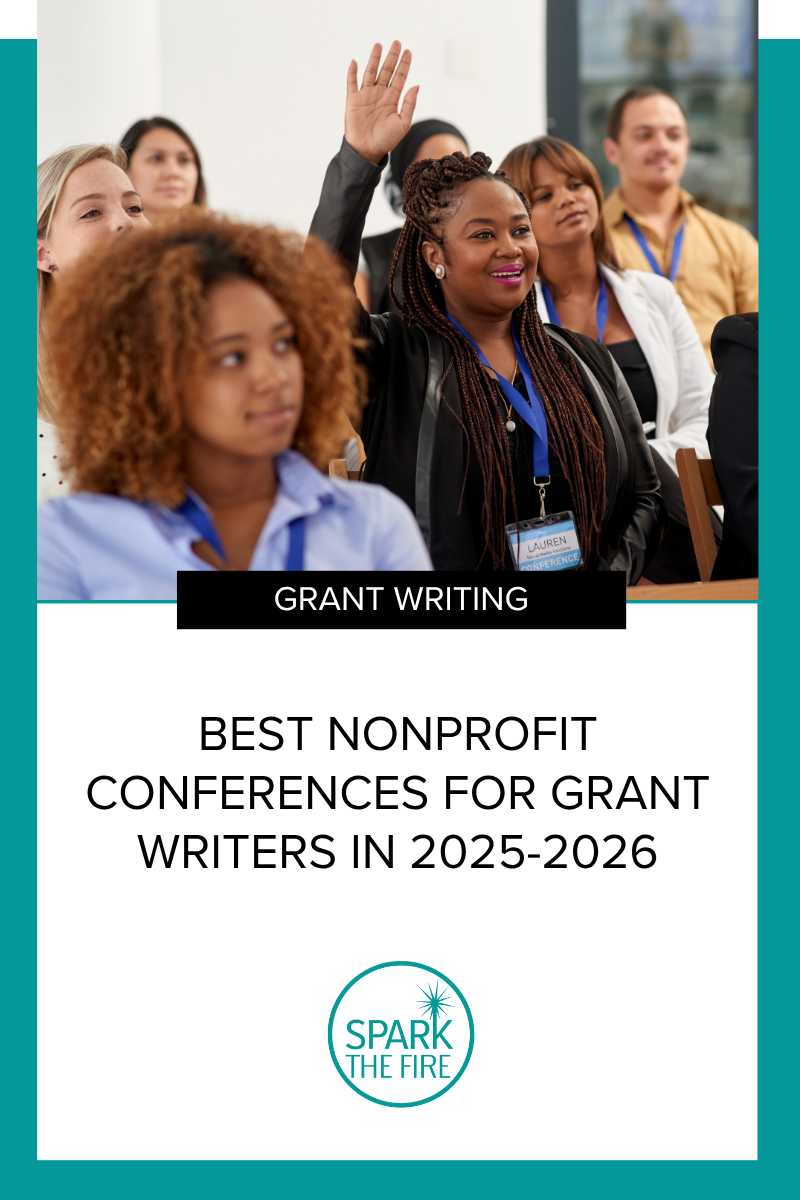
Diverse powerful people at a grant writing conference
 

At Spark the Fire, we believe that professional development should be both practical and meaningful. Conferences aren’t just about brushing up on skills—they’re about building community, nurturing your mission, and discovering the clarity to keep doing the work that matters.

Whether you're a grant writer, nonprofit leader, or community builder, the right conference can ignite new ideas and deepen your purpose. Below, we’ve curated our favorite 2025 and 2026 events with that in mind. These are the conferences we return to again and again—because they align with our values and deliver real impact.

🔥 1. GrantSummit | Grant Professionals Association (GPA)

We’re putting this one first—and yes, we’re a little biased. GrantSummit is the leading national conference dedicated solely to the grant profession. It’s four full days of learning, connection, and practical strategy for those who write, manage, or consult on grants.

The world of grants is constantly shifting—government priorities change, funders evolve, and new tools emerge. This conference is where you go to stay ahead of the curve. You’ll find expert-led sessions on everything from building a logic model to navigating the ethics of AI. It’s a space where you can explore business models for consulting, hear what’s working for peers across sectors, and gain insight into the challenges both funders and nonprofits are facing today.

One of the biggest draws is the people. GrantSummit is packed with professionals who care deeply about doing meaningful work. The networking happens not just in hallways and happy hours, but in the sessions themselves—collaborative, thoughtful conversations that spark new ideas and often lead to long-term partnerships.

Whether you're seeking strategies for managing lost federal revenue, designing more compelling budgets, or simply looking to feel reinspired, GrantSummit delivers. It’s a must-attend for anyone serious about mastering the art and practice of grant writing.

🔥 2. Nonprofit Storytelling Conference

This isn’t just another conference—it’s a masterclass in how to use storytelling to raise more money, deepen donor relationships, and inspire real change. The Nonprofit Storytelling Conference is known for its generous spirit, actionable content, and beautifully curated experience, welcoming approximately 1,200 individuals.

Over three days, you’ll explore how to craft messages that resonate—from donor appeals to case statements to campaign videos. You’ll walk away with practical tools to strengthen every piece of donor communication—and you'll see the difference in your results. Better responses. More gifts. And more confidence in your voice as a fundraiser or communicator.

This conference focuses on results, not just theory. Attendees consistently say it pays for itself—and then some. What sets it apart is the thoughtful attention to detail, including cozy touches like giving each attendee a blanket to keep warm in the session rooms. It's a small gesture, but it speaks volumes about how they value comfort, community, and care.

If you're looking to raise more money using story—and feel good about how you're doing it—this is the room to be in.


🔥 3. AFP ICON | Association of Fundraising Professionals

Known as the largest gathering of fundraising professionals in the world, AFP ICON offers something for everyone—from annual fund managers and grant writers to major gift officers, consultants, and nonprofit executives. What makes this conference stand out is its scale: more than 3,000 fundraisers from across the globe come together to learn, connect, and innovate.

The session lineup covers every aspect of fundraising, including grant writing, donor stewardship, campaign planning, corporate partnerships, and DEI in development. You’ll hear from some of the top voices in the field, engage in powerful panel discussions, and come away with tested strategies to grow your fundraising results.

It’s a large conference, but it doesn’t feel impersonal—especially if you carve out time to attend a smaller workshop or networking group. It’s also a great opportunity to earn CFRE credits while staying on top of trends shaping our field.

If you’re looking to sharpen your skills while gaining a wide-angle view of the fundraising landscape, AFP ICON is a solid investment.

  • Date: April 2026

  • Location: San Diego, CA

  • Cost: ~$1,500–$2,000 (early bird and member discounts available)

  • Websitewww.afpicon.com

🔥 4. Nonprofit Impact Conference | Nonprofit Association of Oregon (NAO)

This is NAO’s inaugural statewide conference—and they’re setting the bar high. What makes this event stand out? For starters, they pay their speakers. In a field where expertise is often undervalued, NAO offers honoraria ranging from $800–$1,500, depending on session length and format. It’s a meaningful commitment to equity, professionalism, and respect for the time and talent of presenters.

But this two-day experience is just as valuable for attendees. The Nonprofit Impact Conference brings together hundreds of nonprofit leaders from across the Pacific Northwest for a dynamic mix of breakout sessions, deep-dive workshops, field trips, networking activities, panel discussions, and expert “office hours.” The programming is designed to keep you engaged, inspired, and connected.

If you're looking for a conference that walks the talk—centering insight, innovation, and community impact—this is a strong new entry worth watching (and attending).


🔥 5. Nonprofit Consulting Conference | Funding for Good

This in-person event is one of the only conferences designed exclusively for nonprofit consultants—making it a perfect fit for grant writers transitioning to consulting or looking to grow a sustainable business. Hosted in beautiful Asheville, NC, at the Sierra Nevada Brewing Company complex, it’s 2.5 days of deep learning, connection, and strategy.

Expect practical, business-focused sessions on branding, pricing, client pipelines, AI tools, work-life balance, scaling services, and more. Early-bird pricing saves $200 and includes access to a pre-conference virtual networking session. The attendee experience is powerful: peer mentoring, breakout groups, and a community designed to support consultants at any stage of growth.

  • Date: September 16–18, 2025

  • Location: Asheville, NC (Sierra Nevada Brewing Company)

  • Cost: ~$1,000

  • Audience: ~200 nonprofit consultants and practitioners

  • Websitenonprofitconsultingconference.org


🔥 6. Annual Conference | Montana Nonprofit Association (MNA)

Don’t underestimate this one—it may be regional, but the Montana Nonprofit Association conference consistently delivers big value. Held in a different city each year, the 2025 event takes place in Billings and includes both in-person and online options.

Drawing around 300 attendees, this conference brings together a diverse and dedicated cross-section of nonprofit leaders, fundraisers, and grant professionals from across Montana and beyond. You’ll find thoughtful sessions on grant readiness, leadership, DEI, financial strategy, rural community challenges, and more. The hybrid format makes it accessible even if you can’t travel—and the in-person gathering is known for its warmth and strong peer-to-peer connections.

If you're based in the Mountain West or serving rural communities, this is a smart choice that offers relevant, relatable insight—and a real sense of belonging.

  • Dates:

    • Virtual: September 15–19, 2025

    • In-Person (Billings): September 25–26, 2025

  • Location: Rotates throughout Montana (2025: Billings, MT)

  • Cost: ~$450

  • Websitewww.mtnonprofit.org


🔥 7. Central Washington Conference for the Greater Good

This conference is a gem—small but mighty, deeply rooted in the communities it serves. Held annually in Toppenish, WA, at Heritage University, it draws around 200+ attendees and offers bilingual content in English and Spanish. It’s designed for nonprofits in rural and Central Washington communities, with a focus on equity, connection, and hands-on tools that strengthen organizations from the inside out.

The 2025 theme, Connected Roots. Collective Power, captured the spirit of the event beautifully. Participants gathered to build skills in fundraising, leadership, community advocacy, budgeting, and emotional resilience. Every workshop was built around action—and 100% of attendees reported they left with something they could immediately apply.

What sets this conference apart is its heart. From interactive workbooks to “Ask a Consultant” sessions to the Hive Mind Exchange, the format encourages collaboration, courage, and conversation. This is the conference where you not only take notes—you take next steps.

  • Date: June 2026

  • Location: Toppenish, WA

  • Cost: ~$125

  • Audience: ~210 participants from 120+ organizations

  • Websitewww.centralwanonprofits.org


🔥 8. Idaho Annual Nonprofit Conference | Idaho Nonprofit Center

Hosted by the Idaho Nonprofit Center, this is the state’s flagship event for nonprofit leaders, fundraisers, board members, and changemakers working across rural and urban communities. If you’re looking for inspiration, collaboration, and actionable tools to strengthen your organization, this two-day conference delivers.

What makes it special
One of the most memorable aspects of this event is the venue: JUMP (Jack’s Urban Meeting Place) in downtown Boise. With bold architecture, playful design, and yes—a three-story spiral slide that even adults can ride—JUMP brings a spirit of creativity and fun that’s rare in nonprofit conferences. It creates a lively, open energy that complements the serious learning happening in the rooms. The space alone makes it feel like you're attending something special—and still, the conference remains thoroughly professional and well-organized.

You’ll find breakout workshops on grants, equity, leadership, fundraising, and nonprofit operations—along with an exhibit hall, networking activities, and catered meals that invite conversation and collaboration. The 2025 theme, Stronger Together: Bridging the Sector, reflects the conference’s focus on connection, shared knowledge, and building capacity across Idaho.

  • Date: August 26–27, 2025

  • Location: JUMP, Boise, ID

  • Cost: ~$250 (members); ~$350 (non-members); higher for late registration

  • Audience: ~200+ nonprofit professionals

  • Websitewww.idahononprofits.org


🔥 9. Nonprofit Marketing Summit | Community Boost

This is the go-to virtual event for nonprofit professionals who want to level up their storytelling, digital strategy, and donor engagement—without spending a dime. Hosted multiple times per year by Community Boost, the Nonprofit Marketing Summit draws thousands of attendees from around the world for high-quality sessions that are actionable, inspiring, and completely free.

It’s perfect for grant writers, fundraisers, and communications pros who wear many hats. Expect sessions on email marketing, website optimization, donor segmentation, content planning, and even AI for nonprofits. The speakers are generous, the content is current, and the format is fast-paced but digestible.

Whether you’re looking for tips on writing stronger donor appeals or want to experiment with new marketing tools, this summit delivers serious value with zero barrier to entry.

🔥 10. Cause Camp | Nonprofit Hub

Cause Camp isn’t just a conference—it’s an experience designed to re-energize nonprofit professionals who are ready to lead with clarity, creativity, and community. Hosted in Grand Rapids, MI, this two-day event blends practical skill-building with big-picture visioning in a retreat-like atmosphere.

You’ll find breakout sessions on fundraising, digital marketing, donor retention, strategic planning, and more—alongside curated networking, wellness touches, and the kind of hallway conversations that can change the trajectory of your work. The energy is uplifting, the audience is deeply mission-driven, and the space is intentionally designed to inspire.

If you’re craving a reset, fresh strategy, and a sense of community among nonprofit thought leaders and changemakers, this is your space.

  • Date: Fall 2025

  • Location: Grand Rapids, MI

  • Cost: ~$400–$600

  • Websitewww.cause.camp

🔥 11. Raise | OneCause

If you’re involved in fundraising events, donor engagement, or campaign planning, Raise is one of the most focused and forward-thinking conferences available. Hosted by OneCause, this event is designed to help nonprofits create more impactful events, strengthen donor relationships, and drive giving through smart, strategic storytelling.

Raise features sessions on donor behavior, inclusive fundraising, event technology, accessibility, and data-informed engagement strategies. Whether you’re planning galas, hybrid events, or smaller community-based gatherings, this conference offers a well-rounded toolkit. You’ll also hear from some of the top voices in the fundraising world—and leave with practical insights you can apply immediately.

It’s also CFRE-approved, so it’s a great way to earn continuing education credits while getting inspired by new ideas.

  • Date: Fall 2025

  • Location: TBD

  • Cost: ~$595–$995

  • Website: www.onecause.com/raise

🔥 12. Good Tech Fest

This is where nonprofit meets innovation—with intention. Good Tech Fest is a conference dedicated to exploring how technology can be used ethically and equitably to advance social good. It’s ideal for grant writers, program staff, evaluators, and nonprofit leaders who are curious about leveraging data, automation, and digital tools in ways that align with their mission.

Sessions cover everything from using AI responsibly to improving data systems, dashboards, and storytelling tools. The vibe is inclusive and forward-thinking, with a strong emphasis on community impact, sustainability, and digital equity.

Whether you're managing grant data, tracking program outcomes, or exploring how to integrate new tools without compromising your values, Good Tech Fest offers thoughtful content and practical guidance.

🔥 13. INSPIRE | Catholic Schools & Parishes Conference

Hosted by the Archdiocese of Seattle, INSPIRE is a two-day conference designed to ignite innovation and deepen mission-focused leadership in Catholic schools and parishes.

This isn’t just a gathering—it’s an energizing space of collaboration, strategy, and creativity. Attendees engage with nationally recognized and locally rooted leaders through dynamic keynotes and breakout sessions. Sessions cover:

INSPIRE anchors its value in community: two full days of learning (8 am–4 pm) at Seattle University, with breakfast and lunch provided each day . It’s free for Archdiocese of Seattle staff, and $250 for Catholic school staff from other dioceses. Optional campus housing is available.

If you work in Catholic education—admissions, development, finance, or leadership—INSPIRE offers a powerful blend of strategy and spirit. It’s a space where values and practices meet—and where fundraising, grant writing, and mission advancement thrive together.

  • Date: August 6–7, 2025

  • Location: Seattle University • Seattle, WA

  • Cost: Free (Archdiocese of Seattle staff); $250 (out-of-diocese staff); optional lodging ~$105/night

  • Website: mycatholicschool.org/inspire

 ✨ Final Thoughts

These events may be different in size and scope, but they all offer something powerful: space to reflect, learn, and grow alongside people who care about the same things you do.

At Spark the Fire, we believe that professional development should feed your spirit and your skills. If you attend any of these events, we’d love to hear about your experience—and we’ll be cheering you on every step of the way.

Could a Grant Writing Certification Double Your Income?

 
Professional grant writer with a certificate in grant writing smiling
 

The Real ROI of Professional Development

In a world where nonprofit funding is increasingly competitive and impact-driven careers are on the rise, professional development is no longer optional—it's a strategic necessity. One of the most common questions I hear from students is: "Will a grant writing certification actually increase my income?" My answer? Yes—and often dramatically so.

Let's break down the return on investment (ROI) of becoming a certified grant writer and how it can influence your income, your confidence, and your career.

The Income Potential of Grant Writing

Whether you're looking to freelance, transition careers, or move up in your current role, grant writing is a high-value skill. Why? Because great grant writers don't just write—they bring in money. In the nonprofit sector, revenue-generating roles are highly valued.

According to the 2023 GPA Compensation Survey, the median salary for a grant writer is $65,000, while grant consultants report a median income of $80,000, with a mean hourly billing rate of $91.29. Certified professionals holding the GPC (Grant Professional Certified) designation often earn even more. For example, GPC-holding Directors of Grants reported a median salary of $103,500.

Here's the kicker: Certified grant writers are often the ones landing those higher-paying jobs and contracts. Why? Because certification signals commitment, training, and a level of professional excellence that stands out.

Real Success Stories: From Certification to Career Transformation

Almost every day, I hear from former students about their successes, and I love staying in touch to become their lifelong cheerleader. These four recent examples show how certification can transform your career, your confidence, and your organization's capacity.

Dream Job Achievement: Lee Avallone 
Sometimes the best success stories are the simplest ones. Lee's excitement says it all: "I wanted to share some good news with you - I just accepted a grant writer job with the American Cancer Society! It's a great career opportunity for me! This is my dream job!" After completing the course, Lee was hired as Grant Writing Manager for the American Cancer Society—proving that grant writers are in high demand, especially certified ones.

From Zero to $274K: Hope Reiden 
Hope works for the Confederated Tribes of the Chehalis Reservation, where her department had never received grant funding before she took the course. Within 12 months of certification, her department secured $274,000 in grants—45% of their annual budget. As Hope shared, "In the last 12 months, my department received almost $274,000 in grants! This funding is a considerable increase since I took your class when my department did not have any grant-funded projects... that is close to 45% of my department's annual budget!" The best part? Hope gets to spend more time doing what she loves—being a biologist in the field.

Quick Career Advancement: Nancy Leal 
Nancy completed our Certificate in Grant Writing course and, within just one month, was promoted to Grants and Communication Specialist at Goodwill. Her certification directly opened the door to a specialized role that perfectly matched her new expertise.

Organizational Impact: Annie Dimitras 
Annie secured over $500,000 in grants within a year of completing the course: "After completing your course last December, I have written several successful grants, securing over $500,000 for our organization. It has been exciting and rewarding to move into this aspect of non-profit work and build new skills."

The Pattern:

  • Lee: Dream job fulfillment

  • Hope: Transforming organizational capacity

  • Nancy: Rapid career advancement

  • Annie: Massive financial impact

This shows certification works across different goals—whether you're seeking purpose, growth, or impact.

The ROI of Certification

Let's say you invest $897 in a professional grant writing course like the Certificate in Grant Writing from Spark the Fire. What can you reasonably expect in return?

Increased Earnings: The stories above aren't outliers—they represent the kind of results we see when people invest in professional development and apply what they've learned. If your new salary or freelance income increases by even $5,000 a year, the certification pays for itself in less than three months. If you double your income? You're talking 10x return or more.

Confidence and Credibility Certification gives you more than a line on your résumé—it gives you language, tools, and structure to show up as a professional. That matters in interviews, proposals, and pricing conversations. According to the 2023 GPA Compensation Survey, only 23% of grant professionals hold any form of professional certification, such as the GPC, CFRE, or CGMS. This means that by earning a certification, you'll truly stand out in the field, positioning yourself as a top candidate for higher-paying opportunities and long-term growth.

Expanded Career Opportunities With certification, you're more likely to be considered for grant writing roles, promoted internally, or selected for consulting work. It opens doors in nonprofit, government, education, and even private sectors.

Who Benefits the Most?

At Spark the Fire, we work with students from all walks of life—young professionals, mid-career changemakers, retirees seeking purpose, and everyone in between. Whether you're just starting out or reinventing your path, grant writing offers a meaningful, flexible, and well-paid way to use your skills for good.

Many of our students begin the course feeling unsure of how to price their services or where to find opportunities. By the end, they're confidently marketing themselves, writing competitive proposals, and stepping into roles that align with their values and goals.

Final Thoughts: Your Investment Is More Than Financial

Professional development is about believing in your future. A grant writing certification is an investment in your income, yes—but it's also an investment in your impact. Every proposal you write funds a mission, supports a community, and helps solve real problems in the world.

And for many of us, that's the best ROI of all.

Ready to Get Certified?

If you're curious whether certification is right for you, check out the Certificate in Grant Writing course. It's self-paced, nationally recognized, and designed to help you start earning faster, without sacrificing depth or quality.

Want to talk it through? Book a complimentary call or reach out to my team. We'd love to support your journey.

Are you a certified grant writer? How has the certification impacted your career? Comment below!