grant writing course

The Metrics Question: How Do We Measure Real Success in Grant Writing Education?


The grant writing profession has spent years proving that "success rates" are unfair metrics for evaluating grant professionals. Too many variables sit outside the writer's control: organizational readiness, funder priorities, relationship history, geographic distribution requirements, and timing factors that have nothing to do with proposal quality.

Still, prospective students and employers ask a fair question:
How do you measure if a grant writing course actually works?

When someone searches for the best grant writing course or wonders whether a grant writing certificate is worth it, what they really want is evidence. Real data. Real results. Real skills demonstrated in real organizations.

That’s the question I’m wrestling with. And I want your help.

In This Article, You Will Learn

·       Why traditional grant success rates cannot measure training effectiveness

·       What academic, professional, and coaching programs track

·       What Spark the Fire currently measures within our 8–10 week Certificate in Grant Writing

·       Four new ideas for measuring real-world success, including a sophisticated revenue forecasting metric

·       How alumni and organizations can help define what “excellent grant writing education” truly means

Why Measuring Grant Writing Training Is So Complicated

The grant writing world has rightfully moved away from simplistic success rates. The field now values strategic thinking, relationship building, professional ethics, readiness assessment, and project design.

But we still haven’t answered one big question:
How do you prove a grant writing training program prepares someone for real jobs and real impact?

After being named the “best grant writing course” in the world by Instrumentl for four years, I’m confident in what we teach. But I’m not satisfied with surface-level metrics. I want evidence that graduates can perform in actual roles across nonprofits, government agencies, educational institutions, tribal entities, and community organizations.


What Other Grant Writing Programs Track

Every program handles this differently:

Academic programs track:

·       completion rates

·       CEUs earned

·       test scores

·       job placement

Training programs track:

·       student confidence surveys

·       testimonials

·       anecdotal success stories

Business coaching models track:

Holly Rustick’s Freelance Grant Writer Academy stood out to me. She tracks collective impact metrics from her 12-month business coaching program:

·       grants raised by students (88 million dollars so far)

·       business revenue earned by students (2.2 million dollars)

What's smart about this is she built it into the program from the start. Students know when they enroll that they're joining a movement toward collective goals: $1 billion in grants for nonprofits and $30 million in student business revenue by 2030. The tracking isn't an afterthought - it's part of the identity.

That works beautifully for a freelance-focused, year-long program with clear entrepreneurial goals.

But what about a comprehensive grant writing education that serves career changers, nonprofit professionals, freelancers, volunteers, and lifelong learners?

No model fully fits Spark the Fire. Each approach tells part of the story. But none feel complete for what we're trying to accomplish at Spark the Fire. So I’m exploring new ones.

How Spark the Fire Grant Writing Classes Already Measures Learning

Let me be clear about what Spark the Fire already includes:

Throughout the 8-10 week course, we assess learning with:

  • Graded knowledge checks on ethics, technical requirements, and strategic thinking

  • Rubric-scored assignments on every component of a grant proposal

  • Individual instructor feedback on multiple drafts

  • Pre- and post-course knowledge and confidence assessments

  • Final project: a complete, professional-quality grant proposal

  • 24 continuing education units toward GPC or CFRE certification

We teach technical writing skills, strategic thinking, prospect research, organizational readiness assessment, professional ethics, and relationship building. Students leave with templates, frameworks, and real work samples.

Our curriculum is rigorous. Students leave prepared.

But is in-course performance enough proof for employers and prospective students? Maybe. Maybe not.

The Four Approaches I'm Considering Next

I'm genuinely exploring several approaches. None are decided. I need your input.

Option A: Strengthen In-Course Assessment

We already assess skills throughout the course. Should we formalize this even more? For example, we could add letter grades to the certification rather than keeping it pass/fail. This would give prospective employers or clients a clearer signal about performance levels.

Question for you: Is in-course assessment the most important proof? Does knowing that graduates demonstrated competency during training give you confidence they can perform after?

Option B: Track Graduate Career Progression

Follow graduates' professional advancement over time:

  • Secured grant writing roles (for career changers)

  • Promoted within their organizations

  • Moved to better-fit organizations (upward or lateral moves that align with their goals)

  • Launched freelance businesses

  • Added grant writing to their responsibilities

  • Transitioned from volunteer to paid positions

Question for you: Does career trajectory prove training effectiveness? Would seeing that graduates advance professionally matter to you?

Option C: Measure Collective Impact (With Full Transparency)

Track the total dollars our graduates help raise for nonprofits, government agencies, educational institutions, tribal entities, and other organizations. I'd be completely transparent about the limitations: this number reflects organizational readiness, existing relationships, program quality, funder priorities, and many factors beyond the grant writer's control.

Question for you: Even with those attribution challenges, does collective impact matter? Would knowing "Spark the Fire graduates collectively raised $X million" influence your trust in the program?

Option D: Forecasting Accuracy (A Sophisticated Professional Metric)

Here's where I get genuinely curious - and I'm not sure if this is too abstract or exactly right.

I have used probability forecasting to predict annual revenue from grant writing for an organization. You assign each opportunity a probability based on fit, readiness, and relationship strength, multiply by the request amount, and sum the weighted values.

Here’s a simple numeric example:

A graduate builds a one-year grant calendar with four proposals totaling 400,000 dollars:

·       Proposal A: 150,000 dollars at 70 percent probability

·       Proposal B: 100,000 dollars at 40 percent probability

·       Proposal C: 100,000 dollars at 25 percent probability

·       Proposal D: 50,000 dollars at 80 percent probability

Expected revenue forecast =
(0.70)(150,000) + (0.40)(100,000) + (0.25)(100,000) + (0.80)(50,000)
= 217,500 dollars

If actual results land within roughly 15 percent over 12 months, the forecast was accurate.

What if we measured whether graduates can accurately forecast grant revenue?

Not "did you raise $X million" but "can you strategically assess your portfolio and make calibrated predictions?"

This metric measures:

  • Strategic thinking about organizational fit and funder priorities

  • Understanding of readiness factors that affect success

  • Professional-level judgment and pattern recognition

  • The ability to think beyond single proposals to portfolio management

An example metric: "Spark the Fire graduates' revenue forecasts averaged within 15% of actual results over a 12-month period."

Here's my question: Is this too complex—or is it exactly the kind of real-world proof the field needs?

 I find it intellectually compelling. But does anyone besides me care?

What Would You Be Willing to Track?

For this to work, alumni must participate. If you're an alumnus, what would you be willing to report back?

Holly Rustick's model works partly because students know upfront they're joining a movement toward collective goals ($1 billion in grants, $30 million in businesses by 2030). Tracking isn't an afterthought - it's part of the identity.

Would that resonate with Spark the Fire graduates?

Would you want to be part of proving that excellent grant writing education produces measurable results? Would you respond to a 6-month survey? Share your career wins? Report your challenges?

And critically: What would motivate you to do this?

Contributing to collective achievement? Demonstrating the value of the profession? Building credibility for future graduates? Access to an alumni community? Something else?

FAQ

How do you measure success in a grant writing course?

We evaluate skills through graded assignments, instructor feedback, and a final professional-quality proposal. We are exploring additional long-term metrics such as career outcomes, collective impact, and grant revenue forecasting.

Do grant writing “success rates” matter?

Not really. Grant decisions depend on funder priorities, relationships, geographic requirements, and organizational readiness. Skill development, strategic thinking, and ethical practice are better indicators of a writer’s ability.

What should employers look for in a grant writing certificate?

Evidence-based curriculum, practical assignments, instructor-reviewed proposals, and skills tied to real-world grant writing (research, readiness assessment, budgeting, outcomes, and forecasting).

What is grant revenue forecasting?

It’s a method professionals use to predict annual grant revenue by assigning probabilities to each opportunity. It measures judgment and strategic thinking, not luck.

Your Turn

I want to hear from you.

·       Prospective students: What evidence gives you confidence that a training program prepares you for real grant writing roles?

·       Alumni: What would you be willing to track and share?

·       Organizations: What information helps you trust a certificate or credential?

·       Educators: What metrics have you found valuable in your own programs?

Email me or share your thoughts in the comments. I’m genuinely listening.

And if the forecasting model either sparks your curiosity or confuses you completely… I especially want to hear from you. 

How to Create Compelling Grant Writing Samples That Win Jobs and Clients

 
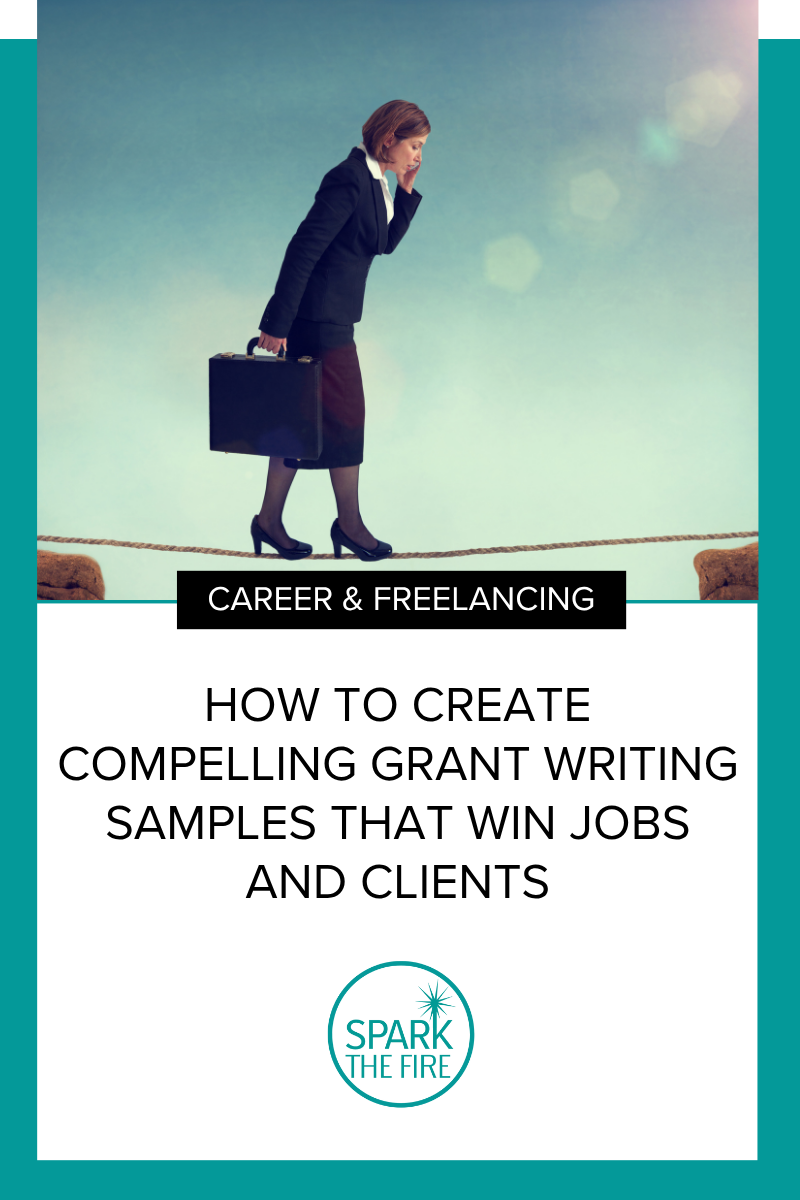
Grant writer with writing samples in briefcase walking on tight rope.
 

In the competitive world of grant writing, your portfolio can make or break your next opportunity. Along with professional certifications, writing samples are among the most requested materials for demonstrating your expertise. They showcase not just your technical skills, but your ability to craft persuasive narratives that reach what I like to call the "of course factor"—that moment when funders think "of course that makes sense" and "of course I want to fund that."

Why Writing Samples Are Essential

When potential employers or clients evaluate grant writers, they're looking for three critical elements: exceptional writing mechanics, strategic thinking, and the ability to tell a compelling story. While a certificate proves you've completed coursework and understand best practices, a writing sample proves you can deliver results.

Your samples demonstrate your command of grammar and spelling—the basic requirements for any professional writer. More importantly, they reveal your strategic approach to framing proposals. Can you position a project to align with a funder's priorities? Do you understand how to build a logical case that moves from problem identification through solution implementation? These sophisticated skills only become apparent through actual writing samples.

The challenge is that your best work often belongs to someone else.

Navigating Confidentiality Without Compromising Quality

Most grant writers face the same dilemma: their strongest proposals contain confidential organizational and financial information that can't be shared freely. The solution isn't to abandon these samples—it's to thoughtfully adapt them while preserving their impact.

Skip the Black Redaction Approach

Nothing kills readability like a document peppered with thick black rectangles. When large portions of text are blacked out, the writing loses its flow, and your potential employer can't assess your actual capabilities. You're essentially asking them to evaluate Swiss cheese.

Avoid Generic Placeholder Names

Don't fall into the "ABC Organization with DEF Program" trap. Acronyms without context force readers to work harder to understand your narrative. Human brains naturally seek stories and meaning—when you use meaningless placeholders, you're fighting against cognitive processing.

Instead, create realistic replacement names that maintain the proposal's authenticity. If you wrote for a youth mentoring nonprofit, rename it something like "Community Youth Connections" with a program called "Pathways to Success Mentoring Initiative." These names immediately convey the organization's mission and program focus, allowing readers to follow your narrative without mental gymnastics.

Handle Financial Information Strategically

Remove all budget figures, financial data, and funding amounts entirely. Don't replace them with placeholder numbers—simply delete them. Potential clients don't need to see dollar amounts unless they're specifically evaluating your budgeting accuracy. What they need to see is your ability to structure logical budget narratives, justify expenses, and demonstrate cost-effectiveness conceptually.

Creating Professional Sample Headers

At the top of each writing sample, include a brief header that serves multiple purposes. This header should contain:

  • A disclaimer that organization and program names have been changed for confidentiality

  • A note that all financial information has been removed for privacy purposes

  • A strategic statement explaining why you've included this particular sample and how it demonstrates your approach to matching proposals with specific grantmaker priorities

For example: "Organization and program names have been changed to protect confidentiality. All financial information has been removed for privacy purposes. This sample demonstrates my approach to private foundation grants, specifically how I align educational programming with the Robert Wood Johnson Foundation's commitment to building a culture of health through community-based initiatives."

This header immediately signals professionalism while giving context for your strategic thinking.

The Head and Heart Balance

Strong grant proposals engage both analytical and emotional decision-making. Your samples should demonstrate this dual approach:

The Head: Data-Driven Evidence Include proposals that showcase your ability to present compelling statistics, research findings, and measurable outcomes. Demonstrate how you use data to build credible arguments for funding necessity and program effectiveness.

The Heart: Human Stories Balance hard data with authentic storytelling. Include client testimonials, case studies, or narrative descriptions that help funders connect emotionally with your cause. Show how you bring abstract problems to life through concrete human experiences.

Curating Your Portfolio: Quality Over Quantity

You don't need an extensive collection—focus on strategic diversity. Aim for three distinct samples that demonstrate your versatility:

Government Grant Sample Choose a federal, state, or local government proposal that shows your ability to navigate complex application requirements and speak the language of public funding priorities.

Private Foundation Sample Select a foundation proposal that demonstrates your research skills and ability to align project goals with philanthropic giving strategies.

Corporate Grant Sample Include a corporate proposal that showcases your understanding of business priorities and corporate social responsibility objectives, as well as your ability to articulate the economic impact of the grant funding.

This trio proves you can adapt your writing style and strategic approach based on different funder types and their unique evaluation criteria.

The In-Person Portfolio Strategy

Resist the urge to email samples ahead of interviews. Instead, bring them as physical copies in a professional portfolio or folder. This approach serves multiple purposes:

You maintain control over your intellectual property while still demonstrating your capabilities. Present the samples during the interview, allow time for review and discussion, then take them with you when you leave.

This strategy also creates a more interactive interview experience. You can walk through your strategic decisions, explain your research process, and demonstrate your expertise in real-time rather than hoping your samples speak for themselves in someone's inbox.

For a complete guide to what materials to bring to grant writing interviews and how to present yourself professionally, check out our Business of Freelance Grant Writing course and Freelance Grant Writer Template Packet.

Planning for Future Success

Building a strong sample portfolio requires advanced planning. If you're early in your career or transitioning into grant writing, consider strategic volunteer opportunities—but only if you can negotiate sample retention rights upfront.

Before beginning any volunteer work, establish a clear agreement that you retain the right to use adapted versions of your writing for future portfolio purposes. This ensures you're building career assets while contributing to worthy causes.

For established professionals, regularly assess your current samples. Are they recent enough to reflect current best practices? Do they represent the types of clients or causes you want to attract? Your portfolio should evolve with your career goals.

Creating compelling writing samples requires balancing confidentiality, authenticity, and strategic positioning. By thoughtfully adapting your best work while preserving its impact, you can build a portfolio that opens doors to your next great opportunity.

Ready to strengthen your grant writing credentials? Learn more about our comprehensive Grant Writing Certificate Program to build the foundational skills that make samples shine.

What tips or questions do you have about writing samples for grant writing? We'd love to hear from you! Comment below.

Could a Grant Writing Certification Double Your Income?

 
Professional grant writer with a certificate in grant writing smiling
 

The Real ROI of Professional Development

In a world where nonprofit funding is increasingly competitive and impact-driven careers are on the rise, professional development is no longer optional—it's a strategic necessity. One of the most common questions I hear from students is: "Will a grant writing certification actually increase my income?" My answer? Yes—and often dramatically so.

Let's break down the return on investment (ROI) of becoming a certified grant writer and how it can influence your income, your confidence, and your career.

The Income Potential of Grant Writing

Whether you're looking to freelance, transition careers, or move up in your current role, grant writing is a high-value skill. Why? Because great grant writers don't just write—they bring in money. In the nonprofit sector, revenue-generating roles are highly valued.

According to the 2023 GPA Compensation Survey, the median salary for a grant writer is $65,000, while grant consultants report a median income of $80,000, with a mean hourly billing rate of $91.29. Certified professionals holding the GPC (Grant Professional Certified) designation often earn even more. For example, GPC-holding Directors of Grants reported a median salary of $103,500.

Here's the kicker: Certified grant writers are often the ones landing those higher-paying jobs and contracts. Why? Because certification signals commitment, training, and a level of professional excellence that stands out.

Real Success Stories: From Certification to Career Transformation

Almost every day, I hear from former students about their successes, and I love staying in touch to become their lifelong cheerleader. These four recent examples show how certification can transform your career, your confidence, and your organization's capacity.

Dream Job Achievement: Lee Avallone 
Sometimes the best success stories are the simplest ones. Lee's excitement says it all: "I wanted to share some good news with you - I just accepted a grant writer job with the American Cancer Society! It's a great career opportunity for me! This is my dream job!" After completing the course, Lee was hired as Grant Writing Manager for the American Cancer Society—proving that grant writers are in high demand, especially certified ones.

From Zero to $274K: Hope Reiden 
Hope works for the Confederated Tribes of the Chehalis Reservation, where her department had never received grant funding before she took the course. Within 12 months of certification, her department secured $274,000 in grants—45% of their annual budget. As Hope shared, "In the last 12 months, my department received almost $274,000 in grants! This funding is a considerable increase since I took your class when my department did not have any grant-funded projects... that is close to 45% of my department's annual budget!" The best part? Hope gets to spend more time doing what she loves—being a biologist in the field.

Quick Career Advancement: Nancy Leal 
Nancy completed our Certificate in Grant Writing course and, within just one month, was promoted to Grants and Communication Specialist at Goodwill. Her certification directly opened the door to a specialized role that perfectly matched her new expertise.

Organizational Impact: Annie Dimitras 
Annie secured over $500,000 in grants within a year of completing the course: "After completing your course last December, I have written several successful grants, securing over $500,000 for our organization. It has been exciting and rewarding to move into this aspect of non-profit work and build new skills."

The Pattern:

  • Lee: Dream job fulfillment

  • Hope: Transforming organizational capacity

  • Nancy: Rapid career advancement

  • Annie: Massive financial impact

This shows certification works across different goals—whether you're seeking purpose, growth, or impact.

The ROI of Certification

Let's say you invest $897 in a professional grant writing course like the Certificate in Grant Writing from Spark the Fire. What can you reasonably expect in return?

Increased Earnings: The stories above aren't outliers—they represent the kind of results we see when people invest in professional development and apply what they've learned. If your new salary or freelance income increases by even $5,000 a year, the certification pays for itself in less than three months. If you double your income? You're talking 10x return or more.

Confidence and Credibility Certification gives you more than a line on your résumé—it gives you language, tools, and structure to show up as a professional. That matters in interviews, proposals, and pricing conversations. According to the 2023 GPA Compensation Survey, only 23% of grant professionals hold any form of professional certification, such as the GPC, CFRE, or CGMS. This means that by earning a certification, you'll truly stand out in the field, positioning yourself as a top candidate for higher-paying opportunities and long-term growth.

Expanded Career Opportunities With certification, you're more likely to be considered for grant writing roles, promoted internally, or selected for consulting work. It opens doors in nonprofit, government, education, and even private sectors.

Who Benefits the Most?

At Spark the Fire, we work with students from all walks of life—young professionals, mid-career changemakers, retirees seeking purpose, and everyone in between. Whether you're just starting out or reinventing your path, grant writing offers a meaningful, flexible, and well-paid way to use your skills for good.

Many of our students begin the course feeling unsure of how to price their services or where to find opportunities. By the end, they're confidently marketing themselves, writing competitive proposals, and stepping into roles that align with their values and goals.

Final Thoughts: Your Investment Is More Than Financial

Professional development is about believing in your future. A grant writing certification is an investment in your income, yes—but it's also an investment in your impact. Every proposal you write funds a mission, supports a community, and helps solve real problems in the world.

And for many of us, that's the best ROI of all.

Ready to Get Certified?

If you're curious whether certification is right for you, check out the Certificate in Grant Writing course. It's self-paced, nationally recognized, and designed to help you start earning faster, without sacrificing depth or quality.

Want to talk it through? Book a complimentary call or reach out to my team. We'd love to support your journey.

Are you a certified grant writer? How has the certification impacted your career? Comment below!