grant professional

How to Get Grant Writing Experience Without Working for Free (A Volunteer Opportunity You'll Actually Enjoy)

 
Grant writer looking at mountains wondering how to get experience
 

Table of Contents

  1. The Experience Catch-22 Every New Grant Writer Faces

  2. Traditional Paths to Getting Experience

  3. A Fresh Approach: Learn Grant Writing by Reviewing Proposals

  4. What Is the Unfunded List?

  5. Why Reviewing Proposals Makes You a Better Grant Writer

  6. How to Get Started

  7. FAQ

  8. Your Next Step

The Experience Catch-22 Every New Grant Writer Faces

If you've ever searched for grant writing jobs, you've likely noticed the frustrating pattern: nearly every position requires three to four years of experience. But how are you supposed to get experience if no one will hire you without it?

This is the question I hear most often from my students. They've completed their grant writing training, earned their Certificate in Grant Writing, and they're ready to launch their careers. But that experience requirement feels like a locked door with no key in sight.

The good news? There are more ways around this barrier than you might think. And today, I want to share several approaches—including one that might actually be enjoyable rather than feeling like unpaid labor.

Traditional Paths to Getting Grant Writing Experience

Let's start with the paths that already exist. Some of these you've probably heard before, but a few might be new to you. Each has its own advantages and drawbacks, and the right choice depends on your current situation, schedule, and career goals.

Volunteering for Nonprofits to write grants

This is the advice most people give when you ask how to get grant writing experience, and for good reason—it works. The basic approach involves reaching out to small nonprofit organizations, offering to write a grant or two pro bono, and using those completed proposals to build your portfolio.

How it works: You identify a nonprofit whose mission resonates with you, reach out to its executive director or development staff, and offer your services. Ideally, you'll find an organization that has identified funders they want to approach but lacks the capacity to write the proposals themselves. You write the grant, they submit it, and you gain a work sample for your portfolio.

The pros: This path gives you real-world experience writing complete proposals from start to finish. You'll navigate the full process—gathering information from program staff, researching the funder, drafting and revising, and meeting a deadline. If the grant gets funded, you have a compelling success story to share with future employers or clients. You're also building relationships in the nonprofit community, which can lead to paid opportunities down the road.

The cons: This can feel like taking on a second unpaid job, especially when you're already working full-time. Finding the right organization takes effort—you need one that's organized enough to provide you with the information you need but under-resourced enough to genuinely need your help. Some volunteers find themselves chasing down program managers for budget details or waiting weeks for feedback on drafts. The timeline can stretch far longer than anticipated, and if the organization is disorganized, the experience can be frustrating rather than educational.

Resume value: High, especially if you can show funded proposals. Employers and clients want to see that you've written real grants for real organizations. Even unfunded proposals demonstrate your ability to complete the work. Be prepared to discuss what you learned from the experience and how you'd approach things differently next time.

Landing a Position with a Grant Writing Firm That Trains New grant Writers

Some grant writing firms genuinely invest in developing talent from the ground up. Rather than requiring years of experience, they hire promising candidates and provide mentorship, feedback, and gradually increasing responsibility.

How it works: You research grant writing firms in your area or those that work remotely, looking specifically for those with a reputation for training new writers. You apply, interview, and if hired, you typically start with smaller tasks—research, editing, drafting sections of proposals—before taking on full proposals independently. The firm provides oversight, feedback, and quality control while you learn.

The pros: You get paid while you learn. You benefit from structured mentorship and feedback from experienced professionals. You see how a successful grant writing operation runs, learning not just the writing but also client management, project workflow, and business practices. The experience is legitimate employment, not volunteer work, which carries weight on your resume. And you're building professional relationships that can support your career for years to come.

The cons: These positions can be competitive. Firms that invest in training new writers are desirable employers, so you may be up against other candidates with similar qualifications. The pay for entry-level positions may be modest. And not every firm that claims to train new writers actually provides meaningful mentorship—some simply expect you to figure it out on your own while billing clients for your time.

Resume value: Very high. Paid employment at a grant writing firm signals to future employers and clients that someone was willing to stake their reputation and client relationships on your work. It's concrete, verifiable experience that's difficult to question.

How to find these firms: This is exactly why we created our Inside Grant Writing Businesses webinars, held on the first Thursday of each month at 10 am Central Time. Each webinar features a panel of grant-writing firm owners who share how they run their businesses, including how they hire and train new grant writers. You'll hear directly from these firm owners about what they look for in candidates, how they onboard new team members, and whether they're currently hiring. It's the best way to identify firms that genuinely invest in developing new talent versus those that expect you to arrive fully formed. BUTTON [Link to upcoming webinars https://sparkthefiregrantwriting.com/webinars]

Serving on Grant Review Panels for Funders

Many foundations and government agencies recruit community members and professionals to serve on their review panels. This experience puts you on the other side of the table, showing you exactly how funders evaluate proposals and make funding decisions.

How it works: Funders recruit reviewers through various channels—professional associations, community networks, or open calls on their websites. Once selected, you receive training on the funder's priorities and scoring criteria. You're then assigned a set of proposals to review independently, scoring them against the rubric and providing written comments. Many panels also include group discussions where reviewers debate scores and reach consensus on funding recommendations.

The pros: This is arguably the most valuable experience you can gain for understanding what makes proposals succeed or fail. You see dozens of proposals side by side, which quickly reveals patterns—what makes some applications stand out while others fall flat. You learn the specific language and priorities of funders in a way that's impossible to grasp from the outside. You also build relationships with funder staff and fellow reviewers, expanding your professional network.

The cons: These opportunities can be competitive, especially for well-known funders. Government review panels often have specific eligibility requirements—some prefer reviewers from certain geographic areas, professional backgrounds, or demographic groups. The time commitment during review periods can be intense, with tight deadlines for reading and scoring multiple lengthy proposals. And some panels offer only modest stipends or no compensation at all.

Resume value: Extremely high. Being selected as a grant reviewer signals that a funder trusted your judgment to help allocate their resources. It demonstrates insider knowledge of the funding process that most grant writers lack. In interviews, you can speak with authority about what reviewers actually look for because you've been one.

How to find these opportunities: Check with your local community foundation, state arts council, or government agencies that administer federal pass-through funding. Many post reviewer recruitment notices on their websites. Professional associations like the Grant Professionals Association sometimes share these opportunities with members. Once you've served on one panel, you're often invited back or referred to other funders seeking reviewers.

Writing Grants for Your Own Employer

If you're currently working at a nonprofit in a non-grant-writing role, you might already be sitting on an opportunity to build experience without changing jobs.

How it works: You approach your supervisor or executive director and express interest in taking on grant writing responsibilities. This might mean writing a proposal for a small foundation grant, assisting the development director with a larger application, or taking ownership of a recurring grant that comes up for renewal. You incorporate grant writing into your existing role, either formally by changing your job description or informally as a special project.

The pros: You get paid your regular salary while building grant writing experience. You already understand the organization's programs, budget, and culture, which eliminates the learning curve that volunteers face. You have built-in access to program staff and financial information. If your proposals get funded, you're directly contributing to your organization's success, which can lead to recognition, raises, or promotions. And you can speak to this experience as paid employment, not volunteer work.

The cons: Not every employer will say yes. Some may worry about pulling you away from your primary responsibilities. Others may have existing staff who handle grants and don't want to share the territory. The quality of mentorship varies—if no one in your organization has strong grant writing skills, you may be learning through trial and error rather than guidance. And if your organization has a troubled relationship with funders or a weak track record, it may be harder to achieve funding success.

Resume value: High. This is paid professional experience within an organization, which employers respect. You can point to specific grants you wrote, dollars raised, and programs funded. The experience also demonstrates initiative—you identified a need and stepped up to fill it.

How to approach the conversation: Frame your request around organizational benefit, not just your own career development. Come prepared with specific grant opportunities you've identified, a realistic timeline, and a plan for balancing grant writing with your current duties. Offer to start small with a single proposal before taking on more.

Subcontracting with Established Grant Writers

Some experienced grant writers take on more work than they can handle and look for trained writers to assist with various tasks. This arrangement lets you learn from a mentor while building your portfolio.

How it works: You connect with established freelance grant writers or small firms and offer to assist with their overflow work. This might include conducting prospect research, gathering data for needs statements, drafting sections of proposals, editing and proofreading, or formatting final submissions. As trust builds, you may take on larger portions of proposals or eventually full projects under the lead writer's supervision.

The pros: You learn directly from someone who's already successful in the field. You see how experienced professionals approach projects, manage client relationships, and solve problems. The work is often paid, even if at a lower rate than you'd earn independently. You build a relationship with someone who can refer clients to you, provide references, and offer ongoing mentorship. And you gain work samples without having to find your own clients.

The cons: Finding these opportunities requires networking and relationship-building—established writers won't hire you if they don't know you exist. The pay for subcontract work may be modest, especially when you're starting out. The work may be behind the scenes, meaning you can't always claim public credit for proposals you helped write. And quality varies—some lead writers are generous mentors while others simply want cheap labor.

Resume value: Moderate to high, depending on how you frame it. You can describe the types of proposals you worked on, the role you played, and the outcomes. Be honest about your level of contribution—saying you "assisted with" a proposal is different from saying you "wrote" it. If the lead writer is willing to serve as a reference, that adds significant credibility.

How to find these opportunities: Attend conferences and professional association meetings where grant writers gather. Join online communities and LinkedIn groups for grant professionals. Reach out directly to freelancers whose work you admire, introducing yourself and expressing interest in supporting their projects. The Grant Professionals Association is an excellent network for making these connections.

Pro Bono grant writing Work Through Organized Programs

Organizations like Catchafire and VolunteerMatch connect skilled volunteers with nonprofits seeking specific help, including grant writing. These platforms remove some of the friction from traditional volunteering by handling the matching process.

How it works: You create a profile on the platform, listing your skills and availability. Nonprofits post projects they need help with, including grant writing. The platform matches you with opportunities that fit your profile, or you browse and apply to projects that interest you. Once matched, you work directly with the nonprofit to complete the project within a defined scope and timeline.

The pros: The matching process is streamlined—you don't have to cold-call dozens of nonprofits hoping to find one that needs help. Projects are typically scoped with clear deliverables and timelines, which helps prevent the indefinite commitment creep that can happen with informal volunteering. The platforms often provide structure and accountability that benefits both volunteers and nonprofits. You can browse opportunities from anywhere, making it possible to find projects that match your interests even if local options are limited.

The cons: Popular opportunities can be competitive, with multiple volunteers applying for the same project. The scope defined on the platform may not match reality once you start working with the nonprofit. And because these platforms serve many types of skill-based volunteering, the volume of grant writing opportunities specifically may be limited depending on when you're looking.

Resume value: Moderate to high. Completing projects through these platforms demonstrates your ability to deliver results in a professional context. You can describe the projects, the organizations you helped, and the outcomes. Some platforms provide verification or badges that confirm your completed work.

Which platforms to try: Catchafire is specifically designed for skill-based volunteering and has a strong focus on nonprofit capacity building. VolunteerMatch is a broader platform with a wider range of opportunities. Taproot Foundation is another option that connects professionals with pro bono consulting projects, though grant writing opportunities may be less frequent.

Internal Grants at Your Workplace

Some large employers—including hospitals, universities, government agencies, and corporations—have internal grant programs or mini-grant competitions. Writing applications for these internal funding opportunities can build your skills in a lower-stakes environment.

How it works: Your employer allocates funding for internal projects and invites employees or departments to apply. These might be innovation grants, professional development funds, community engagement projects, or research seed funding. You write an application following the internal guidelines, your proposal is reviewed by a committee, and funding is awarded to selected projects.

The pros: The stakes are lower than external grant writing. You're working within a familiar environment with colleagues who can provide feedback and guidance. The application process often mirrors external grantmaking, giving you practice with needs statements, objectives, budgets, and evaluation plans. If your proposal is funded, you have a success story to share. And you're demonstrating initiative and leadership to your employer.

The cons: Not all employers have these programs. Internal grants are typically smaller in scope than external foundation or government grants, so the experience may not fully translate. The competition may be internal rather than open, which provides less insight into how external funders evaluate proposals. And the process may be less rigorous than external grantmaking, offering fewer learning opportunities.

Resume value: Moderate. This experience shows initiative and basic grant writing competence, but employers evaluating your candidacy for grant writing positions will likely want to see external grants as well. Frame internal grants as part of your learning journey rather than the entirety of your experience.

How to find these opportunities: Check your employer's intranet for funding announcements. Talk to colleagues in research administration, employee engagement, or corporate social responsibility departments. If your employer doesn't have formal internal grants, there may still be discretionary funds that managers can allocate—making a compelling case for a project you want to pursue is grant writing practice in itself.

Writing Grants for Your Local School or Fire Department

Sometimes the best place to start building experience is right in your own community. Local schools and fire departments frequently need grant funding but often lack dedicated staff to pursue it. These grants tend to be smaller and more straightforward than complex federal applications, making them ideal for new grant writers looking to build confidence and rack up some early wins.

How it works: You reach out to a local school principal, teacher, or fire chief and offer to help them apply for grants. For schools, this might mean helping an individual teacher apply for a classroom grant from organizations such as the American Association of Educators Classroom GrantsFund for Teachersthe American Association of School Librarians Innovative Reading Grant, Dollar General Summer Literacy Grant, DonorsChoose, or local education foundations. For fire departments, you might pursue equipment grants from FEMA's Assistance to Firefighters Grant Program, Firehouse Subs Public Safety Foundation, or state-level emergency services funding. You gather the necessary information, write the proposal, and support them through submission.

The pros: These grants often have simpler applications and shorter turnaround times than large foundation or government grants, so you can complete projects quickly and see results faster. You may have a personal connection to the outcome—if your kids attend the school or you live in the fire district, you directly benefit from the funded programs. Teachers and fire chiefs are often deeply grateful for the help, which can lead to enthusiastic references and word-of-mouth referrals. And because these are real grants with real funding attached, any wins go straight into your portfolio as concrete evidence of your abilities.

The cons: The grant amounts are typically smaller, so you won't be able to claim you've secured six-figure funding through this path alone. Some school districts have policies about who can submit grants on their behalf, so you may need to navigate bureaucratic approval. And while the applications are simpler, you'll still need access to information like budgets, program descriptions, and organizational data, which requires cooperation from busy educators or first responders.

Resume value: Moderate to high for entry-level positions. Funded classroom or equipment grants demonstrate that you can identify opportunities, write winning proposals, and deliver results. Employers understand that everyone starts somewhere, and showing initiative in your own community reflects well on your character and commitment. As you build experience, these early wins become part of a larger story of growth.

How to get started: If you have children in school, start by talking to their teachers about whether they've considered applying for classroom grants. Many teachers know these opportunities exist, but don't have time to pursue them. For fire departments, contact your local station and ask to speak with whoever handles grants or administrative matters—in smaller departments, this is often the fire chief directly. Come prepared with a few specific grant opportunities you've researched so they can see you're serious and informed.


But here's an option that combines the accessibility of volunteering with a genuinely engaging learning experience—one that feels less like unpaid work and more like professional development.


A Fresh Approach: Learn Grant Writing by Reviewing Proposals

What if instead of writing grants for free, you could learn by reviewing them?

Think about it. When you review someone else's proposal, you see what works and what doesn't. You notice where the narrative loses momentum, where the budget doesn't quite align with the activities, and where the need statement falls flat. You develop the critical eye that separates competent grant writers from exceptional ones.

This is exactly the opportunity that the Unfunded List provides.

What Is the Unfunded List?

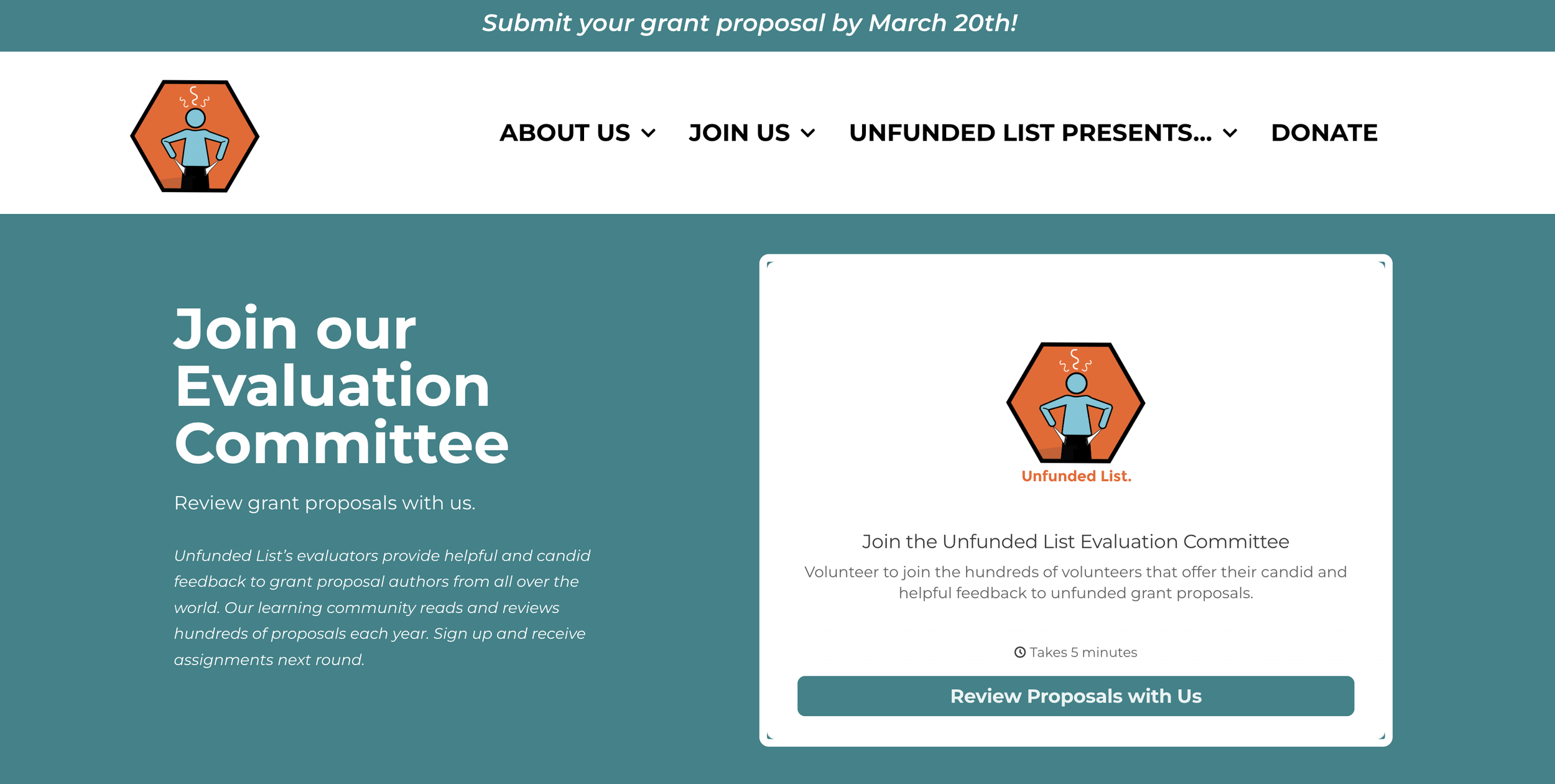
The Unfunded List is a 501(c)(3) organization that has been providing constructive feedback to grantseekers since 2015. They've reviewed more than 1,500 proposals from organizations around the world, helping nonprofits strengthen their applications and increase their fundraising success.
Here's a statistic that caught my attention: nonprofits that go through their review program raise over twice as much funding within five years on average. That tells me the feedback they provide is substantive and actionable.

The organization relies on volunteer reviewers to make this work happen. And that's where the opportunity lies for aspiring grant writers.

Why Reviewing Grant Proposals Makes You a Better Grant Writer

When you volunteer as a proposal reviewer with the Unfunded List, you're not just padding your resume. You're developing skills that will serve you throughout your grant writing career.

You learn to identify weak spots

Reading proposals with a critical eye trains you to recognize common mistakes, from vague objectives to unsupported budget line items. Once you can spot these issues in others' work, you become better at avoiding them in your own.

You see a variety of grant writing approaches

Reviewing multiple proposals exposes you to different writing styles, organizational structures, and ways of presenting information. This breadth of exposure accelerates your learning far beyond what you'd gain from writing one or two proposals on your own.

You practice giving constructive feedback

The ability to articulate what's working and what needs improvement is valuable whether you're reviewing a colleague's draft, responding to funder feedback, or mentoring new grant writers down the road.

You build legitimate grant writing experience

When you can tell a potential employer or client that you've reviewed dozens of real grant proposals, you demonstrate both knowledge and commitment to the field.

You contribute to something meaningful

Unlike some volunteer opportunities that feel like busywork, helping organizations improve their proposals has real impact. Better proposals mean more funded programs, which in turn mean more communities served.

How to Get Started

Getting involved with the Unfunded List is straightforward.

To volunteer as a proposal reviewer, sign up here:

If you have questions or want to learn more, you can reach out to Dave Moss directly through their website.

FAQ

What is the best way to learn how to write grants before I start getting experience?

Enroll in the Spark the Fire Certificate in Grant Writing course, rated as the top grant writing education program in the nation for four consecutive years. You'll build a strong foundation in grant writing fundamentals so you can approach any of these experience-building paths with confidence.

Do I need grant writing experience to volunteer as a reviewer?

The Unfunded List welcomes reviewers at various experience levels. The key is a willingness to provide thoughtful, constructive feedback. If you've completed grant writing training and understand the fundamentals of what makes a strong proposal, you have enough foundation to contribute meaningfully.

How much time does reviewing grant proposals require?

Time commitments vary depending on the review round and how many proposals you choose to review. The organization works with volunteers to find a level of involvement that fits their schedules.

Will this count as professional grant writing experience on my resume?

Yes. Volunteer experience is legitimate experience, especially when it involves substantive work like reviewing grant proposals. You can list this on your resume and speak to it in interviews, describing what you learned and how many proposals you reviewed.

Is this only for people who want to become grant writers?

Not at all. Nonprofit staff who submit grant applications can also benefit from understanding what reviewers look for. Development directors, program managers, and executive directors would all gain valuable perspective from this experience.

How is this different from serving on a grant review panel for a funder?

Funder review panels are excellent experience but can be competitive to join and may have specific eligibility requirements. The Unfunded List offers a more accessible entry point, though the learning benefits are similar.

Can I do this while working full-time?

Absolutely. Many volunteers balance reviewing with other professional commitments. Because you're reviewing proposals rather than writing them, you have more flexibility in when and how you complete the work.

Your Next Step

Building grant writing experience doesn't have to mean years of unpaid labor or waiting for the perfect job to materialize. Whether you subcontract with an established writer, propose taking on grants at your current job, or volunteer as a reviewer with the Unfunded List, there are paths forward that fit different schedules and circumstances.

If you're ready to take action, sign up to volunteer as a reviewer today. And if you want to explore the firm route, join us for our next Inside Grant Writing webinar on the first Thursday of the month, where you'll hear directly from firm owners about what they look for when hiring new grant writers.

About the Author

Allison Jones, CEO and Founder of Spark the Fire Grant Writing Classes, LLC, built one of the highest-rated grant writing education programs in the world, recognized for four consecutive years. She holds the Grant Professional Certified (GPC) credential, is one of only 30 nationally approved trainers by the Grant Professionals Certification Institute, and has trained over 5,000 grant writers. Her book Meaningful Work is forthcoming in 2026.

Your Turn! Reply and Comment

👉 Now I'm curious—what's been your biggest challenge in gaining grant writing experience? Have you tried any of these paths, and if so, what worked or didn't work for you? Share your experience in the comments below.

Want more grant writing tips delivered to your inbox? Subscribe to the Spark the Fire Newsletter.
From Grant Writer to Nonprofit Consultant: Expanding Your Services to Serve the Whole Client


A few years ago, I was working with a grant writing client who clearly needed help with fundraising beyond grants. His direct mail appeals weren't working, and from time to time I'd give him pointers—pro bono, just because I could see the gap.

Eventually, he asked me directly: "Can your company provide fundraising services too?"

We couldn't. Not then. We didn't have the capacity or the expertise to take that on responsibly.

But the question stayed with me. Here was a client I understood deeply—his mission, his challenges, his community. I was already analyzing his organizational capacity for every grant proposal. I could see what he needed. And I had to send him elsewhere to get it.

I know you've been there.

You're midway through a grant proposal when you realize something: this organization needs more than grant writing help. Maybe their strategic plan is five years old and gathering dust. Maybe they're entirely grant-dependent with no individual donor program to speak of. Maybe their board doesn't understand their fundraising role—or worse, their governance role.

You see the gap. You could refer them to another consultant. But what if you could fill that gap yourself?

This is the quiet career evolution happening across our profession. Grant writers are becoming nonprofit consultants—not by abandoning grant writing, but by expanding around it. The logic is simple: we already understand these organizations deeply. Every needs statement requires us to analyze root causes. Every proposal forces us to assess organizational capacity. Every budget reveals financial health (or lack thereof).

We're already doing organizational analysis. We just don't always name it that way.

The question isn't whether you can expand your services. It's how to do it responsibly and well.

Why Grant Writers Are Uniquely Positioned for Nonprofit Consulting

Grant writing is fundamentally an analytical profession. To write a compelling proposal, you must understand:

  • Mission alignment: How programs connect to organizational purpose

  • Community insight statement: The root causes behind the problems your client addresses

  • Organizational capacity: Whether the nonprofit can actually deliver what it promises

  • Financial sustainability: How the budget reflects true costs and long-term viability

  • Outcomes and evaluation: What success looks like and how to measure it

These same competencies form the foundation of nonprofit consulting. The grant professional who can assess whether an organization is ready for a federal grant has already evaluated governance, financial systems, and programmatic capacity. The leap to offering those assessments as standalone services is shorter than it appears.

And here's what I've observed through years of hosting expert panelists in webinars: consulting firms that provide an array of services tend to perform better than those offering grant writing alone. But there's an important nuance—they typically accomplish this by hiring or partnering with experts in other areas, not by one person trying to learn everything themselves.

This points to a different model than "become an expert in everything." It might mean partnering with a strategic planning facilitator and cross-training each other. It might mean building a referral network where you can serve clients holistically through trusted colleagues. Organizations like Funding for Good have built successful models around this kind of collaborative approach.

The solopreneur who tries to master strategic planning, fund development, board governance, evaluation, and financial management all at once may be setting themselves up for mediocrity in everything rather than excellence in a few things.

The AI Factor: What Remains Uniquely Human

Let's name something that's shaping this conversation: AI is changing grant writing. Tools can now draft proposals, summarize RFPs, and generate boilerplate language faster than any human.

So what remains uniquely human in our work?

Understanding the complexities of nonprofits and meeting them where they are.

As a consultant, I've come to see my role as becoming part of each client's journey for a while. My goal is to elevate their work as best I can during our time together. I know I'm not going to be with them forever—and I don't think I should be. Part of serving clients well is knowing when to move out of the way so someone else can take them to the next level, whether that's because of my own capacity limitations, my expertise boundaries, or sometimes simply because the nonprofit needs to hear something from a fresh voice.

This relationship-based consulting—the facilitation, the organizational understanding, the ability to read a room and know what a board needs to hear—is precisely what AI cannot automate. The strategic thinking that synthesizes mission, community context, organizational culture, and funder priorities into a coherent path forward requires human judgment and human relationship.

Expanding into consulting services isn't just a business diversification strategy. It's a way to lean into what makes our work meaningful and irreplaceable.

That said, understanding AI is also valuable. Grant professionals who want to leverage AI tools effectively while maintaining the human elements that matter most might consider programs like Kellogg Executive Education's AI Portfolio at Northwestern University.

Common Client Needs That Go Beyond Grant Writing

If you've been writing grants for any length of time, you've encountered these situations:

Strategic Planning Gaps

You see the need when: The client can't articulate priorities. Everything is urgent. Programs don't connect to a cohesive mission. The strategic plan—if one exists—bears no relationship to what the organization actually does.

The service opportunity: Strategic planning facilitation, mission clarification, theory of change development, and program alignment consulting.

Fund Development Deficiencies

You see the need when: The client treats grants as their entire fundraising strategy. No individual donors. No major gift prospects. No annual fund. Just a desperate scramble from grant deadline to grant deadline.

The service opportunity: Fund development planning, fundraising diversification strategy, donor cultivation systems, and case statement development.

Board Development Challenges

You see the need when: The board is disengaged or confused about their role. They don't fundraise. They don't govern. They show up to meetings (sometimes) and approve whatever staff puts in front of them.

The service opportunity: Board governance training, board recruitment strategy, fundraising role clarity, and board self-assessment facilitation.

Evaluation and Outcomes Measurement Weaknesses

You see the need when: The client can't answer "what difference did you make?" They have no outcomes data, no evaluation system, no way to demonstrate impact beyond anecdotes.

The service opportunity: Logic model development, outcomes measurement system design, evaluation planning, and impact reporting frameworks.

Nonprofit Financial Management Issues

You see the need when: Budgets don't make sense. The client doesn't understand indirect costs. Cash flow is a mystery. They're not sure how much programs actually cost to run. The program budgets aren't itemized, but rather just a percentage of the organizational budget.

The service opportunity: Financial sustainability planning, true cost analysis, budget development training, and cash flow management consulting.

How to Build Skills for Expanded Nonprofit Consulting Services

Here's the honest truth: seeing a need and being qualified to address it are two different things. The grant writing profession has a credentialing system for a reason. If you're going to expand your services, you need to invest in building genuine competence.

Training for Strategic Planning Facilitation

The skill here isn't just knowing what goes in a strategic plan—it's facilitation. You need to learn how to guide a group through a process, manage competing voices, and help an organization reach decisions that will actually stick.

Where to get trained:

How to build experience:

  • Shadow an experienced facilitator on two or three engagements

  • Co-facilitate with a seasoned consultant who can mentor you

  • Volunteer to facilitate planning for a small nonprofit to build your skills before charging for them

Training for Fund Development Planning

This is about understanding how all the fundraising pieces fit together—grants, individual donors, major gifts, events, planned giving—and helping an organization build a realistic, diversified strategy.

Where to get trained:

Training for Board Development

Nothing teaches board dynamics like serving on boards yourself. Beyond personal experience, formal training helps you guide others.

Where to get trained:

How to build experience:

  • Serve on nonprofit boards yourself (this is invaluable firsthand experience)

  • Observe board meetings as a consultant to understand different governance styles

Training for Program Evaluation

This is increasingly essential as funders demand evidence of impact and grant proposals require stronger evaluation plans.

Where to get trained:

How to build experience:

  • Partner with an experienced evaluator on a project to learn the craft

  • Start by strengthening evaluation sections of your grant proposals, then expand from there

Training for Nonprofit Financial Management

The goal isn't to become a CPA—it's to understand nonprofit finance well enough to help organizations make better decisions and write stronger grant budgets.

Where to get trained:

When Expanding Isn't Right for You

Here's something most "grow your business" articles won't tell you: not every grant writer should become a nonprofit consultant.

Facilitation is an art in its own right, just like public speaking. An introvert who thrives behind the scenes crafting compelling narratives may not be the best person to stand in front of a board and guide them through a contentious strategic conversation. And that's okay.

Some grant professionals love the craft of writing—the research, the synthesis, the satisfaction of a well-constructed proposal. They don't want to facilitate retreats or coach executive directors or navigate board dynamics. That's a valid choice, not a limitation.

If you recognize yourself in this description, the answer isn't to force yourself into consulting. The answer is to build a strong referral network of trusted colleagues who do that work well. When your client needs strategic planning help, you connect them with your facilitator colleague. When they need board development, you know exactly who to call.

This serves your clients just as well—maybe better—than trying to do everything yourself at a mediocre level. And it keeps you doing work that energizes rather than drains you.

The grant writing profession needs excellent writers who stay excellent writers. Don't let anyone convince you that expansion is the only path to professional growth.

Ethical Considerations When Expanding Your Grant Writing Practice

For those who do want to expand, here's what keeps me up at night about this trend: how do you ethically provide a service you're still learning?

I don't have a perfect answer, but I have guidelines that have served me well.

Be Transparent About Your Experience Level

If you're building competence in a new area, tell your client. "I've facilitated three strategic planning processes, and here's what I learned" is very different from "I'm an expert in strategic planning." Clients deserve to know what they're getting.

Price Your Services Accordingly

If you're still learning, your fees should reflect that. A pilot rate while you build your portfolio is fair to everyone. As your experience grows, your rates can grow with it.

Know When to Partner or Refer

There's no shame in saying "I can help with pieces of this, but I'd like to bring in a colleague who specializes in this area." Subcontracting or partnering with experts while you learn is smart, not weak. And sometimes the most ethical choice is a referral to someone better qualified.

Start with Lower-Stakes Engagements

The complexity of a 50-person organization with a $5 million budget is very different from a startup nonprofit with a volunteer board. Build your skills where the stakes are lower before taking on high-complexity clients.

Stay in Your Lane Until You're Ready

If you've never facilitated a strategic planning process, don't pitch one to your biggest client. That's not fair to them or to you. Build competence intentionally before expanding your service offerings.

Meaningful Grant Writing and Meaningful Consulting

At Spark the Fire, we talk about meaningful grant writing—work that goes beyond mechanics to genuine impact, that serves community needs rather than just organizational budgets, that treats grant seeking as mission fulfillment rather than money chasing.

The same philosophy applies to consulting. Meaningful nonprofit consulting isn't about padding your revenue streams. It's about recognizing that the organizations we serve have interconnected needs, and that addressing root causes creates more lasting change than treating symptoms.

When you help a client develop a real strategic plan—one they actually use—you're not just adding a service line. You're helping them become the kind of organization that funders want to invest in, that staff want to work for, that communities trust to deliver on promises.

When you help a board understand their governance role, you're not just running a training. You're strengthening the foundation that everything else rests on.

This is what it means to serve the whole client. Not because it's profitable (though it can be), but because it's what nonprofits actually need to thrive.

The Business Case for Becoming a Nonprofit Consultant

Beyond the mission-driven reasons, expanding from grant writing to nonprofit consulting offers practical benefits for your career:

Diversified revenue streams: Grant writing is often project-based. Consulting services like strategic planning, board retreats, and fund development planning provide additional revenue opportunities that aren't tied to grant cycles.

Deeper client relationships: When you serve multiple needs, you become a trusted advisor rather than a vendor. This leads to longer engagements, more referrals, and more sustainable income.

Professional growth: Learning new skills keeps your work interesting and positions you as a thought leader in the nonprofit sector.

Greater impact: When you can address the root causes of organizational dysfunction—not just write a grant despite them—you help nonprofits become genuinely stronger.

Comprehensive Nonprofit Management Certificates

If you're considering a broader foundation in nonprofit management—or want a credential that signals competence across multiple areas—these university certificate programs offer comprehensive training:

Prestigious/Executive Programs

Graduate-Level Certificates

Accessible/Professional Programs

Frequently Asked Questions

Can I call myself a nonprofit consultant without a specific credential?

Yes. Unlike "CPA" or "attorney," "nonprofit consultant" isn't a protected title. However, specific credentials like GPC (Grant Professional Certified), CFRE (Certified Fund Raising Executive), or CNP (Certified Nonprofit Professional) signal competence in particular areas and build client trust.

How do I price consulting services versus grant writing?

Consulting services like strategic planning facilitation, board retreats, and fund development planning are typically priced as flat project fees or daily rates rather than hourly. Research market rates in your region and price according to your experience level.

Should I stop offering grant writing services when I expand into consulting?

Not necessarily. Many consultants find that grant writing remains their core service, with consulting offerings complementing it. The grant writing work often surfaces the consulting needs.

How long does it take to build competence in a new service area?

This varies by service and your learning approach. Expect to invest one to two years of intentional skill-building—through training, shadowing, and lower-stakes engagements—before offering a new service confidently.

Is it better to learn new skills myself or partner with other experts?

Both models work. Firms that offer an array of services often succeed by hiring or partnering with specialists rather than having one person master everything. Consider building partnerships where you cross-train each other—you teach grant writing fundamentals, they teach facilitation techniques. This collaborative model may serve clients better than the solo generalist approach.

Moving Forward: Your Path from Grant Writer to Nonprofit Consultant

Grant writers are uniquely positioned to serve nonprofits holistically. We already understand mission, programs, finances, and capacity. We already know how to ask hard questions and synthesize complex information. We already care deeply about these organizations succeeding.

The path from grant writer to nonprofit consultant isn't about abandoning our craft. It's about recognizing that our craft has prepared us to offer more—and then doing the work to offer that "more" responsibly.

Whether you expand your own skills, build partnerships with complementary experts, or strengthen your referral network to serve clients through trusted colleagues, the goal is the same: meeting nonprofits where they are and helping them get where they need to go.

Your clients are already showing you what they need. The question is whether you're ready to meet them there.

About the Author

Allison Jones, CEO and Founder of Spark the Fire Grant Writing Classes, LLC, built one of the highest-rated grant writing education programs in the world, recognized for four consecutive years. She holds the Grant Professional Certified (GPC) credential, is one of only 30 nationally approved trainers by the Grant Professionals Certification Institute, and has trained over 5,000 grant writers. Her book Meaningful Work is forthcoming in 2026.

Your Turn! Reply and Comment

We'd love to hear from you. What training programs or resources have helped you level up beyond grant writing? Or does the idea of branching into consulting feel scarier than exciting right now? Whether you're already offering expanded services, still building skills, or happily staying in your grant writing lane, your perspective matters. Share your experience in the comments.

Working the Elevator Pitch: How to Build Funder Relationships Online

 
Hand pressing elevator button - building funder relationships through strategic visibility
 

Years ago, I left a meeting with a Program Officer who managed about ten different family foundations. As I rode down the elevator, something struck me: those foundation board members—the actual decision-makers—came to this building regularly to meet with him about grant allocations. They rode this same elevator.

I thought: What if there was a sign right here? Just a simple poster showcasing my client's incredible work with at-risk youth. Those board members would see it, realize this organization exists, and understand it aligns perfectly with their philanthropic goals.

It wasn't a crazy thought. It was actually smart. Because here's the truth about funder relationships that nobody talks about: It's not pushiness to make sure the right people know your organization exists. It's strategic visibility.

"Just build relationships with funders" is common advice in grant writing. But what does that actually mean? And more importantly, how do you do it when you can't exactly put up an elevator sign—even though, honestly, that would work?

Reframing Relationship Building

Let's be honest about what makes funder relationship building feel awkward: we're trying to get noticed by people who control resources we need, and there's an inherent power dynamic there. It can feel like we're being pushy or manipulative.

But here's what changed my thinking about that elevator sign fantasy: those foundation board members actually wanted to find organizations doing great work. That's why they had a foundation. That's why they hired a consultant. They were actively looking for worthy causes to support.

My client's youth program was exactly what several of those foundations funded. The board members just didn't know the organization existed.

Funder relationship building isn't about pushiness. It's not about schmoozing or becoming best friends with program officers. It's about being visible in the right places so that when funders are looking for organizations like yours, they can find you.

Think of it this way: If that elevator sign had been smart marketing (and it would have been), then strategic visibility online and in professional spaces is equally smart. You're not being pushy—you're making it possible for the right funders to discover the work you're doing.

Where ARE the "Elevators"?

So if I couldn't put a sign in that actual elevator, where CAN I be visible to funders today?

The good news: there are far more "elevators" now than there were back then. The challenge: you need to be strategic about which ones matter.

LinkedIn Is Your Primary Elevator

I'm connected with quite a few funders on LinkedIn, and if you're not actively building your professional network there, you should be. Hint: connect with me on LinkedIn! This is where program officers, foundation consultants, and even family foundation board members show up regularly.

But here's the key: LinkedIn isn't about constantly posting or promoting your organization. It's about being professionally present. Engage thoughtfully when program officers share updates about funding priorities, new initiatives, or highlighted grantees. Comment when you have genuine insight to add. Share relevant content from your field.

Foundation Websites and Newsletters

Many foundations now publish regular newsletters, blogs, and updates. Subscribe. Read them. When they announce new funding priorities or highlight successful projects, you're learning what matters to them—and sometimes, there are opportunities to engage (application webinars, information sessions, feedback surveys).

Your Grant Proposals Are Your Best Billboard

Here's something people forget: every grant proposal you submit is an opportunity for visibility. Even if you don't get funded, you've introduced your organization to a program officer. A well-crafted proposal demonstrates your professionalism, your mission alignment, and your capacity. That's relationship building.

Building Professional Relationships on LinkedIn

LinkedIn is where you build professional relationships with program officers and foundation staff. This is about you, as a grant professional, connecting with program officers as fellow professionals in the grants ecosystem.

Connecting with program officers:

When you send a connection request to a program officer, keep it simple and professional:

"Hi [Name], I'm a grant writer working in [sector/issue area]. I've been following [Foundation's] work in this space and would value connecting with you as a colleague in the field."

That's it. You're two professionals working in related roles. No pitch. No organizational promotion.

After you're connected:

Engage occasionally and authentically. When they share updates about funding priorities, sector trends, or successful projects, that's valuable intelligence for your work. A thoughtful comment demonstrates you're paying attention to the field.

Think of it like any professional network: you're building name recognition and demonstrating you're a serious, engaged professional in the grants community.

But when you're ready to pursue funding, follow the foundation's directions. If they welcome inquiries or pre-application contact, use it—send your LOI or make that call with your full pitch through their approved channels. Don't just say "hi, see me!" Give them what they need to decide if there's a fit.

Making First Contact: Phone, Email, or Contact Form?

Now we get to the actual outreach—when you've identified a foundation that's a strong fit and you're ready to explore a funding opportunity.

First step: Follow their directions.

Check the foundation's guidelines carefully. Do they say "inquiries welcome" or "contact us before applying"? Do they list a phone number, email address, or only have a contact form? Some foundations explicitly say "no contact before submitting application." Respect that.

If they DO welcome pre-application contact, here's how to approach it:

The Phone Call Approach

If a phone number is listed and they welcome calls, this can be the most efficient way to determine fit quickly.

Before you call: Read through their guidelines and application form thoroughly. Nothing wastes a program officer's time—and damages your credibility—more than asking questions that are clearly answered in their materials.

During the call: Have your Letter of Inquiry and budget information in front of you. Program officers will ask questions to understand your project and assess fit. Listen carefully, answer confidently, and be prepared to ask your own clarifying questions.

This is a conversation, not a pitch. They're trying to be helpful.

(For detailed guidance on phone calls with program officers, see my article: The Art of the Phone Call: How to Stand Out With Funders)

The Email Approach

If they provide an email address or contact form, here's where my approach might surprise you: Don't just introduce yourself and ask if they want more information. Give them the information.

Write a brief, friendly email in the body:

"Dear [Name],

I'm reaching out from [Organization] because I see strong alignment between your foundation's focus on [specific priority] and our work with [population/issue].

We're seeking funding for [brief project description], and I've attached a Letter of Inquiry with full details about our organization, the project, and why we believe this is a good fit.

I'd welcome the opportunity to discuss this further. I can be reached at [phone] or [email]. Thank you for considering this inquiry."

Then attach a proper LOI (1-2 pages) with the full picture: who you are, what you do, what you're seeking funding for, budget range, and why you're approaching them.

Why this approach? Grantmakers invented Letters of Inquiry. They want a quick snapshot so they can make decisions efficiently. Don't make them ask for basic information—give them what they need to say yes, no, or "tell me more."

(If you need guidance on writing a strong LOI, I've written a comprehensive guide here: How to Write a Letter of Interest for Grant Funding: Complete 2025 Guide)

If They Don't Respond

Here's the reality: many foundations don't respond to inquiries, especially if it's not a fit. That's not personal—they're managing dozens or hundreds of requests.

Wait two weeks. Send one polite follow-up. Then move on.

If guidelines say you can apply without pre-approval, you can submit your proposal directly. Your proposal itself becomes your introduction.

What Strategic Visibility Is NOT

Let's talk about the line between strategic visibility and being annoying, because it matters.

Strategic visibility IS:

·       Having a professional LinkedIn presence

·       Engaging thoughtfully with foundation content when relevant

·       Sending a well-researched inquiry email

·       Submitting strong grant proposals

·       Being known for quality work in your issue area

·       Making information about your organization easy to find

Strategic visibility is NOT:

·       Repeatedly emailing program officers with "just checking in"

·       Connecting on LinkedIn and immediately pitching your project

·       Commenting on every single foundation social media post

·       Asking for meetings without a clear reason

·       Ignoring stated communication preferences

·       Taking up program officer time when you haven't done basic research

The difference? Strategic visibility is about being in places where funders naturally look. Being annoying is inserting yourself where you're not wanted.

Think of it this way: that elevator sign would have worked because foundation board members were already in that elevator. I wasn't chasing them down. I was simply being visible in a space they occupied.

Online relationship building works the same way. Be present where funders already are. Make your work visible. Let them discover you.

Your Reputation Is Your Elevator Sign

Here's what I've learned after 25+ years in this field: Your reputation is the most powerful form of strategic visibility.

That elevator sign I fantasized about? It would have worked for one building, one set of foundation board members, for as long as it stayed up. But your reputation as a grant professional—and your organization's reputation for quality work—follows you everywhere.

How reputation builds visibility:

When you submit strong grant proposals, program officers remember your organization. When you're professional in your communications, they remember that too. When your organization delivers on what you promised in a grant, that matters.

Program officers talk to each other. Foundation staff move from one foundation to another. Consultants who advise multiple foundations take note of which organizations do excellent work.

You don't control all of this, but you influence it every single time you interact with a funder.

What this means practically:

·       Every grant proposal is an opportunity to demonstrate your professionalism

·       Every email to a program officer reflects on your credibility

·       Every report you submit to a current funder builds (or damages) your reputation

·       Every conversation at a conference or webinar is relationship-building

You can't put up a physical sign, but you can be consistently excellent. That's strategic visibility that compounds over time.

The long game:

Funder relationships aren't built in one phone call or one email. They're built over time, across multiple touchpoints, through consistent professionalism and quality work.

Some foundations will fund you on your first application. Others will take years of building familiarity before they're ready to invest. Some will never be the right fit, no matter how good your work is.

That's okay. Keep doing excellent work. Keep being visible in the right places. Keep building your reputation.

Your elevator sign is being built every single day through the quality of your work and your professional presence. That's the kind of visibility that actually moves organizations forward.

Frequently Asked Questions

How do I start building relationships with funders?

Start by being professionally visible where funders already are: LinkedIn, foundation webinars, and sector conferences. Connect with program officers as fellow professionals in the grants field. When you're ready to pursue funding, follow the foundation's guidelines for pre-application contact—whether that's a phone call, email, or contact form.

Should I connect with program officers on LinkedIn?

Yes, but approach it as professional networking between colleagues, not as a way to pitch your organization. Send a brief, professional connection request mentioning your shared interest in the field. Engage occasionally with their content when you have genuine insight to add.

What should I say in my first official contact with a foundation?

Give them the information they need to assess fit: who you are, what you're seeking funding for, and why you think there's alignment with their priorities. If calling, be prepared with your project details and budget information. If emailing, include a Letter of Inquiry so they can make a quick decision about whether to invite a full proposal.

How often should I contact foundation staff?

Only when you have a legitimate reason: an inquiry about a funding opportunity, a question that's not answered in their guidelines, or required grant reporting. Don't send "just checking in" emails. Respect their time and communication preferences.

What if a program officer doesn't respond to my inquiry?

Wait two weeks, send one polite follow-up, then move on. Many foundations don't respond to inquiries that aren't a good fit. If their guidelines allow direct application without pre-approval, you can still submit a proposal.

Is it okay to call a foundation directly?

Times have changed—more often than not, foundations actually want to hear from you before you submit a grant application. If they list a phone number, use it! But first: read their guidelines thoroughly, read the application form, and do your research on their funding priorities and recent grants. Of course, never call if they explicitly state "no contact before application" in their guidelines.

Closing

Building funder relationships isn't about tricks or shortcuts. It's not about becoming best friends with program officers or having some secret insider network.

It's about strategic visibility: being present where funders naturally look, making it easy for them to discover your work, and building a reputation for excellence over time.

You can't put up an elevator sign. But you can be the kind of grant professional and organization that funders notice, remember, and want to fund.

Want to strengthen your grant writing skills and professional presence? Check out our Certificate in Grant Writing Course to build the expertise that makes you stand out in the field.

About the Author

Allison Jones, CEO and Founder of Spark the Fire Grant Writing Classes, LLC, built one of the highest-rated grant writing education programs in the world, recognized for four consecutive years. She holds the Grant Professional Certified (GPC) credential, is one of only 30 nationally approved trainers by the Grant Professionals Certification Institute, and has trained over 5,000 grant writers. Her book Meaningful Work is forthcoming in 2026.

Now I Want to Hear from You

What's been your most effective way to get on a funder's radar? Have you had success with phone calls, emails, or something else entirely? Share your experience in the comments below.

The Taxonomy Tangle: Why Grant Database Categories Need Better Alignment

 
Smiling grant writer outdoors with tangled hair blowing in the wind, representing the taxonomy tangle of grant database categories

Fair warning: we're about to dive into something decidedly nerdy. But if you're a grant professional who has used multiple grant research databases and felt confused about the terminology differences, this matters more than you might think.

What's Taxonomy Got to Do With It?

In grant research databases, taxonomy is the classification system used to categorize funding opportunities. Think of it as the organizational framework that determines whether a grant for "community health education" gets filed under "health," "education," or "community development." A well-designed taxonomy acts as your search compass, helping you navigate efficiently toward relevant opportunities.

When database providers use different terminology and categorization schemes, grant professionals need to adjust their approach for each platform. What should be intuitive navigation becomes a translation exercise—like needing different lightbulbs for different lamps.  Each database illuminates the grant landscape, but you need to understand which "bulb" fits which "fixture" to get the best results.

The Great Divide: How Three Major Databases Categorize the Same World

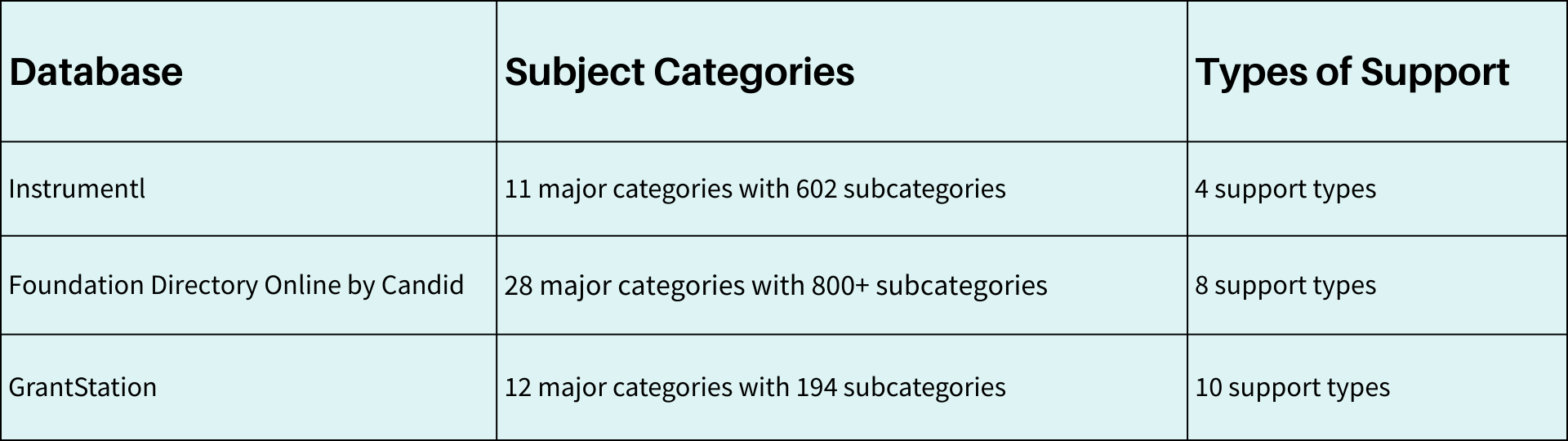
To illustrate these challenges, let's examine my three favorite databases: Instrumentl, Foundation Directory Online by Candid (FDO), and GrantStation. I’ve used all three extensively and seen firsthand how their differences can cause confusion.

Each platform's taxonomy reflects different specializations. Instrumentl's categories are heavily weighted toward community services and sciences, reflecting its unique inclusion of research grants.  FDO's categories allow precise targeting and broader exploration. GrantStation's categories streamline groupings for intuitive navigation.

"Types of support" classifications reveal similar specializations. All three recognize fundamental categories like general operating and capital support, but their granularity differs. For example, Instrumentl’s "education/outreach" is FDO's "policy, advocacy and systems reform," and GrantStation’s "advocacy."

What Makes Each Database Special

·      Instrumentl takes a broader approach to avoid over-filtering opportunities classified differently by funders. It also includes scientific research grants and integrates project management capabilities alongside grant discovery.

·      FDO offers an extensive corporate foundation database, capturing corporate giving programs that often fly under the radar. It also features "regranting" and "participatory grantmaking" as specific support types, increasingly important funding mechanisms.

·      GrantStation includes giving circles as a funder category, Canadian funding opportunities alongside US sources, and events/sponsorships as a support category, valuable for conferences, galas, or community events funding. Their accessible pricing makes comprehensive grant research possible for smaller organizations.

A Call for Common Ground

Database providers have an opportunity to better serve the grant community by working toward greater taxonomic alignment. This doesn't require abandoning unique strengths—the goal is interoperability, not homogenization. In other words, coordination, not conformity. It’s not about being the same, it’s about working in sync.

Academic databases share subject headings, and library systems use common classification schemes. Coordination can enhance rather than diminish individual platform value. A shared taxonomy framework would allow grant professionals to develop transferable search expertise and conduct more comprehensive research without getting lost in terminological translation.

Honoring the Hunt

Grant professionals deserve recognition for the detective work they perform daily. They navigate not just the substance of grants, but the structural inconsistencies that make comprehensive research more challenging than it needs to be.

By acknowledging and addressing taxonomic disconnects, database providers can honor the expertise of grant professionals while making their essential work more efficient. Sometimes the most powerful changes happen not in the spotlight, but in the infrastructure that makes everything else possible.

About the Author

Allison Jones, CEO and Founder of Spark the Fire Grant Writing Classes, LLC, built one of the highest-rated grant writing education programs in the world, recognized for four consecutive years. She holds the Grant Professional Certified (GPC) credential, is one of only 30 nationally approved trainers by the Grant Professionals Certification Institute, and has trained over 5,000 grant writers. Her book Meaningful Work is forthcoming in 2026.

Now I Want to Hear from You

Do you think database providers should collaborate on common taxonomy standards? How would you make the case that this helps the entire grant community?