foundation research

Why 2026 is the Year to Stop Writing Grant Proposals to Every Foundation

 
Grant writer out hiking in contemplation

Have you noticed that more and more foundations are moving to "no unsolicited proposals" policies? You research a foundation that looks like a perfect fit for your organization, only to discover that it only accepts proposals by invitation.

It's not your imagination. The door to foundation funding has been closing slowly for years—and the data proves it. 

In 2011, 60% of foundations didn't accept unsolicited proposals (Smith, 2011). By 2015, that number jumped to 72% (Eisenberg, 2015). According to Candid's most recent research analyzing over 112,000 private foundations, 71% now only fund "pre-selected charitable organizations" (Candid, 2024).

That means only 29% of foundations will even look at your proposal unless they've invited you to apply. But 2026 might be the year that the remaining door slams shut for good—and sloppy AI is the reason.

Foundations are already overwhelmed. With AI making it easier than ever to churn out generic grant proposals, program officers are drowning in poorly-written applications using the outdated spray-and-pray method. According to Candid's 2024 Foundation Giving Forecast Survey, 23% of foundations already won't accept AI-generated proposals, and 67% are still figuring out their policies (Mika, 2024). This was an anonymous survey, which allowed foundations to be more candid about their concerns—most haven't made public statements about AI policies yet, so this data reveals what's happening behind the scenes.

Translation: Those foundations that still accept unsolicited proposals are one bad grant cycle away from going invitation-only permanently.

And if you're still using spray-and-pray—sending generic proposals to every foundation you find—you're not just wasting your time. You're actively contributing to the problem that's closing doors for everyone.


The Spray-And-Pray Era Is Over

You know the drill: Research 50 foundations, send essentially the same proposal to all of them, hope for the best.

Here's the thing—it never really worked. But now? It's actively harmful.

Here's what's happening behind the scenes:

Foundation program officers are receiving more proposals than ever. Many are clearly mass-produced. Some are obviously AI-generated by people who don't understand grant writing fundamentals. The quality is declining while the volume is increasing.

The foundation's response? Close the door. No more unsolicited proposals. Invitation only. By the time you realize that perfect-fit foundation has gone invitation-only, you've already lost your chance.

The Real Problem Isn't AI—It's Inexperience

Let me be clear: The problem isn't AI itself. The problem is using AI to write grant applications when you don't have the experience to know whether AI is doing it right.

 Think about it: If you don't understand what makes a compelling needs statement, how will you know if the AI-generated needs statement is compelling? If you can't identify a good organizational fit for grant funding, how will you evaluate whether AI matched you with the right funders?

Learn grant writing first. Master strategic thinking, understand what makes proposals fundable, and develop your judgment about fit and quality. Then use AI to make your work more efficient. AI can help you write faster, generate first drafts, and organize information—but only if you have the grant writing expertise to direct it and evaluate its output.

How Foundations Spot Sloppy Ai Proposals (Hint: Not Through Detectors)

 You might be wondering: Are foundations using AI detection software to screen out AI-generated proposals? The short answer is no, and they don't need to. AI detectors don't work reliably, producing high rates of false positives and false negatives. They flag human-written content as AI-generated and miss obvious AI content. Even the companies that make these tools acknowledge their limitations. But here's the thing: foundations don't need detection software to spot poorly-written AI proposals. The problems with sloppy AI grant writing are obvious to any experienced grant reviewer, not because they "sound like AI" but because they lack the substance, specificity, and strategic thinking that characterize strong proposals.

Bad AI proposals reveal themselves through lack of substance:

Flowery statements without evidence: "Our innovative, transformative program creates lasting change in the community," → but no data on how many people served, what outcomes were achieved, or what "transformative" actually means

Generic descriptions that could apply to anyone: Any youth development organization could claim the same things, any food bank could use the same language 

Buzzword soup without specifics: Talking about "strategic partnerships" and "collaborative impact" without naming a single partner or describing what the collaboration actually looks like 

Perfect grammar, disconnected logic: Beautiful sentences that don't actually connect to each other or build a coherent argument

Misunderstanding the funder's actual priorities: The AI matched keywords, but the proposal shows the applicant doesn't really understand what the foundation cares about

Overpromising without realistic plans: Grand claims about impact that don't match the organization's budget, staffing, or track record

The tell isn't that it "sounds like AI"—it's that it lacks the authentic details, specific evidence, and strategic understanding that only comes from someone who truly knows both the organization and grant writing.

A proposal written by an experienced grant writer using AI thoughtfully? It still has those specifics, that evidence, that strategic fit assessment. Because the human knows what details matter and how to direct the AI to strengthen (not replace) their expertise.


The Strategic Alternative: Quality Over Quantity

 So if spray-and-pray is dead, what's the alternative? 

Strategic grant writing. And it starts with one critical skill: knowing when NOT to apply.

This might sound counterintuitive. You need funding, so shouldn't you cast the widest net possible? Actually, no. That approach wastes your limited time and contributes to the problem that's shutting down access for everyone. Instead, you need to become ruthlessly strategic about where you invest your grant prospecting effort.

Focus on Low-Hanging Fruit First

Low-hanging fruit doesn't mean "easy grants that everyone wins." It means perfect fit funders—foundations where the alignment between your work and their priorities is so clear that your proposal practically writes itself.

What does a perfect fit look like? Start with mission alignment. The foundation funds exactly the kind of work you do—not tangentially related, not sort of similar, but directly aligned. If you run an environmental education program for youth, you're looking for foundations that specifically fund environmental education for youth, not just "youth programs" or "environmental causes" broadly.

Geographic alignment matters too. You need to be squarely in their funding area. If a foundation focuses on three specific counties and you're in one of them, that's a good fit. If they fund the entire Pacific Northwest and you're in Seattle, you're competing with hundreds of other organizations. Be honest about whether you're in the sweet spot or on the periphery.

Grant size alignment is equally important. If you need $50,000 and a foundation typically gives $5,000 grants, you're not a fit—no matter how perfect the mission match. Look at their grantmaking history using tools like Candid's Foundation Directory. What's their typical range? Do they ever make grants at your level? Don't waste time trying to convince a small family foundation to make their largest grant ever to your organization. 

Finally, look at their history of funding organizations like yours. When you review their past grantees, can you genuinely say "of course—we should be on that list too"? That's what I call the "of course" factor.


Getting to "Of Course"

The "of course" factor is that moment when a grant reviewer reads your proposal and thinks "of course that makes sense" and "of course we want to fund that." You've achieved a strategic fit so clear that funding feels obvious. 

Getting to "of course" requires deep research. You need to understand what the foundation values, not just what they say they fund. Read their annual reports. Study the organizations they support. Look for patterns in who gets funding and why. What do their grantees have in common? What kinds of projects do they prioritize—pilot programs or proven models? Direct service or capacity building? Local grassroots organizations or regional powerhouses?

When you can see yourself clearly in that pattern of funding, you've found low-hanging fruit. These are the opportunities where you should spend 80% of your grant writing time. Perfect the proposal. Build the relationship. Demonstrate the fit. These are your highest probability opportunities, and they deserve your best effort.

Long-Shots Can Work—But Only With Strategy

I'm not saying you should never pursue a foundation that's a less obvious fit. Long shots aren't impossible. But they require a fundamentally different approach than spray-and-pray.

A legitimate long-shot means you've identified a genuine strategic connection that might not be obvious at first glance, and you're willing to invest significant time proving it. Maybe the foundation primarily funds healthcare, but they've shown interest in addressing social determinants of health, and your housing stability program directly impacts health outcomes. That's a strategic long-shot—there's a real connection, but you need to make the case.

What makes a long shot worth pursuing? You need a clear, compelling angle for how your work fits their mission, even if your project doesn't look exactly like what they typically fund. You need to be willing to build the relationship first—attending their events, engaging with their published research, and making personal connections with staff or board members. And you need to go all-in on the application itself. Don't submit a recycled proposal with minor tweaks and hope for the best. If you're going after a long shot, treat it like the long shot it is: invest the time to craft a proposal that explicitly makes the strategic connection clear.

Don't apply to long-shots as a numbers game, hoping that if you submit to enough "maybes," a few will pay off. That's just spray-and-pray with better targeting. Apply to long-shots only when you've done the strategic thinking, and you're prepared to do the work.


The Middle Ground: Be Selective

Then there are mid-range opportunities—foundations where you have good but not perfect alignment. Maybe your geographic area overlaps with theirs, but it isn't their primary focus. Maybe your mission connects to theirs tangentially. Maybe they fund your issue area, but usually support larger organizations.

 These require judgment. Some are worth pursuing. Many aren't. The question to ask yourself: Can you genuinely demonstrate fit, or are you just checking boxes? If you're writing a proposal, thinking "well, we kind of fit because..." stop. That's not strategic. That's spray-and-pray disguised as research.

Be selective. Choose the opportunities where you can make a clear, honest case for why you belong in their funding portfolio. Skip the rest.


The Hidden Costs Of Spray-And-Pray

Beyond wasting your time, the spray-and-pray approach to grant writing has real consequences:

Reputational damage: Foundations talk to each other. Submit poorly-matched proposals consistently, and you develop a reputation as someone who doesn't do their homework. In the tight-knit world of philanthropy, that reputation follows you.

Opportunity cost: Every hour spent on a bad-fit proposal is an hour not spent on a good-fit opportunity. If you can write 5 excellent, strategic proposals or 20 mediocre, generic ones, which will raise more money? The data from the Grant Professionals Association shows that grant professionals are already being more selective—writing a median of 19-20 proposals per year, not 50 or 100 (Grant Professionals Association, 2023). Quality matters more than quantity.

Contributing to the problem: Every generic, poorly-matched proposal that lands in a program officer's inbox makes them more likely to close the door to unsolicited applications entirely. You're not just hurting your own chances—you're making it harder for every nonprofit organization.

Diminishing access for everyone: When foundations go invitation-only because they're overwhelmed with poor applications, you've just made it harder for every nonprofit—including yours—to access foundation funding in the future. This particularly impacts smaller organizations and those serving marginalized communities who have fewer insider connections.

What This Means For 2026

The data is clear: Foundations have been moving toward invitation-only policies for over a decade. AI hasn't created this trend—but sloppy use of AI is accelerating it.

In 2026, the strategic grant writers will thrive.

They'll focus on fit, build relationships, and demonstrate an authentic understanding of both their organizations and their funders. They'll use AI as a tool to enhance their expertise, not replace it. They'll invest in professional grant writing training to develop the judgment needed to evaluate quality.

The spray-and-pray crowd will find fewer and fewer doors open.

Which side of that divide do you want to be on?


What You Can Do Right Now

1. Audit your current prospect list. Remove any foundation where you can't clearly articulate why you're a strong fit. If you're using a prospect tracking spreadsheet, add a "fit score" column and be honest about each opportunity.

2. Research thoroughly before applying. Look at 3-5 years of past grantees using resources like Instrumentl, Candid, or foundation 990-PF forms. Can you genuinely say, "Of course, we belong on this list"? If not, move on.

3. Invest in learning. If you're using AI to write proposals, make sure you have the grant writing expertise to evaluate and improve what AI produces. Consider professional certification in grant writing to build that foundation.

4. Build relationships. Don't let your first contact with a foundation be a proposal. Attend their events, engage with their content, and make connections. Relationship-based fundraising still works—even in an AI era.

5. Track your success rates by fit level. Are your "perfect fit" applications succeeding? If not, the problem isn't fit—it's proposal quality. Get help with grant writing training or hire an experienced consultant.


Frequently Asked Questions

Q: How can I tell if a foundation is a good fit for my organization?

A: Look at four key alignment factors: mission (do they fund exactly what you do?), geography (are you squarely in their funding area?), grant size (do they give grants at your level?), and grantee history (when you look at who they fund, do you belong on that list?). If you can't clearly articulate why you fit in all four areas, it's probably not worth applying.

Q: Should I never use AI for grant writing?

A: AI can be a powerful tool for experienced grant writers—it can help generate first drafts, organize information, and improve efficiency. The problem is using AI when you don't have the expertise to evaluate whether its output is good. Learn grant writing fundamentals first, then use AI to enhance your work.

Q: What if all the foundations in my area don't accept unsolicited proposals?

A: This is increasingly common. Your strategy shifts from "submit proposals" to "build relationships." Research foundations that align with your work, identify connections (board members, staff, funded organizations you know), and start relationship-building. Attend their events, engage with their content, and ask for informational conversations. The goal is to get invited to apply.

Q: How many grant proposals should I be submitting per year?

A: According to Grant Professionals Association data, grant professionals write a median of 19-20 proposals per year. Quality matters far more than quantity. It's better to submit 10 highly strategic, well-researched proposals than 50 generic ones.

Q: How do I know if my proposal is too generic?

A: Ask yourself: Could another organization in your field submit this exact same proposal by just changing the name? If yes, it's too generic. Strong proposals include specific data about your organization, concrete examples of your work, and clear evidence of why you're the right organization for this funder at this time.

Q: What's the difference between a strategic long-shot and spray-and-pray?

A: A strategic long-shot means you've identified a genuine connection between your work and the funder's priorities (even if it's not obvious), and you're willing to invest significant time building the relationship and crafting a targeted proposal. Spray-and-pray means sending essentially the same proposal to many funders, hoping something sticks, without strategic thinking about fit.


The Bottom Line

The landscape of foundation fundraising is changing. The doors are closing—not because foundations don't want to fund good work, but because they're overwhelmed with poor applications from organizations that haven't done the strategic thinking.

Strategic grant writing isn't just about writing better proposals. It's about making better decisions about where to invest your limited time. It's about knowing when to walk away from a poor-fit opportunity. It's about building relationships and demonstrating a genuine understanding of what funders care about.

If you're serious about foundation funding in 2026 and beyond, it's time to stop throwing applications at every foundation you find and start being strategic about fit.

The foundations that remain open to unsolicited proposals are looking for thoughtful, strategic applications from people who've done their homework.

Give them what they're looking for—and stop contributing to the problem that's closing doors for everyone.

Now I want to hear from you: Have you noticed foundations in your area closing to unsolicited proposals? Are you seeing AI-generated proposals flood your field? And honestly, where do you fall on the spray-and-pray to strategic spectrum? Share your experience in the comments.

References

Candid. (2024). How often do foundations accept unsolicited requests for funds? https://candid.org/blogs/do-foundations-accept-unsolicited-requests-for-funds-from-nonprofits/

Eisenberg, P. (2015, October 20). Let's require all big foundations to let more nonprofits apply for grants. Chronicle of Philanthropy.

Grant Professionals Association. (2023). 2023 GPA compensation and benefits survey. https://grantprofessionals.org/page/salarysurvey

Mika, G. (2024, December 5). Where do foundations stand on AI-generated grant proposals? Candid Insights. https://blog.candid.org/post/funders-insights-on-ai-generated-grant-application-proposals/

Smith, B. K. (2011). [Foundation Center research on unsolicited proposals]. Referenced in Nonprofit Quarterly. (2017, February 24). Scaling the wall: Getting your grant proposal heard. https://nonprofitquarterly.org/scaling-the-wall-getting-your-grant-proposal-heard/


Unsolicited Proposals: What Foundation Grant Statistics Really Mean


Quick Takeaway

Candid reports that only 23% of foundations accept unsolicited proposals, but this statistic is based on checkboxes foundations mark on tax forms—often for administrative convenience rather than actual practice. Additionally, when foundations report low acceptance rates (like 10%), that includes the 80-90% of applications that are immediately rejected for being poorly written or misaligned. For well-prepared, mission-aligned nonprofits, your actual odds are much higher than the statistics suggest. Focus on relationships, not percentages.

Imagine This: The Dating Profile Analogy

You're scrolling through dating profiles and see someone who's marked themselves as "single" and "open to meeting people." Does that mean you should show up at their house unannounced with flowers?

Of course not. "Open to meeting people" might mean:

  • "Message me first so we can chat before meeting" (letter of interest required)

  • "I only go on dates during summer when work calms down" (specific application windows)

  • "I prefer meeting through mutual friends" (invitation-only grantmaking)

That's exactly what it's like when Candid reports that only 23% of foundations "accept unsolicited proposals."

What Candid's Data Says—and What It Doesn't

The Statistic: Candid's recent report notes that roughly 23% of foundations accept unsolicited proposals.

What People Think It Means: Only one in four funders are open to new applicants.

What It Actually Means: Only 23% of foundations have documented their detailed grantmaking procedures on a public tax form. The other 77% may still consider applications—they just didn't want to provide all the details on their IRS Form 990-PF.

As Candid itself points out, the data is easily misunderstood. The statistic doesn't mean that 77% of funders are off limits—it means that many prefer a relationship first, invite proposals through specific channels, or simply didn't complete the detailed disclosure section of their tax form.

What "Unsolicited" Actually Means on the IRS Form—and Why the Data May Be Unreliable

Here's where it gets complicated: foundations check a box on their IRS Form 990-PF that asks, "Do you accept unsolicited requests for funds?"

But this is a compliance question on a tax form, and the answer may have more to do with paperwork than actual practice.

The Tax Form Shortcut

The IRS requires Form 990-PF to ensure transparency and accountability of private foundations. This transparency helps donors, beneficiaries, and other stakeholders assess how the foundation operates and manages its resources. In Part XV of the form, foundations must disclose their grantmaking procedures to help potential grant applicants understand how to approach them.

Here's the catch: If a foundation checks the box saying they "only make contributions to preselected charitable organizations and do not accept unsolicited requests for funds," they're done. They can skip the rest of the section.

But if they leave that box unchecked, they must provide detailed information:

  • The name, address, and contact information of the person handling applications

  • The required form and materials applicants should submit

  • Submission procedures and deadlines

  • All restrictions and limitations on awards (geographic areas, funding priorities, organization types, etc.)

Why Foundations Might Check the "No Unsolicited Requests" Box

That's a lot of work on an already lengthy tax form. Foundations might check that box not because they refuse to consider new organizations, but because:

  • They have informal or evolving processes that are hard to document

  • They're a small operation without dedicated grant management staff

  • They change priorities year to year and don't want to commit to specific procedures publicly

  • They want flexibility to fund opportunistically

  • It's simply easier than completing several detailed fields

...checking that box and skipping the detailed disclosures is the path of least resistance.

The result? Many foundations may check "no unsolicited requests" not because they refuse to consider new organizations, but because explaining their actual process is more administrative burden than they want to take on. Some might:

  • Accept applications but only during certain windows (which change)

  • Prefer a letter of inquiry first (but not always)

  • Want to maintain flexibility in how they find grantees

  • Simply not want to commit their informal process to a public IRS document

This means the 23% statistic may be less about actual accessibility and more about which foundations are willing to document detailed procedures on a tax form.

It's like checking "prefer not to say" on a survey—not because you're hiding something, but because explaining is more work than skipping.

Why Award Percentages Are Equally Misleading

Some grant writing experts advise nonprofits to call foundations and ask, "What percentage of applications do you award?" The theory is that you shouldn't apply unless the acceptance rate meets a certain threshold.

This advice sounds logical, but it's fundamentally flawed—and here's why.

Most Applications Are Immediately Rejected for Basic Reasons

The acceptance percentage includes terrible applications. Research on grant proposals reveals a sobering truth: at the W.K. Kellogg Foundation, 80% of grant applications are immediately rejected because applicants didn't do their homework about the foundation's specific priorities. One foundation manager reported that 90% of the proposals they receive are badly organized and don't communicate well.

Think about what this means. If a foundation reports a 10% acceptance rate, that statistic includes:

  • Applications that don't match the funder's priorities at all

  • Proposals with poor writing and mechanical errors

  • Submissions that don't follow basic guidelines

  • Requests from organizations that aren't even eligible

Popular foundations get flooded with applications—most of them poor. Well-known foundations like Gates, Ford, or Kellogg receive thousands of applications. A significant portion come from organizations that haven't done basic research, don't fit the funding priorities, or submit substandard proposals. These low-quality applications drag down the overall acceptance rate, making the foundation appear more selective than it actually is for qualified applicants.

The Question You Should Actually Ask

The question you really want answered is different. What you actually need to know is: "What percentage of well-written, mission-aligned applications from strong organizations get funded?" That's a very different number—and one that foundations can't easily provide.

As Candid itself notes in its analysis: "How many grant proposals submitted by well-run, well-governed nonprofits that perform a valuable service with effective programs actually get funded? Our guess: most of them."

Why Relationships Matter More Than Statistics

The overall acceptance rate statistics are misleading because they don't account for relationship quality or application strength. Here's what the numbers actually mean for your organization:

Three Reasons Why Relationships Matter More Than Statistics:

1.     Overall statistic: Foundation funds only 5% of all applications Your reality: With an established relationship and board connection, your odds improve to approximately 50%—ten times better than the posted rate.

2.     Overall statistic: Foundation reports 25% acceptance rate Your reality: This number includes everyone. Cold applications from unknown organizations have nearly 0% success, while known partners have significantly higher odds.

3.     Overall statistic: 80% of applications rejected immediately for poor quality Your reality: Most rejections are for poor quality or misalignment. A well-researched, perfectly aligned proposal from a strong organization competes in an entirely different pool with much better odds.

The acceptance percentage tells you almost nothing about your chances—because your chances depend on the quality of your proposal, the strength of your relationship, and the alignment of your mission with their priorities.

Reframing the Statistic

Instead of reading, "Only 23% of foundations accept proposals," interpret it as:

"23% of foundations have publicly documented their detailed grantmaking procedures on a tax form—but that doesn't mean the other 77% won't consider your application."

Many of those 77% might be open to proposals—they just didn't want to spell out all the details on their 990-PF.


The Grant Writer's Secret Advantage: How to Read Between the Lines

Strong grant writers know that numbers don't determine access—relationships do.

6 Strategies That Work Better Than Statistics

1. Look beyond the form. Even if a funder "doesn't accept unsolicited proposals," a thoughtful email, board connection, or participation in their initiatives can open doors.

2. Track actual funder behavior. Use tools like Instrumentl or Foundation Directory Online to see:

  • Who they've funded in the past 2-3 years

  • Geographic giving patterns

  • Average grant sizes

  • Program areas that receive the most funding

3. Build trust before you ask.

  • Attend foundation-hosted webinars

  • Comment thoughtfully on their impact reports

  • Share success stories that align with their mission

  • Connect on LinkedIn (appropriately)

4. Time it right.

  • Respect application deadlines

  • Lead with letters of inquiry if preferred

  • Apply during their active funding cycles

5. Do your homework. The vast majority of rejected applications fail not because they're bad programs, but because applicants didn't dig deep enough into the funder's specific priorities and initiatives.

6. Don't be afraid to have a conversation. Sometimes guidelines seem to disqualify you—but a phone call can reveal unexpected opportunities.

Real-World Grant Writing Example: When Guidelines Don't Tell the Whole Story

The Boeing Foundation changed its funding priorities one year, shifting from providing direct grants to early learning nonprofits to funding only early learning coalitions—regional networks of providers working together.

At first glance, this seemed to disqualify my client, a small early learning provider on an island of just 10,000 people. They weren't a coalition, and they certainly weren't a region. By the letter of the guidelines, they appeared ineligible.

But my client had already been collaborating informally with other early learning providers on the island, identifying gaps in services and working to better serve their community. We had the collaborative spirit Boeing was looking for—we just didn't fit the geographic definition of a "region."

Instead of simply not applying based on the guidelines, I picked up the phone and called the program officer. I explained our situation: we were an island with no access to the mainland except by ferry. In essence, we were a region unto ourselves, with our own unique needs and challenges. We were already doing the collaborative work Boeing wanted to support—just on a smaller geographic scale.

The program officer understood. Not only were we invited to apply, but we also received a substantial grant.

The lesson: relevance and relationships outweigh statistics every time.

Frequently Asked Questions About Foundation Grants and Unsolicited Proposals

Should I apply to a foundation that doesn't accept unsolicited proposals?

Not directly—but don't write them off entirely. First, try submitting a brief letter of inquiry asking if you may apply. Request a conversation with a program officer to discuss your project and their current priorities. Seek an introduction through a board member or mutual contact. Attend their public events or webinars to begin building a relationship. Many foundations marked as "invitation only" will invite you to apply after these preliminary steps demonstrate your alignment with their mission.

Should I avoid foundations with low acceptance rates?

No. Low acceptance rates—like 5% or 10%—are misleading because they include the 80-90% of applications that are immediately rejected for poor quality, misalignment, or not following basic guidelines. If your organization is well-run, your proposal is excellent, and your mission aligns perfectly with their priorities, you're not competing against all those applications—you're competing in a much smaller pool of serious contenders. A foundation that funds "only 5% of applications" might actually fund 40-50% of well-prepared, mission-aligned proposals. Focus on fit and quality, not overall statistics.

How do I know if a foundation is really open to new applicants?

Look beyond the checkbox on their 990-PF and examine their actual behavior. Do you see any new organizations in their recent grants list—organizations they've never funded before? Are they funding in your geographic area? Do they fund organizations your size? Does their website information contradict or clarify the 990-PF data? When in doubt, call and ask directly about their openness to new applicants in your program area.

What percentage of grant applications actually get funded?

This varies widely by foundation, but overall statistics are misleading. While many foundations fund only 10-20% of applications, 80-90% of applications are immediately rejected for poor quality, misalignment, or failure to follow guidelines. For well-prepared, mission-aligned organizations, the real success rate is much higher. You're not competing against all applications—you're competing against the small subset that cleared basic quality hurdles.

How can I increase my chances of getting a grant?

Focus on perfect alignment—only apply when your mission clearly matches their priorities. Do deep research beyond the guidelines to understand their recent funding patterns. Build relationships with the foundation before applying. Submit a letter of inquiry first to test the waters. Follow every instruction exactly. Write clearly and compellingly. Demonstrate strong impact with solid outcomes data. These strategies matter far more than acceptance rate statistics.

Can I contact a foundation before submitting an application?

Yes, and in most cases this is encouraged! Appropriate pre-application contact includes calling to verify your eligibility and fit, asking clarifying questions about guidelines, requesting feedback on a preliminary idea, and submitting a letter of inquiry. What to avoid: don't ask them to read your draft proposal, don't be pushy or demanding of their time, and don't ignore stated preferences (if they say "no phone calls," respect that).

How long does it take to build a relationship with a foundation?

Building a meaningful relationship typically takes a minimum of six to twelve months for initial recognition and trust, one to two years for a strong relationship that improves funding odds, and three or more years for deep partnership and multi-year funding. You can accelerate relationship building by attending their events, sharing relevant success stories without asking for anything, demonstrating mission alignment through your work, and making connections through board members or current grantees.

Key Takeaways: What Grant Writers Need to Know

Your Action Plan

✓ Research funders based on their actual giving patterns, not their 990-PF checkboxes
✓ Start with a letter of inquiry or phone call—even to "invitation only" foundations
✓ Build relationships over time through authentic engagement
✓ Only apply where there's strong mission alignment
✓ Make your proposal exceptional—eliminate yourself from the 80% who get immediately rejected
✓ Be patient and strategic, not desperate and scattered

The Bottom Line

Candid's data isn't wrong—but the way it's collected and read often is. The 23% statistic is based on checkboxes on tax forms, where foundations may be choosing the easiest path rather than accurately describing their practices. Numbers can inform your strategy, but they shouldn't define it. Behind every statistic is a story of people, values, and alignment.

The "23% accept unsolicited proposals" figure is like someone checking "single" on a form. It's technically accurate, but it doesn't tell you how to actually connect with them—and it might not even reflect their real openness to meeting new people.

Don't let acceptance percentages scare you away from strong prospects. A 10% overall acceptance rate means very little if your organization is well-run, your proposal is excellent, and your mission aligns perfectly with their priorities. You're not competing against all applicants—you're competing against the small subset of qualified, well-prepared organizations.

And sometimes, you're not competing at all—you're having a conversation that opens a door you didn't even know existed.

Grant writing isn't about chasing odds—it's about building trust, one relationship at a time.

This post responds to insights from Candid's recent analysis: Do foundations accept unsolicited requests for funds from nonprofits?


The Taxonomy Tangle: Why Grant Database Categories Need Better Alignment

 
Smiling grant writer outdoors with tangled hair blowing in the wind, representing the taxonomy tangle of grant database categories

Fair warning: we're about to dive into something decidedly nerdy. But if you're a grant professional who has used multiple grant research databases and felt confused about the terminology differences, this matters more than you might think.

What's Taxonomy Got to Do With It?

In grant research databases, taxonomy is the classification system used to categorize funding opportunities. Think of it as the organizational framework that determines whether a grant for "community health education" gets filed under "health," "education," or "community development." A well-designed taxonomy acts as your search compass, helping you navigate efficiently toward relevant opportunities.

When database providers use different terminology and categorization schemes, grant professionals need to adjust their approach for each platform. What should be intuitive navigation becomes a translation exercise—like needing different lightbulbs for different lamps.  Each database illuminates the grant landscape, but you need to understand which "bulb" fits which "fixture" to get the best results.

The Great Divide: How Three Major Databases Categorize the Same World

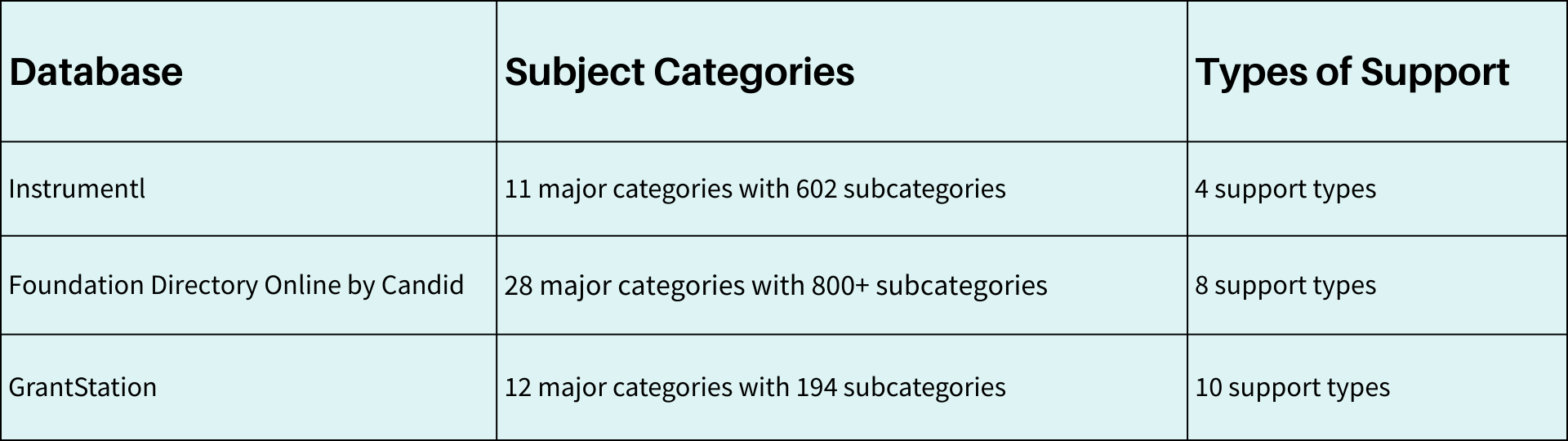
To illustrate these challenges, let's examine my three favorite databases: Instrumentl, Foundation Directory Online by Candid (FDO), and GrantStation. I’ve used all three extensively and seen firsthand how their differences can cause confusion.

Each platform's taxonomy reflects different specializations. Instrumentl's categories are heavily weighted toward community services and sciences, reflecting its unique inclusion of research grants.  FDO's categories allow precise targeting and broader exploration. GrantStation's categories streamline groupings for intuitive navigation.

"Types of support" classifications reveal similar specializations. All three recognize fundamental categories like general operating and capital support, but their granularity differs. For example, Instrumentl’s "education/outreach" is FDO's "policy, advocacy and systems reform," and GrantStation’s "advocacy."

What Makes Each Database Special

·      Instrumentl takes a broader approach to avoid over-filtering opportunities classified differently by funders. It also includes scientific research grants and integrates project management capabilities alongside grant discovery.

·      FDO offers an extensive corporate foundation database, capturing corporate giving programs that often fly under the radar. It also features "regranting" and "participatory grantmaking" as specific support types, increasingly important funding mechanisms.

·      GrantStation includes giving circles as a funder category, Canadian funding opportunities alongside US sources, and events/sponsorships as a support category, valuable for conferences, galas, or community events funding. Their accessible pricing makes comprehensive grant research possible for smaller organizations.

A Call for Common Ground

Database providers have an opportunity to better serve the grant community by working toward greater taxonomic alignment. This doesn't require abandoning unique strengths—the goal is interoperability, not homogenization. In other words, coordination, not conformity. It’s not about being the same, it’s about working in sync.

Academic databases share subject headings, and library systems use common classification schemes. Coordination can enhance rather than diminish individual platform value. A shared taxonomy framework would allow grant professionals to develop transferable search expertise and conduct more comprehensive research without getting lost in terminological translation.

Honoring the Hunt

Grant professionals deserve recognition for the detective work they perform daily. They navigate not just the substance of grants, but the structural inconsistencies that make comprehensive research more challenging than it needs to be.

By acknowledging and addressing taxonomic disconnects, database providers can honor the expertise of grant professionals while making their essential work more efficient. Sometimes the most powerful changes happen not in the spotlight, but in the infrastructure that makes everything else possible.

Do you think database providers should collaborate on common taxonomy standards? How would you make the case that this helps the entire grant community?