How Grant Consultants Give Honest Feedback That Clients Actually Use

Here is the uncomfortable truth about consulting: the moment you see a client's problem clearly is the moment your job gets harder. You can see the website that undercuts their credibility, the outreach that misses half their community, the budget that doesn't add up. Saying so is the work. Softening it into oblivion is not kindness, it is avoidance wearing kindness as a costume.
Constructive criticism is the job, not a risk to the job. The question is never whether to tell a client the truth. It is how to deliver it so they can actually hear it and act on it, especially when you are working with founders and leaders who are deeply attached to what they have built. This is not about softening the truth. It is about changing how you deliver it so it lands.
Table of Contents
Two common scenarios consultants face
Imagine this. You're working with a founder who started an organization after the tragic death of their child. In the early years, that story was central to the mission, and it remains deeply personal for the founder. But now, a decade later, the organization has grown and is making a significant impact, an impact no longer directly tied to that original story. The organizational description, however, still leans heavily on the founder's personal tragedy. You can see the disconnect right away: funders want to understand the organization's current reach and measurable results, not just its origin story. But how do you say that without diminishing the founder's grief, or the powerful legacy they've built?
Or here's another. An organization calls you for help, and you go to their website to learn more. Immediately you notice that the homepage is all about how to donate, but there's almost nothing about what the organization actually does. You know funders will be frustrated by this lack of clarity, but telling the organization flat-out could raise their defenses rather than helping them move toward a clearer picture of their value.
Two frameworks help here: motivational interviewing and appreciative inquiry. Both help clients discover their own insights, which makes feedback feel like a partnership instead of judgment. They also position you as an ally and thought-partner, which is critical in the early weeks of a consulting relationship. Establishing yourself this way signals that you're not there to take orders or nod along. You're there to bring expertise, perspective, and candor in service of the organization's growth. You want to show up as a consultant and thought leader, not as a yes-person.
A note before we go further, because it matters. These frameworks are tools for making honest feedback land, not for avoiding it. If you use them to dodge the hard message, you've missed the point. The goal is a client who hears the truth and owns the fix, not a client you left comfortable and uninformed.
Why feedback feels so hard in grant consulting
Most of us have been there. A new client is excited about funding opportunities, but within minutes you notice red flags: an unclear mission, no evaluation plan, or communication channels that exclude whole populations. You know these issues will block them from winning grants, but blurting that out can backfire.
The tension is real:
Clients are proud of their organizations.
Funders expect professionalism and readiness.
Consultants are caught in the middle.
That's why techniques built on curiosity, reflection, and respect are so valuable. They don't replace honesty; they carry it. Instead of criticizing, we invite clients to think differently about grant readiness and how they communicate with funders, and then we name what we see clearly.
Motivational interviewing: moving through ambivalence
Motivational interviewing was developed in the 1980s by psychologists William R. Miller and Stephen Rollnick, initially as a counseling approach for addiction treatment. Since then, it has been widely adapted for health, education, leadership, and coaching, anywhere people face resistance to change.
It has also made its way onto the business and leadership shelves. Miller and Rollnick's Motivational Interviewing: Helping People Change (affiliate link) lays the foundation. Other leadership-oriented works, like John Whitmore's Coaching for Performance (affiliate link) and Michael Bungay Stanier's The Coaching Habit (affiliate link), echo its emphasis on open-ended questions and drawing out solutions rather than prescribing them.
In leadership contexts, motivational interviewing helps executives navigate resistance to change, build teams' intrinsic motivation, and align personal values with organizational goals. For grant consultants, the lesson is clear: we can borrow from these proven practices. Instead of telling clients what's wrong, we invite them to reflect on what they want funders to see, how their current systems measure up, and what changes they're willing to make. Then we fill in what they don't see on their own.
Core principles of motivational interviewing
Motivational interviewing rests on four core principles that translate well into consulting. At its heart, it is about expressing empathy, listening without judgment so clients feel heard rather than corrected. It emphasizes developing discrepancy, or what I like to call dissonance, gently helping people see the gap between where they are and where they want to be. Rather than confronting resistance, it encourages us to roll with it, treating pushback as a signal to explore further rather than to argue. Finally, it underscores supporting self-efficacy, reinforcing the client's belief that they are capable of making meaningful changes.
The OARS technique
One of the most practical ways to put these principles into action is the OARS technique:
Open-ended questions
Affirmations
Reflective listening
Summaries
Motivational interviewing example in practice
These principles come to life in everyday consultant communication. The key is shifting from statements that tell clients what's wrong to questions that invite them to reflect on what they want and how well their current systems align with those goals.
Instead of saying:
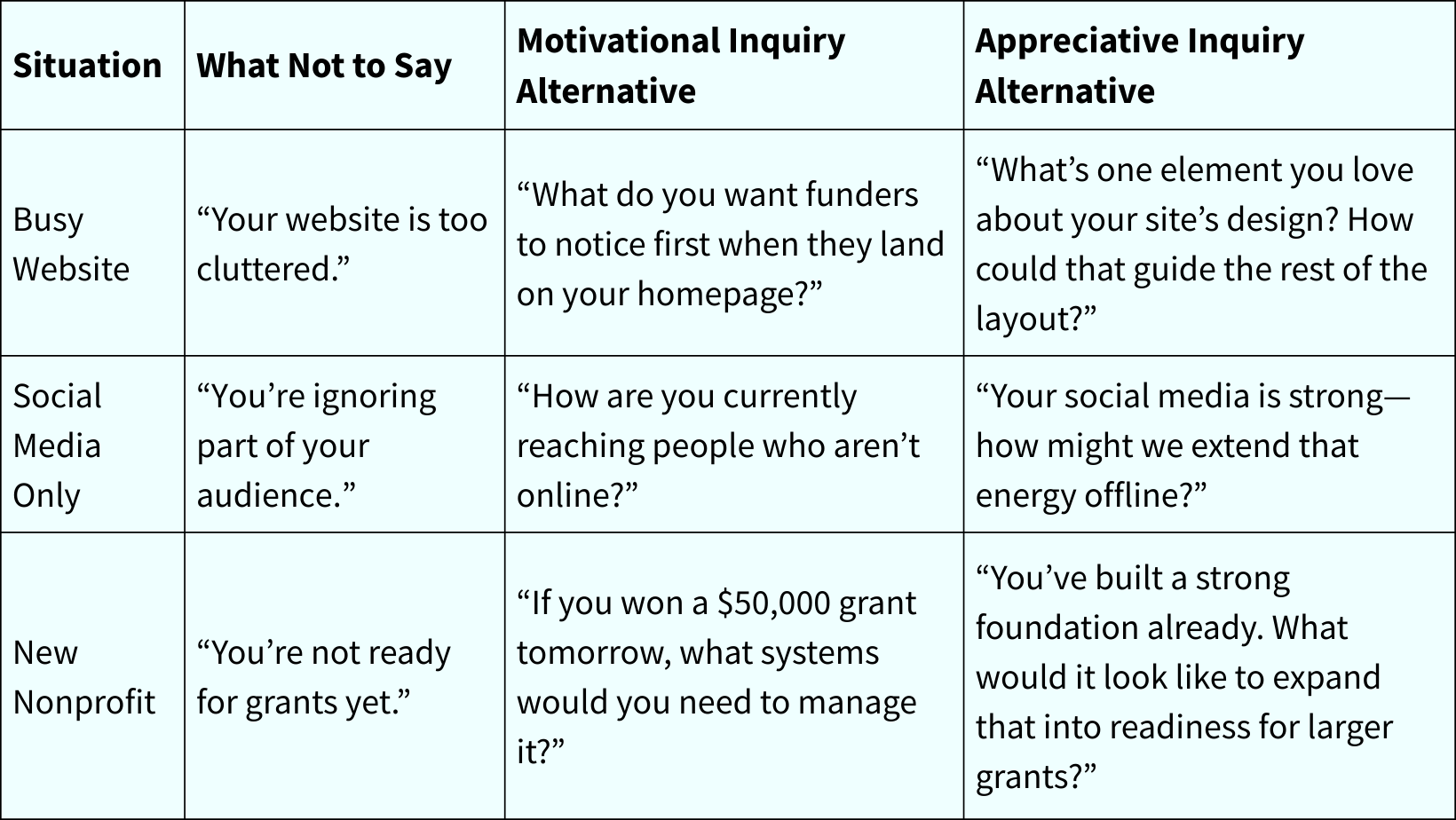
"Your website is too cluttered for funders."
You might ask:
"When a funder visits your site, what do you most want them to notice first? How well do you think your current design supports that?"
This gentle reframing helps the client articulate the problem themselves, and people are much more likely to act on their own insights. Note what this is not: it is not a way to avoid telling them the site has a problem. It is a way to get them to see it with you, so the fix is theirs.
Appreciative inquiry: building on strengths
Appreciative inquiry was created in the mid-1980s by organizational scholars David Cooperrider and Suresh Srivastva at Case Western Reserve University. It emerged as an alternative to traditional problem-solving models of organizational development, focusing instead on amplifying what works.
Over time, it has shaped organizational change and leadership. Cooperrider's Appreciative Inquiry: A Positive Revolution in Change (affiliate link) helped popularize the method, and Diana Whitney and Amanda Trosten-Bloom's The Power of Appreciative Inquiry (affiliate link) has become a go-to resource for leaders and consultants building strengths-based cultures.
In practice, appreciative inquiry is used in:
Strategic planning, guiding teams to dream big and design based on strengths.
Leadership development, helping leaders focus on what brings life to their organizations.
Culture change, shifting from deficit-based conversations ("what's wrong here?") to generative ones ("what gives this team energy?").
For grant consultants, the lesson is that we can frame feedback in ways that celebrate and extend existing strengths. By spotlighting what's already effective, we help organizations build confidence while inspiring practical improvements.
The 5-D cycle of appreciative inquiry
Appreciative inquiry is often practiced through the 5-D Cycle, which guides organizations from reflection to action. It begins with Define, clarifying the focus of inquiry and setting the stage for what the group wants to explore. From there, the Discover phase invites participants to share stories and insights about what already works well. Building on those strengths, the Dream phase encourages people to imagine what could be possible if the organization were at its best. Next comes Design, where the group shapes practical strategies and structures to bring that vision to life. Finally, the Destiny (or Deliver) phase focuses on sustaining momentum and embedding the changes into daily practice.
Appreciative inquiry example in practice
Imagine working with a board that feels discouraged after several declined grant applications. Using the 5-D Cycle, you might start by helping them define the focus, perhaps strengthening their overall grant readiness. In the discover phase, you'd ask them to recall a time when their organization successfully built a strong partnership or secured funding, and explore what made that work. In the dream phase, you'd invite them to imagine what it would look like if every funder relationship felt that strong. Moving into design, the group could brainstorm concrete practices, such as clearer impact reporting or stronger community engagement, that would move them closer to that vision. Finally, in the destiny phase, you'd help them commit to small, sustainable steps to carry the momentum forward.
Instead of saying:
"You're missing a lot of your audience by only using social media."
You could say:
"Your social media presence is vibrant and engaging. How could we build on that same strength to reach people who aren't online?"
Appreciative inquiry reframes the conversation as an opportunity rather than a deficiency.
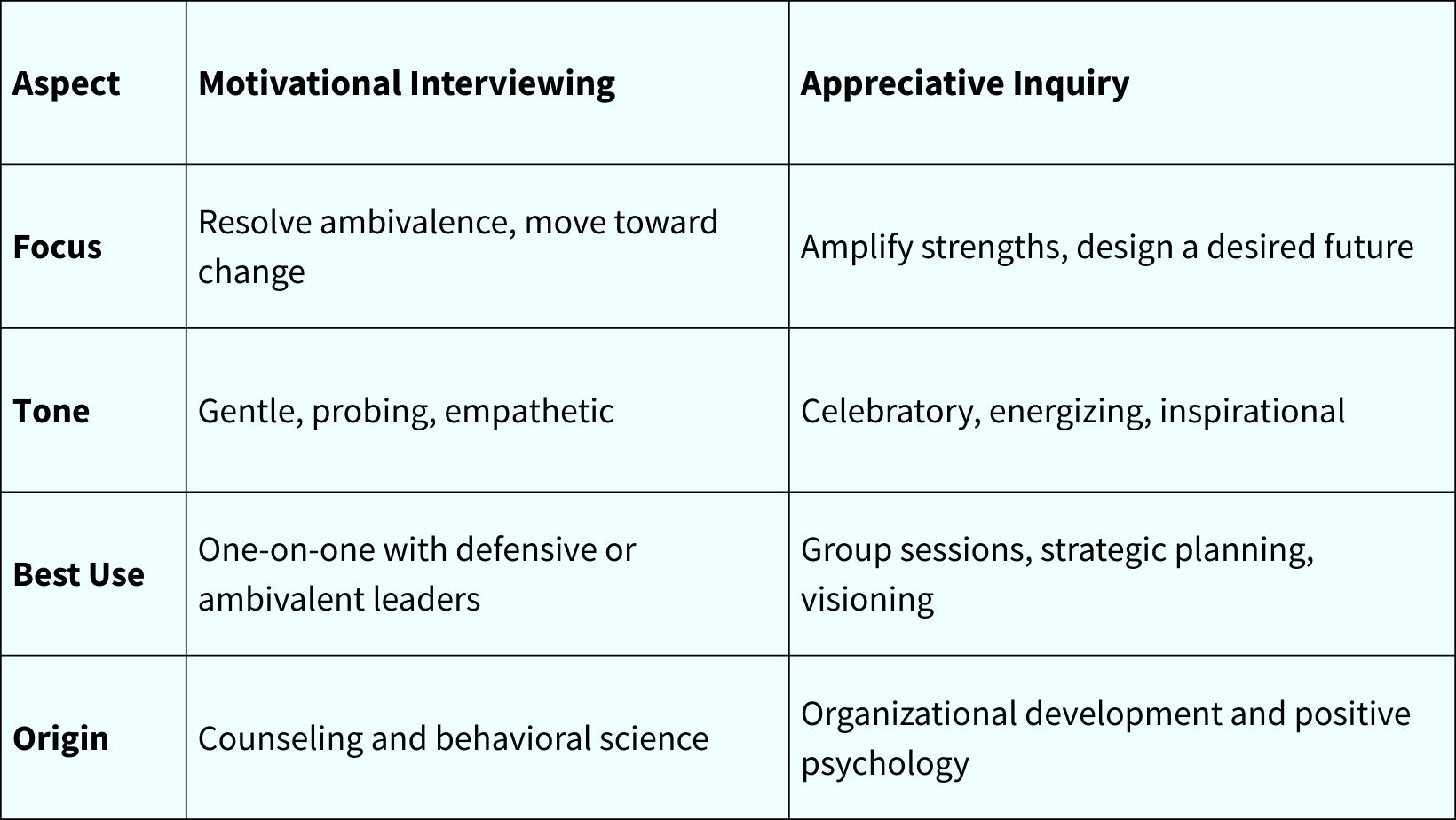
Motivational interviewing vs. appreciative inquiry
Both approaches rely on open-ended questions, strong consultant communication skills, and respect for clients. They shine in different settings.
From criticism to curiosity: practical examples
Here’s how feedback can shift when reframed through motivational interviewing or appreciative inquiry:
Case story: the new organization
A consultant I worked with recently faced a dilemma. Her client, an organization less than a year old, wanted her to write major grant proposals. Her instinct was to say, "You're not ready."
Instead, she asked:
"If a funder awarded you $50,000 tomorrow, how would you track the money, report outcomes, and share results with your board?"
The board realized immediately that they lacked systems for accounting, data collection, and evaluation. The conversation ended not with defensiveness but with a shared commitment to building infrastructure first. That's the power of asking the right question, and notice that the honest message, "you're not ready yet," still got delivered. It just arrived in a form they could accept.
Case story: the donation-heavy website
Earlier we considered an organization whose homepage was dominated by donation appeals but offered little explanation of its programs. One consultant I know faced this exact situation.
Rather than bluntly saying, "Funders won't understand what you do," she asked:
"If a grantmaker landed here today, what would they learn about your mission and results?"
That simple question flipped the conversation. The organization quickly saw the issue themselves and shifted to presenting a clearer picture of their impact.
Consultant takeaways
Clear is kind. Avoiding feedback helps no one. Being vague or withholding tough observations only delays growth. Clients appreciate honesty when it's delivered with care and respect.
Choose your approach. Use motivational interviewing when resistance is high, and appreciative inquiry when momentum is needed. Motivational interviewing helps navigate defensiveness in one-on-one settings, while appreciative inquiry energizes teams when it's time to envision a stronger future.
Keep clients in the driver's seat. Insight sticks when it's theirs. Change is most sustainable when clients feel ownership of the solution. Guide them with questions that let them see the gaps and opportunities themselves.
Frame feedback as partnership. You're helping their organization grow, not tearing it down. Position yourself as an ally and thought-partner, building trust and credibility early in the relationship.
Frequently asked questions
What’s the difference between motivational interviewing and appreciative inquiry?
Motivational interviewing focuses on resolving ambivalence and guiding individuals toward change. Appreciative inquiry emphasizes strengths and collective visioning. Both use curiosity and open-ended questions but in different contexts.
How do I give feedback without offending my client?
Reframe feedback as a question. Instead of pointing out flaws, invite reflection: “What would you want a funder to see first?” or “How might we extend what’s already working?”
What is a grant readiness checklist?
A grant readiness checklist is a tool consultants use to assess whether an organization has the systems, documents, and capacity needed to apply for and manage grants effectively. It covers governance, finances, program evaluation, and communication.
What is an example of motivational interviewing in consulting?
Asking a client, “When a funder visits your site, what do you want them to notice first?” instead of telling them their website is confusing is a practical application of motivational interviewing in grant consulting.
What are examples of appreciative inquiry questions for nonprofits?
Some appreciative inquiry questions that work well with nonprofit boards or staff include: “When has our organization been at its best, and what made that possible?”“What strengths do we bring to partnerships that funders value most?”and “What would it look like if our impact were even greater five years from now?” These questions keep the focus on strengths while sparking ideas for future growth.
How do consultants use motivational interviewing in leadership coaching?
In leadership coaching, consultants use motivational interviewing to help leaders explore resistance to change, clarify their goals, and build confidence in their ability to act. For example, instead of prescribing solutions, a consultant might ask: “What kind of leader do you want to be seen as during this transition?” or “What do you think your team needs most from you right now?” This approach deepens reflection and helps leaders commit to their own strategies for growth.
Final thoughts
Constructive criticism doesn't have to feel harsh, but it does have to be honest. By drawing on motivational interviewing and appreciative inquiry, consultants can ask powerful questions that help clients discover their own gaps and strengths. Feedback becomes less about judgment and more about partnership, without ever going quiet on the truth.
At the end of the day, clients hire us not just to write grants, but to help them grow into stronger, more fundable organizations. That's the real work, and it starts with the right questions and the courage to ask them.
Cheering you on,
Allison
At Spark the Fire, we don't just teach you how to write grants. We prepare you to thrive as a confident, trusted consultant, the kind who can deliver hard feedback and keep the relationship. If you want to master proposal writing with hands-on feedback, start with the Certificate in Grant Writing. If you're ready to grow your consulting practice and step into the role of thought-partner, the Business of Freelance Grant Writing course shows you how to set boundaries, build trust, and lead tough conversations. Want both? When you enroll in either course, you'll see the Craft to Career bundle offered as an option at checkout, pairing the two at a reduced rate.