What Are Programs, Anyway? How to Categorize Your Organization's Work for Grants
Pad ready. Pen ready. Still stuck on question two.
If you've ever hit the "what programs does your organization provide" question on a grant application and drawn a blank, you're not alone, and you're not stuck. It's one of the most common places grant writers get tripped up, especially when they work for a department or organization that has never used the word "program" for anything it does.
This post walks through a real example from a Tribal police department writing for a drone grant, then shows how the same categorization technique holds up whether you're working with a massive hospital system, a university, or an organization with three staff members and no formal program structure at all. Here's what's ahead.
Table of Contents
The programs question that trips people up
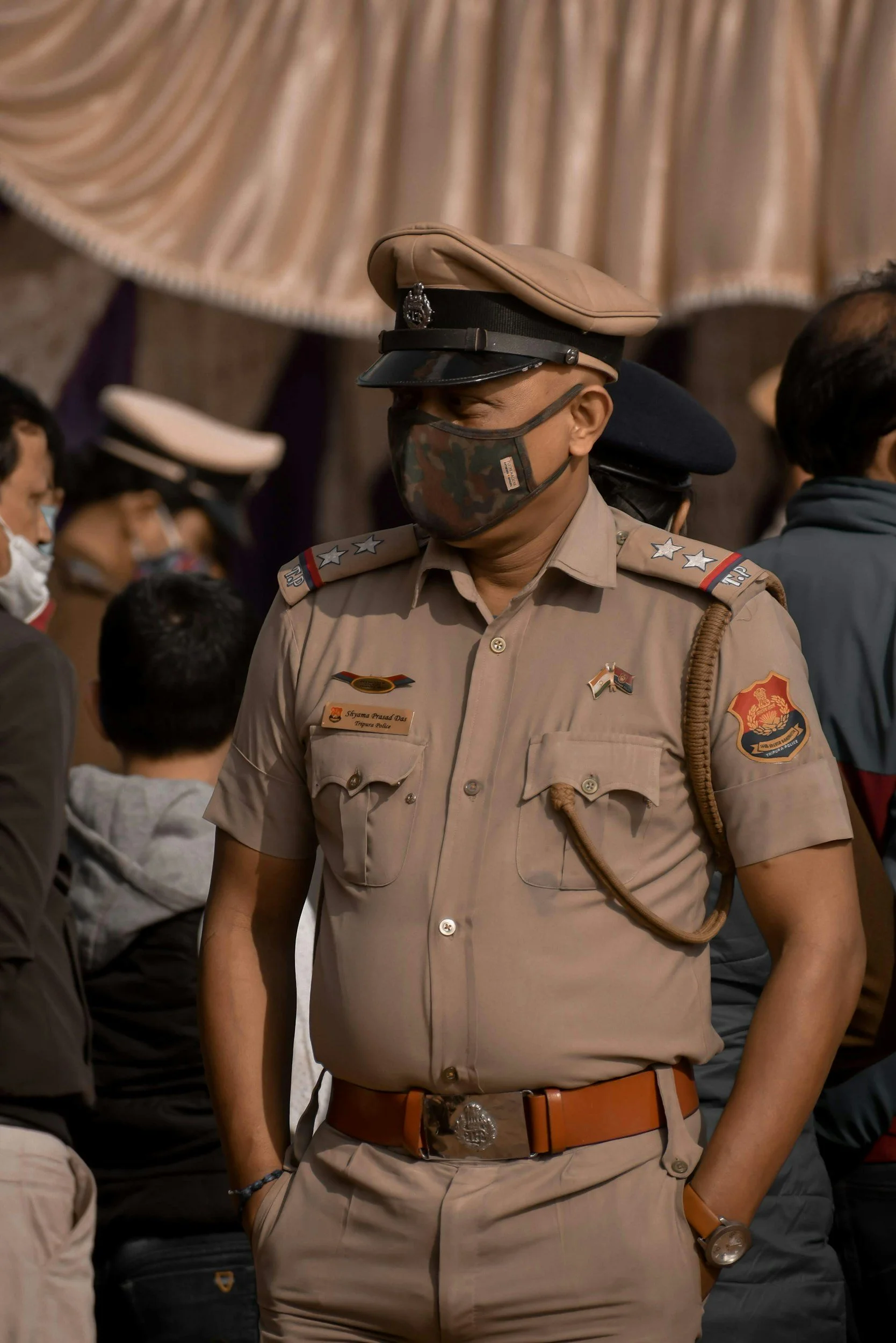
Hands in his pockets, eyes on the crowd. Nobody's ever called this a program. That's exactly the point.
One of the questions that inevitably comes up on a grant application asks about your organization's programs. Something like, "What programs and services does the organization provide?"
The question seems innocuous enough. But it's one of the ways a reviewer builds organizational credibility before reading anything else, and it trips up a lot of grant writers who work for an organization that does not have traditional "programs and services" categories.
This came up with a student this week, who works with a Tribal organization and is writing for the Tribal police department, seeking a grant to purchase drones since much of their reservation is marshland. While the Tribe coordinates with other departments, the relationship is referral-based, and the department doesn't directly have anything to do with those other departments. She wasn't sure what to write in that section, since they do not consider the department to have programs of its own.
If you have ever stared at that question and thought "we don't really have programs, we just do the work," this one is for you.
Two ways to reframe the problem
There are two ways to look at this.
Shift levels. Instead of treating the police department as the organization, treat the Tribe as a whole as the organization. In that framing, the writer would describe everything the Tribe does, with the police department as one program among several.
Categorize the work. Alternatively, think of programs as the things the department already does, sorted into categories. In other words, frame "programs" as the operational or service categories the department runs, even if no one internally has ever called them that.

These didn't sort themselves. Neither will your programs.
Both approaches are legitimate, and which one fits depends on how the funder has scoped the question and how the application is organized elsewhere. But the second approach is the one that does the most work for a request like this one, because it gives you natural, specific hooks to justify the equipment you are asking for. A drone request that floats free of any operational context reads as "we want a cool piece of technology." A drone request tied to five named functions of the department reads as infrastructure.
The Tribal police department example
For a Tribal police department, here are categories that are both realistic and give you natural hooks for a drone justification.
Core operational
Patrol operations (routine patrol, traffic stops, calls for service)
Criminal investigations
Traffic safety and accident investigation
Crime scene processing and evidence documentation
Especially strong hooks for a drone request
Search and rescue
Missing persons, worth naming explicitly given the Missing and Murdered Indigenous Persons (MMIP) crisis. Drones for search have obvious, compelling relevance here.
Emergency management and disaster response (wildfire, flood, severe weather on the reservation)
Land and boundary protection: trespass, illegal dumping, poaching, unauthorized activity on Tribal lands
Cultural and natural resource protection (sacred sites, hunting and fishing enforcement)
Community-facing
Community policing and public safety outreach
Event and gathering safety (powwows, Tribal celebrations, large community events)
School safety and school resource officer work
She doesn't need all of these. She'll pick four to six that this department actually does, given its size and scope, and then write a sentence or two for each one on how a drone specifically extends or improves that function.
That's the move that turns "programs" from a checkbox into connective tissue. It's the difference between listing what the department does and showing a reviewer exactly why the equipment matters to each thing on the list.
How to pick your categories and connect them to the ask
Same fixture, same power source, every bulb aimed somewhere different. That's what a connective sentence does.
A few guardrails as you build your own list, for this example or any other:
Pick categories the department actually operates in, not aspirational ones. If the department has never done a boundary enforcement patrol, don't invent one to make the drone sound more useful.
Match the category to the equipment, not the other way around. Write the sentence that explains what the drone does for search and rescue before you write the sentence for community outreach. The strongest categories should come first.
Keep the connective sentence concrete. "Drones improve search and rescue" is a claim. "Drones can cover marshland terrain in minutes that would take a ground team hours to search on foot" is evidence a reviewer can picture.
Four to six categories is the right range. Fewer than that and the request looks thin. More than that and you're padding, and a reviewer will notice the padding faster than they notice the drone.
This isn't unique to public safety
This categorization technique isn't unique to public safety. It applies just as well to large organizations like hospitals and universities, and to smaller organizations that have never formalized their programs and services in the first place.
Hospitals and health systems
Core operational: emergency and trauma services, inpatient nursing units, diagnostic imaging and laboratory services, discharge planning and care coordination.
Especially strong hooks for equipment or access requests: community health outreach and mobile health services, behavioral health and crisis intervention, maternal and child health, chronic disease management.
Community-facing: patient education, community health screenings and events, language access and interpreter services.
Universities
Core operational: academic advising, enrollment management and admissions, financial aid and scholarship services, instruction within specific colleges or majors.
Especially strong hooks for equipment or program requests: retention and early-alert intervention, career services and workforce readiness, research support and grants administration, support for first-generation and underrepresented students.
Community-facing: continuing education and extension services, alumni engagement, campus safety and wellness programming.
A small, newer organization
Hospitals and universities already have built-in structure to categorize. A small, newer organization doesn't always have that luxury. Picture an organization with a handful of staff who provide mentoring, workshops, and group support for diverse college students. There's no department chart to pull categories from, because the categories have never been named.
That's exactly the situation where this technique earns its keep, though it looks a little different here than it did for the hospital or the university. There's no department structure to split into three buckets, so the categories come from how the work actually happens instead. Two ways in for an organization like this:
By mode of delivery: one-on-one mentoring, workshops and skill-building sessions, peer group support.
By population served: first-generation students, LGBTQ+ students, students of color, international students.
Neither approach is more correct than the other. Pick whichever framing gives the strongest, most specific connection to what the grant is funding, and use it consistently across the application.
In each case, the instruction is the same as it was for the police department. Don't use every category. Pick the ones the organization actually runs, and write the sentence that connects each one to what you're asking the funder to fund.
A strategy for applying this to your own organization
If you're staring down a programs question for an organization that has never formalized its "programs," here's how to work through it.

A bright idea does nothing until it's screwed into something.
List everything the department or organization does, without worrying about categories yet. Every function, every recurring activity, every division of labor. Don't edit as you go.
Group the list into four to eight natural categories. Look for things that already cluster: types of work, types of population served, or stages of a process. The categories should feel obvious once you see them, not invented.
Decide whether you're framing at the organization level or the department level. This is the shift-levels option from earlier. If the parent organization has a clearer program structure, consider whether shifting levels solves the problem before you build categories from scratch.
Cut down to four to six categories that best support the request. You are not documenting the department for its own sake. You are choosing the categories that make the strongest case for why this funding matters.
Write one to two connective sentences per category. Name the category, then say specifically how the funded item extends, improves, or enables that function. Concrete beats general every time.
Order the categories by strength of connection, not by importance to the organization. The category with the most obvious tie to your request goes first, even if it's not the department's biggest function overall.
Once you've done this once for one grant, you'll find you can reuse most of the category list for the next one. The categories don't change much. The connective sentences do, depending on what you're asking for.
If you'd rather work through this with a guided worksheet instead of a blank page, the Programs Categorization Worksheet walks through these same six steps, with room to write, a worked example, and space to draft your connective sentences as you go.
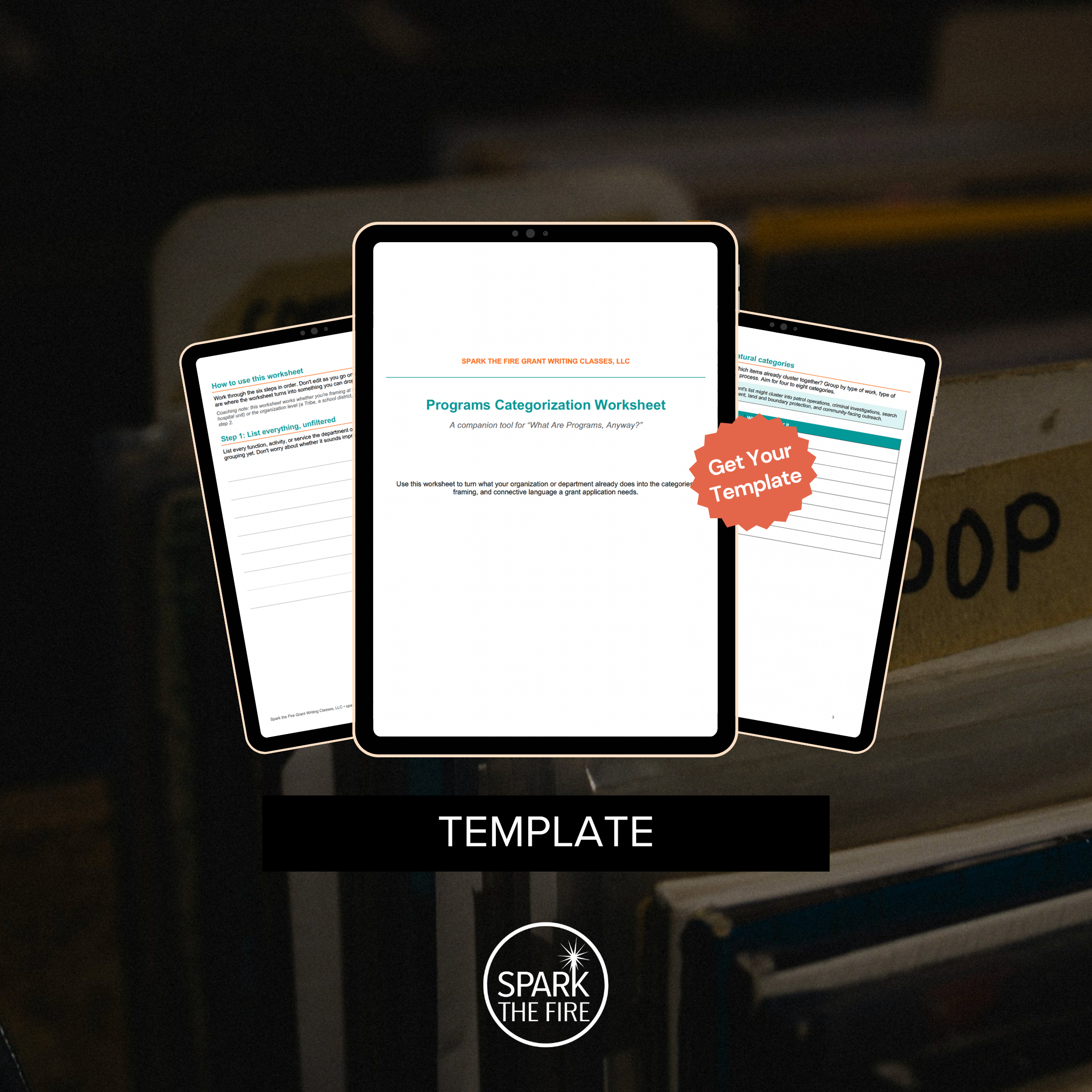
Every grant application eventually asks what programs your organization runs. If you work for a department, or a small organization, that has never used that word for what it does, the question can stall an otherwise strong proposal.
The Programs Categorization Worksheet walks you through the same six-step process taught in "What Are Programs, Anyway?": list everything the department does, group it into natural categories, decide whether to frame at the department or organization level, cut down to the four to six categories that make the strongest case, write the sentence that connects each one to what you're asking a funder to fund, and order them for maximum impact.
You'll walk away with a completed worksheet ready to drop into your current application, and a reusable framework for every one after that.
FAQ
What if my organization genuinely doesn't have programs?
Every organization does something, even if no one has ever called it a program. Work through the six-step strategy above: list everything the department or organization does, then look for the natural clusters. The categories are usually already there, just unnamed.
How many categories should I include on the application?
Four to six is the sweet spot. Fewer looks thin. More starts to look like padding, and a reviewer will notice the padding faster than they notice your actual request.
Does this only work for equipment requests like drones?
No. The same six steps apply whether you're asking for equipment, staff positions, or general operating support. The connective sentence just changes to match what you're funding.
Should I frame at the department level or the organization level?
Whichever gives you a clearer, more credible set of categories. If the department has no program history of its own but the parent organization does, shifting up a level is often the simpler fix.
What is the best grant writing class?
That depends on where you are in your career, but if you want training that goes beyond templates and teaches you to think the way a reviewer thinks, the Spark the Fire Certificate in Grant Writing course is built for exactly that. It's a grant writing certification in its own right, and it's also approved for continuing education credit toward GPCI and CFRE International, so the credential works whether you're building your resume or working toward those larger designations too.
Cheering you on,
Allison