The "Of Course" Factor: What It Is and How to Write Proposals That Earn It
Imagine you're sitting down to review grant proposals. It's your job to decide which organizations are most likely to actually move your foundation's mission forward, and the money isn't infinite. You want the most impact for every dollar you give away.
You start reading. Maybe you've got a stack of fifty in front of you. Some are well written. Some were clearly written by AI and never quite make it past the fluff to say anything real. Some are just poorly conceived, or poorly written, or both. A few don't even meet your criteria. A few, honestly, don't make sense at all.
You're trying hard not to skim. You're really paying attention to each one. And then, without quite noticing the shift, you find yourself hanging on every word of one proposal. The room around you has disappeared. You're not reviewing anymore, you're just reading.
Table of Contents
What is the "of course" factor?
I've been on that side of the table. What makes a proposal do that? What makes a reviewer lean in like that? That's what I call the "of course" factor: a proposal so clear and so logically built that by the last page, the reader thinks, of course this makes sense, and of course I want to fund it.
It's rarely dazzle that gets a proposal funded. It's the moment, usually about halfway through, when a reviewer stops skimming and starts nodding. That's the mechanism behind the "of course" factor. It's what happens when a proposal is built on simple logic instead of persuasion tricks. When someone is making a thoughtful decision, not a fast one, they're looking for logic they can follow, point by point, without having to take a leap of faith. A grant proposal that combines real logic with real hope is a powerful thing. It makes funders and the reviewers they rely on stop, lean in, and, if I'm honest, breathe a small sigh of relief. Because they're not looking for the most impressive proposal in the stack. They're looking for one that fits their mission, moves the needle on something that matters, and is going to work. When a proposal delivers that, everyone in the room already knows what happens next.
So how do you build one? It comes down to six moves. In an ideal world, you'd walk through them in this order, credibility, need, solution, work plan, evaluation, budget, because each one sets up the next. In the real world, you rarely get to choose. Applications ask their questions in whatever order the funder designed the form, and you answer them as they come. The good news is that this system doesn't depend on writing it in sequence. It depends on all six pieces being present and locking into each other by the time the proposal is finished, no matter what order you drafted them in. Miss one, and the logic has a hole in it. Get all six right, and the reader reaches the last page thinking exactly what you want them to think: of course this makes sense, and of course I want to fund it.
Start with organizational credibility

Before a funder cares about your project, they need to believe your organization will still be standing when the project is over. This is the foundation everything else sits on, and if it's shaky, nothing above it matters.
Your job here is to convince the reader that your organization has staying power and is making a real, positive difference. Talk about the full scope of what you do, not just the piece tied to this grant. Cite specific accomplishments and specific expertise. Explain just enough about how you operate that it's clear you have real systems in place, not good intentions held together with duct tape. If a proposal reads like it could be describing a fly-by-night operation, it's never getting funded, no matter how good the project idea is.
Ground the need in real community conditions

Once credibility is established, you can turn to the community insight statement: what's actually happening in the community that deserves attention right now. What challenge or opportunity is in front of you, today, that makes this the right moment to act.
This is where real research earns its keep. Bring in data, with citations, and put local conditions next to the bigger picture so the reader can see the gap. Walk them through it step by step, point by point. You're not just informing them here, you're building tension, so that by the time you get to your solution, the reader is genuinely ready for it.
Two things matter here that are easy to get backwards. First, keep the focus on the cause, not on your organization. This section is about the community, not a pitch for why you deserve the money. Second, don't stay abstract the whole way through. If you can bring the story down to one relatable person, do it. It's far easier to care about one person than about a faceless population, and you can do this while still using empowering language and giving your program participants real agency, not painting them as helpless.
Explain the solution so the reader can see it
Now that the reader is hooked, it's time to explain what your organization is actually going to do about it. This is where a visual description matters most. The reader needs to be able to picture the project working: what happens first, what happens second, what happens third, and who, by job title, is responsible for making sure each piece gets done.
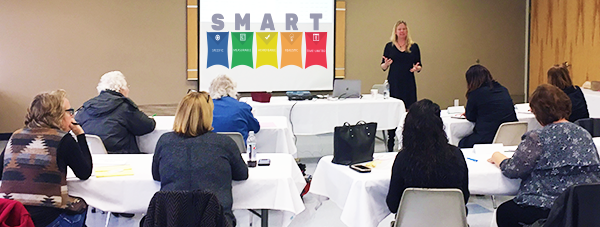
This naturally leads into your goal and your SMART objectives, which matter for more than just this section. They're also what you'll be held accountable to once the award comes through, so getting them specific and measurable here sets you up for an easier reporting season later.
Build a work plan and timeline that proves it's real
SMART objectives on their own are still a promise. A work plan and timeline is where the promise becomes a plan. Each objective should break down into three to five milestones that lead up to its accomplishment, laid out in table form so a reviewer can see, at a glance, exactly how and when the work happens and who owns it.
Here's a simplified example of what that looks like for a single objective:
Milestone Timeframe Person Responsible
Objective: Increase job readiness among 60 program participants by June 2027
Milestone | Timeframe | Person Responsible
Finalize curriculum and hire lead facilitator | Months 1–2 | Program Director
Recruit and enroll first cohort of 30 participants | Months 2–3 | Outreach Coordinator
Deliver first 8-week cohort and collect pre/post assessments | Months 3–5 | Lead Facilitator
Review outcomes and adjust curriculum for cohort two | Month 6 | Program Director
Deliver second cohort and finalize year-one reporting | Months 7–9 | Lead Facilitator
Every objective in your proposal deserves this same treatment. It's tedious to build, and it's exactly what makes a reviewer trust that you've actually thought this through, not just described it in the abstract.
Design an evaluation plan with your program staff, not for them
With the project fully explained and visible in the reader's mind, the last piece is showing how you'll know it worked. Go back to your goal and SMART objectives and describe how you'll collect data, measure it, analyze it, report it to key stakeholders, and feed it back into the project design for continuous improvement.
Here's the part that's easy to skip and shouldn't be: this plan cannot be built by the grant writer alone, in isolation. It's tempting to design an evaluation plan around what the grantmaker or donors want to hear. Resist that. The plan has to come from your program staff, because they're the ones who can tell you what actually shows that the work is making a difference, and what that looks like in practice. If the people doing the work aren't invested in finding out whether it's working, the evaluation plan is going to end up meaningless at best, and untrue at worst. Evaluation can't be delegated as a task. The staff have to want the answer.
Be specific with your reader about two different things: your outputs and your outcomes. Outputs are the metrics, the bed nights, the counseling sessions, the workshops delivered. These are essentially what the grantmaker is purchasing. Outcomes are the change: the shift in behavior, attitude, skill, knowledge, or awareness that results for the people you serve. A strong proposal names both, clearly, and doesn't confuse one for the other.
Align the budget with everything above it

None of this holds together without a budget that reflects it. For a proposal to reach the "of course" factor, the budget has to be well planned: every important piece of the project accounted for and properly funded.
The fastest way to build this correctly is to go back through your SMART objectives and every milestone underneath them and ask, plainly, what resources does this actually require? When your budget is built directly off that list, rather than reverse-engineered from a number you wanted to land on, it aligns with the outcomes you've promised. And when the budget aligns with the outcomes, everything else in the proposal falls into place behind it.
Close by handing the mission back to them
Wrap up by reminding the grantmaker why any of this matters in the first place, and frame it in terms of what they care about, not what you care about. Their mission, not yours, is the last thing they should be thinking about as they read your closing line.
When a proposal is built this way, credibility, then need, then solution, then work plan, then evaluation, then budget, all locking into each other, it becomes obvious to the reader that this is the most efficient and effective way to get this work done. There's a real, tangible relief in that. The reader isn't just convinced. They can feel that funding this proposal is going to create results. It's logical. It makes sense. And it feels good to be part of it.
That feeling, right there, is the "of course" factor. And it's not luck. It's structure.
FAQ
Is the "of course" factor the same thing as writing a persuasive proposal?
Not exactly. Persuasion tries to move someone emotionally past their doubts. The "of course" factor is what happens when there's nothing left to doubt, because the logic already answered the question. Hope matters here too, but it's hope backed by a plan, not hope instead of one.
Which section matters most for getting the "of course" reaction?
It's less about any single section and more about whether the sections logically fit together. A proposal can nail every individual section and still fail the "of course" test if the pieces don't add up to each other. Imagine a proposal where the community insight statement is about preventing infectious disease, and the solution is building more playgrounds. Read on its own, each section might be well written. Put next to each other, the logic falls apart, and you'd be surprised how often faulty logic like that ends up written into real proposals without anyone catching it. Reviewers notice gaps like this, even when they can't always name exactly what's missing.
Do I need all three to five milestones for every single objective, even small ones?
Yes, though "milestone" can flex to the size of the objective. Even a modest objective should show the reader the handful of concrete steps between where you are now and the finish line, and who's responsible for each one.
Who should actually write the evaluation plan?
Program staff, with the grant writer helping shape and word it. If the grant writer builds it alone based on what sounds good to a funder, it tends to read as compliance rather than genuine practice, and it usually falls apart once the award is in hand and someone has to actually run it.