Your Budget Equals the Grant Maximum. Here's Why That's a Red Flag.
Hitting the maximum on the nose isn't precision. It's a tell.
I was reviewing applications for a state tourism grant a few years ago. The RFP capped awards at $30,000. One application came in for a two-day music festival, and when I opened the budget, it totaled exactly $30,000.
That alone is a yellow flag. What made it red was the inside of the budget. Personnel rounded to the nearest thousand. A line for "office equipment" with no detail. Marketing costs that looked suspiciously like whatever number was needed to close the gap to the ceiling.
The organization had built the budget to fit the grant. And every experienced reviewer can tell when that's what happened.
Table of Contents
What a Budget Narrative Actually Is
Here's the shift I want you to make. A budget narrative is not a justification for what you want. It is the story of how this project actually gets paid for.
The grant ask is one column in that story. The rest of the columns matter just as much, and reviewers read them carefully.
When you build the budget to fit the maximum award, you are telling the reviewer two things you do not want to tell them. First, you have not thought carefully about what this project really costs. Second, your organization is not bringing anything to the table. Both of those signals work against you, even when the writing is otherwise strong.
Build the Budget for the Project, Not the Grant

Price the event first. Fit the grant to it, not the other way around.
Start with the actual cost of doing the work. Not what you want to ask for. Not what the funder will give. The real number.
Go back to our two-day music festival. If you sit down and think through what a real two-day festival actually costs, the budget probably looks something like this:
Artist fees and contracts: $46,000
Sound, lighting, and stage rental: $25,000
Venue (fair market value of public amphitheater, two days): $7,500
Festival staff and volunteer coordination: $6,500
Marketing and promotion: $5,500
Security and safety: $4,200
Hospitality (green room, artist meals and lodging): $3,500
Equipment, signage, and supplies: $2,000
Permitting and city fees: $1,800
That comes to $102,000. Not $30,000.
Now here is where the budget narrative does its real work. You present the full $102,000 project budget. Then you show where the money is coming from:
Sponsorships from regional hotels, restaurants, and breweries: $39,500
Requested from the state tourism grant: $30,000
City contribution from lodging tax revenue: $20,000
In-kind donation of public amphitheater use from the city: $7,500
Vendor fees from food trucks and merchandise sellers: $5,000
The total adds up to the real cost. You are only asking the funder for $30,000. But the reviewer can see that this project is going to happen, that other people are already investing in it, and that your organization has built a funding strategy that matches what the grant is actually for. The hotels are sponsoring because they will fill rooms. The city is contributing lodging tax dollars because that is exactly what lodging tax dollars exist to support. Every line tells the tourism story.
What Reviewers Actually Read in a Budget Narrative
I have sat on review panels for private foundations and state grant programs. Here is what experienced reviewers are looking for when they read a budget narrative, in roughly this order.
Does the budget reflect the real cost of the work?
If the personnel line is too thin, we wonder who is actually going to do this project. If the indirect cost calculation is missing or arbitrary, we wonder whether the organization understands its own operating costs. If the numbers are suspiciously round, we wonder whether anyone got quotes.
Is the organization invested?
Cash match, in-kind contributions, board commitments, other secured funding. Reviewers want to see that the applicant has skin in the game. A project entirely dependent on this one grant is a riskier investment than one with diversified support.
Will this project happen if we do not fully fund it?
Funders almost never tell you this directly, but it shapes their decision. A budget that shows multiple revenue sources signals that you have a Plan B. A budget that equals the grant ask exactly signals that you do not.
Does the budget connect to the proposal narrative?
If you described a robust evaluation plan but the budget has $200 for evaluation, something is wrong. If you said you would hire two part-time staff but the personnel line will only cover one, the reviewer notices.
Is the income side as well-developed as the expense side?
This is the failure mode I see most often. Applicants spend three weeks on expense lines and then dash off the income side in twenty minutes. A budget is two columns. If the income side is thin, vague, or implausible, it does not matter how carefully the expense lines are built, the whole budget reads as unfinished.
How to Write the Narrative Itself
The line-item budget tells the reviewer what. The budget narrative tells them why.

The narrative isn't decoration for the budget. It's the proof the budget is real.
For each significant line, the narrative should answer three questions. What is this cost for? Why does it cost what it costs? How does it connect to the work you described in the proposal?
Weak version: "Festival staff costs total $6,500. This covers the Festival Director and two part-time coordinators."
Stronger version: "Festival staff costs total $6,500 and reflect the staffing structure outlined in our project plan. The Festival Director ($4,000) leads artist contracting, site logistics, and day-of operations across approximately 110 hours over four months. Two part-time coordinators ($1,250 each) handle volunteer recruitment and community partnerships in the eight weeks leading up to the festival. These figures reflect prevailing local rates for contract event staff and are consistent with comparable small-festival budgets in our region."
The stronger version is not longer because it is padded. It is longer because it is doing work. A reviewer reading the second version learns that you have thought about scope, timeline, market rates, and how the staffing connects to the project. A reviewer reading the first version learns nothing.
A Word About "Generally Specific"

A reviewer isn't counting your stamps. They're checking whether the whole budget adds up to something believable.
If you have been around grant writing instruction for any length of time, you have probably heard the advice to be "generally specific" in your line items. The reasoning goes like this: if you write "postage, $1,000," you can only spend that money on postage. But if you write "marketing expenses, $1,000," you can use it for postage, printing, design, or any other marketing cost that comes up. The broader category gives you flexibility after the award.
That advice is correct, as far as it goes. The problem is that it is solving the grantee's problem, not the reviewer's problem. And reviewers are the ones who decide whether you get funded in the first place.
When I read a line item that says "marketing expenses, $1,000," I have no way to evaluate whether $1,000 is the right number. I do not know what you are planning to do, what it costs in your market, or whether you have thought it through. The line item gives me nothing to work with. So I move from "is this budget well-reasoned?" to "I have to trust that it is," and most reviewers will not extend that trust to an unfamiliar applicant.
Here is the resolution. The line item can stay generally specific. The narrative is where you make it specific. Something like:
"Marketing expenses ($1,000) cover the production and distribution of program outreach materials, including approximately $400 for direct mail postage to our service area, $300 for printing of 500 trifold brochures, and $300 for graphic design of brochure and digital ad templates. We have built flexibility into this line to respond to outreach opportunities that emerge during the program year, including digital advertising and event-based promotion."
The line item gives you flexibility after the award. The narrative gives the reviewer enough specificity to trust the number before the award. You get both.
One caveat. Generally specific should never mean vague to the point of meaninglessness. A line that says "program expenses, $15,000" with a narrative that just says "this covers program expenses" tells the reviewer nothing. And avoid naming specific brands or models in the narrative either. "Fellowes Jupiter 2 A3 laminator, $400" reads as overcommitted. "Heavy-duty laminator for classroom materials, approximately $400" tells the reviewer exactly the same thing without locking you into a single product if that model is out of stock when the funds arrive. You want the level of specificity a reviewer would use when describing the project to a colleague: specific enough to be real, general enough to allow for reasonable substitution.
One more thing about equipment specifically. Equipment lines get more scrutiny than almost anything else in a budget, because reviewers go to Office Depot too. If you write "laminator, $400" and a reviewer just bought one for $200, you have a problem. You cannot guess. You have to do the research and price it. And then the narrative is what saves you, because that is where you explain that this is a heavy-duty, high-volume laminator built for daily classroom use, not the $200 home-office model the reviewer is thinking of. The line item gives the number. The narrative tells the reviewer why the number is what it is.
Ten Before-and-After Examples
Here are ten line items, drawn from real proposals I have reviewed or edited, showing the before and the after. Read them as a set, the pattern is more important than any single example.
1. Equipment
Before: "Computer, $1,200."
After: "Laptop for program coordinator, $1,200. Mid-tier business laptop suitable for daily program management, database entry, and virtual client meetings. Quote obtained from regional IT vendor; price reflects business-class warranty and security software included."
2. Equipment, big-ticket item
Before: "Van, $35,000."
After: "Used 12-passenger van for client transportation, $35,000. Price reflects current regional market for low-mileage used vans (2-3 years old) at certified dealerships, based on three written quotes obtained in [month]. Vehicle will be used to transport seniors to medical appointments four days per week."
3. Personnel, full-time
Before: "Program Director, $58,000."
After: "Program Director, $58,000 (1.0 FTE). Salary reflects regional market rates for nonprofit program leadership positions requiring 5+ years of experience and an MSW or equivalent. Position oversees all program operations, supervises three case managers, and reports to the Executive Director."
4. Personnel, contractor
Before: "Evaluator, $5,000."
After: "External evaluation consultant, $5,000. Contracted evaluator will design pre/post instruments, conduct mid-year and end-of-year data analysis, and produce a final evaluation report. Rate of approximately $125/hour for 40 hours reflects standard local consulting rates for evaluators with MPH or equivalent credentials."
5. Supplies
Before: "Art supplies, $2,500."
After: "Art and program supplies, $2,500. Covers consumables for 30 youth participants across 32 weekly sessions, including paper, paint, drawing materials, project-specific kits, and basic tools. Per-participant cost of approximately $83 reflects program experience over the past three years."
6. Travel
Before: "Travel, $1,800."
After: "Travel expenses, $1,800. Covers mileage reimbursement for home visits by case managers (estimated 2,400 miles at the current federal rate), parking, tolls, and limited public transit costs for clients accompanying staff to appointments."
7. Marketing and outreach
Before: "Outreach, $1,500."
After: "Community outreach and program promotion, $1,500. Includes printing of bilingual flyers and intake materials, digital advertising in two community Facebook groups, sponsorship of one community event table, and limited postage for mailings to referral partners."
8. Indirect costs
Before: "Indirect, $3,200."
After: "Indirect costs, $3,200 (10% of direct project costs). Calculated using our federally negotiated indirect cost rate of 10%, applied to the direct cost base shown above. Covers a proportionate share of organizational overhead including accounting, IT, facilities, and executive leadership time."
9. Income, secured funding
Before: "Matching funds, $15,000."
After: "Secured matching funds, $15,000. Includes a $10,000 program grant from the [Foundation Name], confirmed in [month/year], and $5,000 from our annual giving campaign, allocated by board action in [month/year]. Both sources are unrestricted within the scope of this project."
10. Income, in-kind
Before: "In-kind, $8,000."
After: "In-kind contributions, $8,000. Includes pro bono legal services (approximately 32 hours at $175/hour standard rate, $5,600) from [Firm Name] and donated meeting space (24 evenings at $100/evening fair market value, $2,400) from [Partner Organization]. Both contributions are confirmed in writing and documented in attached letters of support."
The pattern across all ten: the "before" leaves the reviewer guessing about scope, source, market rates, and whether the number is real. The "after" answers those questions before they get asked. The reviewer never has to wonder, which means they never have to extend trust that has not been earned.
The Quietest Trust Signal in Your Proposal
A budget narrative is one of the quietest places in a proposal where you either build trust or lose it. Most applicants do not realize how much weight reviewers put on it. They spend weeks polishing the project description and then assemble the budget in an afternoon to hit the ceiling.

Trust doesn't announce itself. It shows up in the small details a reviewer almost doesn't notice they're noticing.
Do the opposite. Build the budget first, from the real cost of the work. Then build the ask around what this funder can contribute to that real cost. Then write a narrative that explains the reasoning behind every meaningful number.
A reviewer who reads a budget like that will believe the rest of your proposal more than they would have otherwise. That is worth more than the few thousand dollars you thought you were squeezing in by rounding up the office supplies line.
Frequently Asked Questions
What is a budget narrative in a grant proposal?
A budget narrative is the written explanation of your line-item budget. It tells the reviewer what each cost is for, why it costs what it costs, and how it connects to the project you described in the proposal. The line item gives the number. The narrative tells the reviewer why the number is what it is.
How long should a budget narrative be?
Long enough to answer the reviewer's questions, short enough that nothing in it is padding. For a small project (under $50,000), one to two pages is typical. For larger projects, three to five pages. Funders sometimes set page limits; if they do, follow them. If they do not, prioritize clarity over length.
Should my budget match the maximum grant amount?
No. Build the budget for the real cost of the project, then build the funding strategy around it. If your project costs $100,000 and the grant maximum is $30,000, your budget should show $100,000 in costs and $30,000 as the requested portion, with the remaining $70,000 coming from other sources. A budget that exactly matches the grant maximum signals to reviewers that you built the numbers backwards.
What goes in a budget narrative for each line item?
Three things: what the cost is for, why it costs what it costs (research, quotes, market rates), and how it connects to the project. Avoid naming specific brands or model numbers. Use the level of specificity a reviewer would use when describing the project to a colleague.
How do I write a budget narrative for personnel?
Identify the position, the FTE or hourly commitment, the salary or rate, and the role the person plays in the project. Reference market rates or comparable positions where you can. If the position is being hired specifically for the grant, say so. If the person is already on staff, identify what portion of their time is allocated to this project.
Should the budget narrative explain in-kind contributions?
Yes. In-kind contributions appear in two places in a complete budget picture, once as a cost (at fair market value) and once as a funding source. The narrative should identify the source of each in-kind contribution, the basis for the value (standard hourly rate, market rental rate, retail price), and confirmation that the contribution is secured.
What is the biggest mistake grant writers make in budget narratives?
Treating the budget narrative as an afterthought. Most applicants spend weeks polishing the project description and then assemble the budget in an afternoon. Reviewers read budgets carefully, and a thin or vague budget narrative undermines the trust the rest of the proposal has built.
Do reviewers actually read budget narratives?
Yes. In some review processes, the budget narrative is scored separately from the project narrative. Even when it is not, experienced reviewers use the budget to validate the project description. If the project narrative promises something the budget does not fund, the reviewer notices.
Get the Template
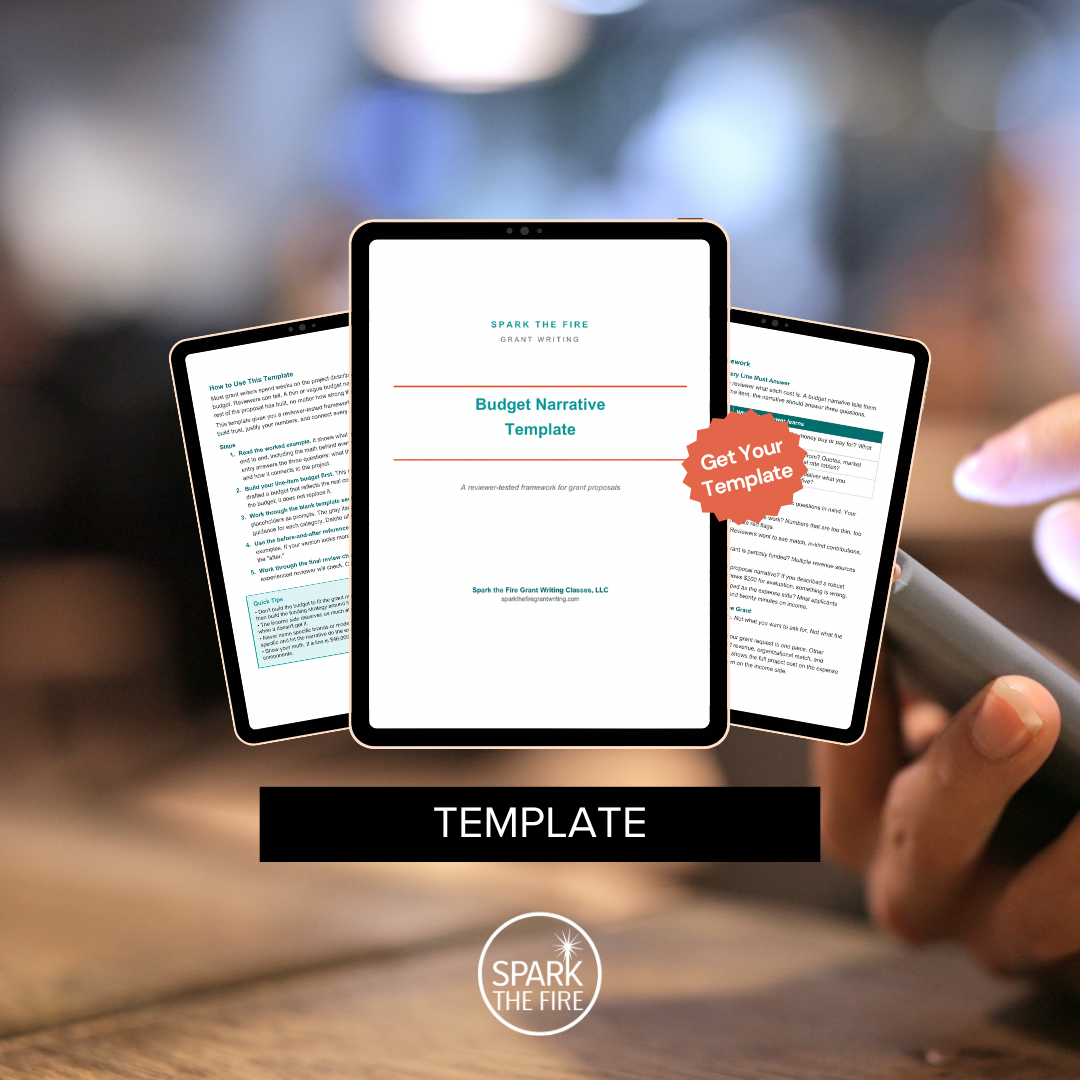
If you want a structured starting point, I built a Budget Narrative Template that walks you through this approach line by line. It includes prompts for the three reviewer questions above, a worked example, and a format that connects directly to the project narrative section of your proposal.
You spent three weeks on the project narrative. Then you sat down to write the budget narrative the night before the deadline. You restated the line items in sentence form, padded a few entries with vague justifications, and hoped the reviewer wouldn't look too closely.
They will. And they can tell.
The budget narrative is one of the quietest places in a proposal where reviewers decide whether to trust you. Numbers without explanations, round figures with no sourcing, line items that exactly match the grant maximum: every one of these signals to an experienced reviewer that the budget was assembled to fit the funder rather than to fund the work. No matter how strong the project description is, a thin budget narrative undermines it.
The Budget Narrative Template is a reviewer-tested framework for writing budget narratives that actually justify your numbers and connect every cost to the project. Built by a former grant reviewer and trainer of 5,000+ grant writers, it walks you through the same questions reviewers ask when they read your budget, then shows you exactly how to answer them.
What's inside (15 pages):
A complete worked example: the full budget narrative for a two-day music festival applying for a state tourism grant, with the math shown explicitly for every line item
A section-by-section blank template with fill-in prompts for personnel, contractors, equipment, supplies, travel, marketing, evaluation, indirect costs, and every income source
Ten before-and-after entries from real proposals, showing exactly how to transform a weak line into one a reviewer will trust
The three questions every line of your narrative must answer, and how to answer them in 2-3 sentences
A final review checklist covering expense side, income side, and cross-check with the project narrative
Guidance on the "generally specific" trade-off, equipment scrutiny, in-kind contributions, and what to do when your real costs exceed the grant maximum
Whether you're writing your first budget narrative or your fiftieth, this template gives you the structure, language, and reviewer perspective to write one that holds up under scrutiny. Downloadable Word Doc (.docx). Built by a grant writer, for grant writers.