Finding Freelance Grant Writing Clients Through Cold Outreach

Somewhere out there is an organization that needs exactly what you do. They just don't know you exist yet.
Table of Contents
When I decided to build out the freelance side of my grant writing practice, I had one advantage many new consultants don't: a part-time grant writing position already lined up as a base. It gave me stability while I figured out the rest. But the "rest" — actually finding freelance clients — meant I had to go out and talk to people.
No job boards. No postings. Just me, calling up executive directors and asking for meetings.
It sounds more intimidating than it was. And what I learned from those early conversations — including one of the most instructive "no" conversations I've ever had — shaped how I think about client development to this day.
The Freelance Dilemma: Skills Without Clients

The tools don't get you hired. Someone knowing you have them does.
Here's the thing about freelance grant writing that nobody tells you upfront: having the skills is only half the equation. The other half is finding the organizations that need those skills and don't yet know you exist.
Most grant writers who go independent do what I did at first — they wait for opportunities to come to them. They post on LinkedIn, watch job boards, tell a few colleagues they're available. And sometimes that works. But waiting is a passive strategy, and a slow one.
Cold outreach is the active version. You identify organizations that could benefit from grant writing support, you introduce yourself before a need becomes urgent, and you plant seeds that often grow into something — if not immediately, then down the road.
Why Cold Outreach Works for Grant Writers
Grant writing is a specialized skill, and most small-to-mid-size organizations are chronically understaffed. The development director who does everything — including grants — is quietly wondering where she's going to find time to research and write the next proposal. The ED who does her own grant writing knows it's taking her away from other work, but hasn't figured out the alternative.
Neither of them has posted a job. Neither of them has searched for a consultant. But both of them are candidates for your services — they just don't know you exist yet.
When you show up in their inbox or on their phone before they're actively looking, you remove the friction of the search entirely. You become the solution to a problem they've already identified. And because organizations talk to each other, one good relationship in a community can open doors you didn't even know were there.
Start Local: Your Community Is Your Best First Market
When I started doing cold outreach, I began with the organizations in my local community. That was intentional.

You don't need a national reputation to start. You need one organization in your own community that trusts you.
Local connections work for a few reasons. First, you probably have some existing credibility — people may have heard your name through community networks, service clubs, or neighborhood connections even if they've never met you professionally. Second, meeting in person (or even a phone call with someone a few miles away) feels more natural than reaching out to strangers across the country. Third, when the work goes well, local word travels fast.
I simply called up executive directors, introduced myself as a grant writer who was starting a freelance practice, and asked whether they needed any grant writing assistance. That was essentially the whole pitch at first.
Think about the organizations in your area that do work you care about and have the kind of programs that attract grant funding. Arts organizations, human services agencies, environmental groups, food banks, literacy programs — wherever your expertise and interest align. Start there.
Who to Contact
For small organizations — typically those with fewer than five to ten staff — go straight to the executive director. They're usually making all the decisions about consultants and contractors, and they appreciate that you respected their time by going directly to them.
For larger organizations with a development team, the development director or director of grants is typically the right first contact. They're the ones managing the grant pipeline and would be bringing in a contractor to support their work.
If you're not sure who handles grants, a quick look at the organization's website or LinkedIn usually tells you. When in doubt, the ED is always an appropriate starting point — they can redirect you if needed, and it signals confidence.
One note: avoid contacting multiple people at the same organization simultaneously. Pick one, make your introduction, and see where it goes before broadening the conversation.
How to Make the First Move
I'll tell you what I actually did, and then I'll tell you what to do if you're not in a small town.
I stopped by. In person. I'd walk into an organization, ask the person at the front desk if the ED was in — by name — and introduce myself. If she wasn't there, I left a note saying I'd stopped by and would follow up. Then I came back. I kept showing up until I caught them. I want to be clear: this was not stalking. It was casual. It was a small-town move in a small town where everyone knew everyone, and dropping in was completely normal.
If you're in a city or working with organizations you can't easily walk to, the equivalent move is a phone call. Not an email — a call. A voice is harder to ignore than an inbox message, and the goal of this first contact is simply to get a conversation, not to pitch anything.
Email is fine as a first contact if calling feels like too much, but keep it brief — two or three short paragraphs, maximum. You're not pitching the full engagement. You're asking for 20 minutes.
If you don't hear back within a week or ten days, one follow-up is completely appropriate. Then let it rest. Your goal is to be memorable for the right reasons — not to be the person who sent four emails.
However you make first contact, the goal is the same: get a meeting.
What to Say: The Pitch in Plain English
Here's roughly what I said when I finally caught an ED in person — and it translates directly to a phone call or email:

No windup, no jargon. Just tell them what you do and who it's for.
"Hi, I'm Allison — I'm a grant writer who's starting a freelance grant writing practice here in the area. I've been writing grants for [X years] and work with organizations on [types of work]. I'd love to learn more about what [Organization Name] is working on and whether there's a way I could support your grant efforts. Would you have 10 minutes to connect?"
That's it. No hard sell. No list of services. No rate sheet. Just an introduction, a brief credential, and a low-stakes ask for a conversation.
A few things to notice about this approach:
Lead with who you are, not what you're selling. You're introducing yourself as a professional, not pitching a transaction.
Mention something specific about them. Even one sentence showing you've looked at their website — "I've been following the work you're doing with [program]" — signals that you're not blasting the same message to every organization in the directory.
Ask for a small commitment. Ten minutes is easy to say yes to. A full pitch meeting is not.
Keep the door open without pressure. If they're not interested or not ready, a gracious close — "I understand completely — if anything changes down the road, I hope you'll keep me in mind" — leaves the relationship intact.
What to Do With a "No"
Here's a story I think about often.
When I was doing those early calls on Vashon Island, one of the conversations that stands out most was with Molly at Vashon Center for the Arts. Of all the people I spoke with, she was among the most thorough. She asked me questions. She wanted to understand my background, my experience, my approach. She gave me real time and treated me like a professional — not like someone cold-calling with a script.
And then she told me no.
They already had a grant writing contractor they'd worked with for years. The relationship was solid, the work was going well, and there was no opening. It was a completely reasonable no, delivered with real respect.
But here's what that conversation gave me: practice. By the time I sat down with the next prospect, I had already answered the hard questions — the ones about my experience, my process, my rates, my value. Molly had done me a favor I didn't fully appreciate until later.
She also said: "If anything changes, I'll reach out."
Vashon Center for the Arts may be the one nonprofit on Vashon Island I never wrote grants for. But the conversation was worth more than many of the yeses that followed.
When you get a "no," treat it as what it often actually is: a future relationship, a practice run, and evidence that you showed up professionally enough to get a real answer. Those things compound over time.
Following Up Without Being Annoying

Persistence reads as professional right up until it starts reading as pressure.
The best cold outreach doesn't end at the first conversation — it continues with a light, professional follow-up system that keeps you in people's minds without being a nuisance.
A few practices that work:
Send a thank-you after any meeting. Even a brief email the same day — "Thank you for your time today. I really enjoyed learning more about your work with [program]" — reinforces the impression you made and gives them something to respond to if they want to continue the conversation.
Stay on their radar with value, not asks. If you notice a relevant grant opportunity, a sector news item, or a resource that might be useful to an organization you've spoken with, send it along with a one-line note. You're not asking for work — you're being a useful person in their professional world. That's memorable.
Check in occasionally. A brief, low-pressure check-in every few months — "Just wanted to touch base and see how things are going at [Organization] — hope the spring grant season is treating you well" — is warm and professional. It's the kind of message that prompts a response when something has changed on their end.
Don't disappear after a no. The no you got six months ago may not be a no today. Organizations change. Contractors move on. Budgets shift. If you've stayed in touch appropriately, you'll be the first person they think of when the need arises.
Word of Mouth: The Real Engine
I want to be honest about something: cold outreach is how you start. Word of mouth is how you grow.
My freelance practice grew quickly — but not primarily because of cold calls. It grew because the work was good, and good work gets talked about. Organizations talk to each other constantly. They compare notes on contractors, share recommendations, and refer consultants to peer organizations without thinking twice.
If you do good work and treat every client relationship with professionalism and care — even when it's hard, even when a grant doesn't come through, even when you're delivering news a client doesn't want to hear — word gets around fast. The sector is smaller than it looks.
Cold outreach plants the seeds. Your reputation grows the tree.
Frequently Asked Questions About Cold Outreach for Grant Writers
Is it actually acceptable to cold-call an organization?
Yes — and many EDs appreciate it. Nonprofit leaders are generally mission-driven people who understand the value of professional relationships. A respectful, brief cold call or email is a normal part of business development, and most people will respond graciously even if the answer is no.
Should I have a website or portfolio before I start reaching out?
It helps, but it's not required to begin. At minimum, have a professional email address, a clear description of your experience, and a sense of the types of organizations you serve and the work you do well. If you don't have samples yet, describe your background and offer references. Build the portfolio as the work comes in.
What if I've never had a freelance client? What do I say about my experience?
Be honest and specific about what you have done. If you've written grants in a staff role, that counts. If you've volunteered grant writing for a nonprofit, that counts. Frame your experience in terms of outcomes: proposals written, funders cultivated, grants awarded. You don't need a client list to demonstrate competence.
How many cold outreach contacts should I make?
There's no magic number, but starting with ten to twenty organizations in your immediate area gives you a meaningful sample. Expect a mix of responses: some meetings, some polite no-interest replies, some non-responses. It's a numbers game at first, and persistence with professionalism is the strategy.
What if an ED seems interested but says they don't have budget right now?
Ask if you can stay in touch, and do it. Budgets change, grants come in, staff leave. An organization with interest but no current budget is a warm lead worth nurturing — gently, over time.
When should I bring up my rates?
Not in the initial outreach. Save the rate conversation for the actual meeting, once you've had a chance to understand their needs and they've had a chance to see your value. Going into the first email or call with your fee schedule signals you're selling a transaction, not building a relationship.
Cold outreach is uncomfortable at first. Making calls when you don't know how they'll land, walking into meetings where you have to articulate your own value, sitting with a polished "no" from someone who clearly could have been a great client — none of that is easy.
But the discomfort gets smaller every time. And somewhere in those conversations — even the ones that don't turn into work — you are building something: your professional presence, your reputation, your network. In a field where word travels fast and relationships last for careers, that foundation is worth more than any single client.
If you're ready to make those first calls or send those first emails, the Cold Outreach Email Template in the shop gives you a starting point — a professional, customizable email you can adapt for any organization introduction, so you're not staring at a blank page when the time comes.
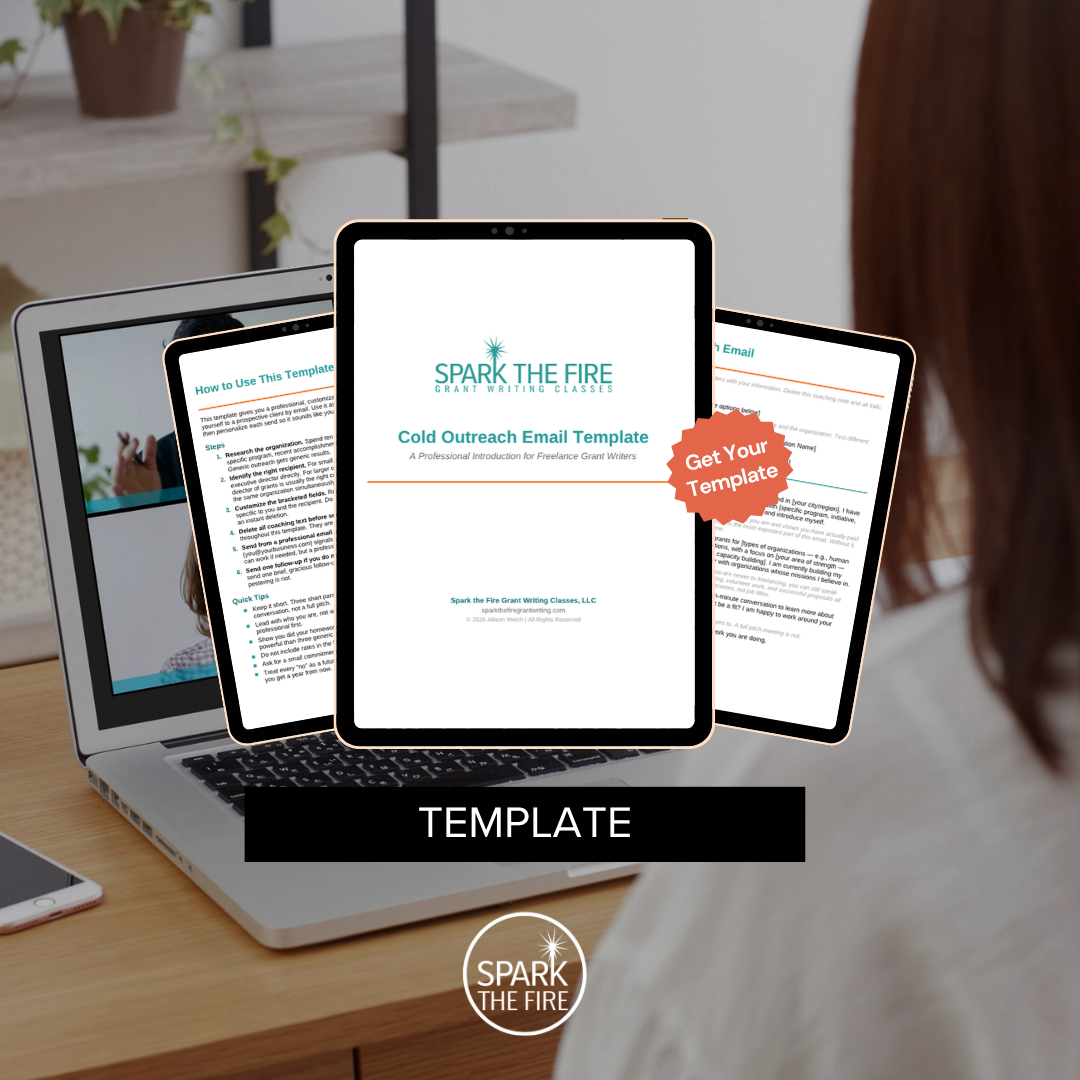
You know you can do the work. You just need the clients. But staring at a blank email to a stranger — wondering if you sound desperate, too salesy, or like you're just begging for attention — can stall a freelance practice before it even gets going. Should you mention rates? Lead with credentials? How do you sound confident without sounding like every other consultant blasting the same generic pitch?
Cold outreach is one of the most uncomfortable parts of building a freelance grant writing practice, and most advice treats it like a sales course. This one does not.
The Cold Outreach Email Template is a professional, customizable starting point for introducing yourself to prospective clients by email. It gives you the language, structure, and confidence to send that first message without staring at a blank page — and a graceful path forward whether the answer is yes, no, or silence.
What's inside:
Three subject line options designed to get opened (not deleted)
A three-paragraph cold outreach email built around a proven structure: who you are, why you're reaching out to them specifically, and a low-stakes ask
Gray-italic coaching notes throughout, explaining why each section works so you can adapt it confidently to any prospect
A follow-up email for when you don't hear back the first time, including a clever ask-for-a-referral line that opens doors a direct pitch cannot
A gracious "no thanks" reply template that keeps the door open for future opportunities — because the no you get today may be the yes you get a year from now
A complete signature block with placeholders for your credentials, business name, and contact info
Step-by-step instructions for customizing each section before you send
Whether you're sending your first cold email or refining a practice you've already started, this template gives you a polished, professional framework so you can stop waiting for clients to find you and start building the freelance practice you actually want.
Spark the Fire Grant Writing Classes, LLC. Built by a grant writer, for grant writers.