The Taxonomy Tangle: Why Grant Database Categories Need Better Alignment

Fair warning: we're about to dive into something decidedly nerdy. But if you're a grant professional who has used multiple grant research databases and felt confused about the terminology differences, this matters more than you might think.
Table of Contents
What's taxonomy got to do with it?
In grant research databases, taxonomy is the classification system used to categorize funding opportunities. Think of it as the organizational framework that determines whether a grant for "community health education" gets filed under "health," "education," or "community development." A well-designed taxonomy acts as your search compass, helping you navigate efficiently toward relevant opportunities.
When database providers use different terminology and categorization schemes, grant professionals need to adjust their approach for each platform. What should be intuitive navigation becomes a translation exercise—like needing different lightbulbs for different lamps. Each database illuminates the grant landscape, but you need to understand which "bulb" fits which "fixture" to get the best results.
The great divide: how three major databases categorize the same world
To illustrate these challenges, let's examine my three favorite databases: Instrumentl, Foundation Directory Online by Candid (FDO), and GrantStation. I’ve used all three extensively and seen firsthand how their differences can cause confusion.
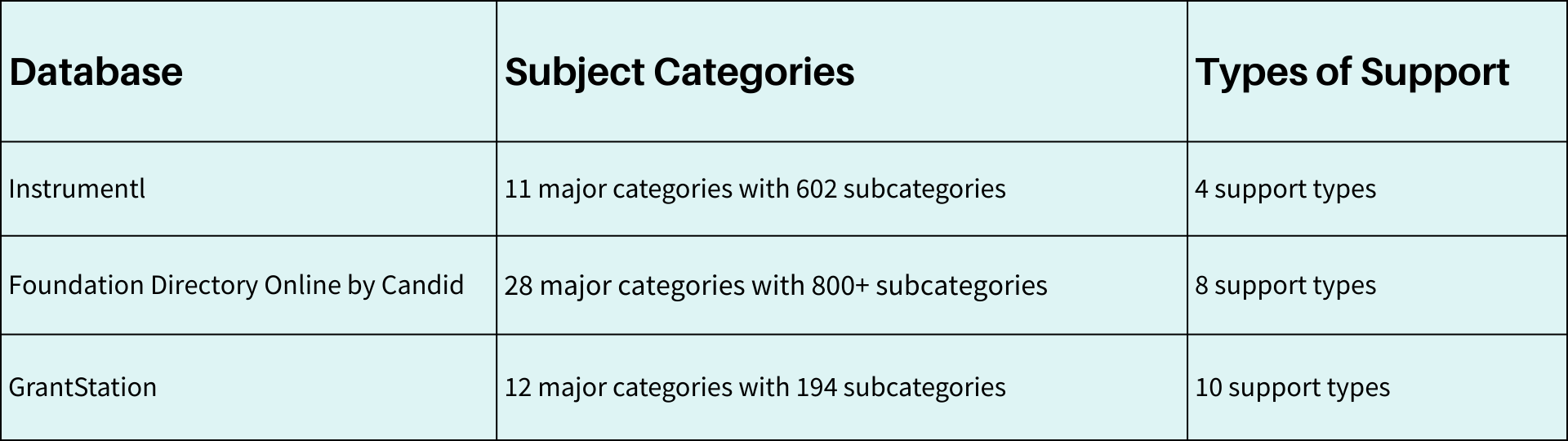
Each platform's taxonomy reflects different specializations. Instrumentl's categories are heavily weighted toward community services and sciences, reflecting its unique inclusion of research grants. FDO's categories allow precise targeting and broader exploration. GrantStation's categories streamline groupings for intuitive navigation.
"Types of support" classifications reveal similar specializations. All three recognize fundamental categories like general operating and capital support, but their granularity differs. For example, Instrumentl’s "education/outreach" is FDO's "policy, advocacy and systems reform," and GrantStation’s "advocacy."
What makes each database special
Instrumentl takes a broader approach to avoid over-filtering opportunities classified differently by funders. It also includes scientific research grants and integrates project management capabilities alongside grant discovery.
Candid’s Foundation Directory offers an extensive corporate foundation database, capturing corporate giving programs that often fly under the radar. It also features "regranting" and "participatory grantmaking" as specific support types, increasingly important funding mechanisms.
GrantStation includes giving circles as a funder category, Canadian funding opportunities alongside US sources, and events/sponsorships as a support category, valuable for conferences, galas, or community events funding. Their accessible pricing makes comprehensive grant research possible for smaller organizations.
Each of these platforms has real strengths, and which one fits depends on your organization's funding focus, workflow, and budget. This isn't a ranking. It's a look at how three well-built tools carve up the same world differently, and what that means for the people searching across them. If you want a fuller side-by-side of the platforms themselves, I compared them in The Best Grant Prospect Research Databases of 2026.
A call for common ground
Database providers have an opportunity to better serve the grant community by working toward greater taxonomic alignment. This doesn't require abandoning unique strengths—the goal is interoperability, not homogenization. In other words, coordination, not conformity. It’s not about being the same, it’s about working in sync.
Academic databases share subject headings, and library systems use common classification schemes. Coordination can enhance rather than diminish individual platform value. A shared taxonomy framework would allow grant professionals to develop transferable search expertise and conduct more comprehensive research without getting lost in terminological translation.
When AI hides the taxonomy instead of fixing it
A new wave of AI and natural-language search promises to end the translation problem altogether. Instead of learning each database's categories, you just describe your project in plain language and let the tool do the sorting. The idea is genuinely appealing, and the best versions do more than match keywords. They draw on a funder's recent grants, geographic giving patterns, and actual funding behavior, and some will even explain why a particular funder aligns. I have written admiringly about one such feature in Grant Prospecting Software Innovations for 2026.
But here is where I want to be clear about what I actually want as a professional. I do not want a tool to make my judgment calls for me. I want to make them myself, precisely, and I want a tool that lets me. Give me the controls and let me filter to exactly what I am looking for. A plain-language assistant can be a wonderful addition on top of that, but it should never replace my ability to see and work the filters directly.
Here is the catch, and it is the whole point of this article. The taxonomy underneath was never really the problem. The categories have always been imperfect, and grant professionals have always been able to work with imperfect categories, because we could see them and adjust. We could add a filter, drop one, or notice when a category was quietly pulling in the wrong results. The plain-language layer changes that. It covers the controls with a beautiful marble cabinet. The pipes are still there, doing the same sorting they always did, but now you cannot reach them.
That is exactly when it fails you. When a confident, well-formatted list of "matches" includes something obviously wrong, and there is no panel to open and no filter to override, you are stuck with a wrong answer and nowhere to go. The extra data the AI pulled in doesn't help; it just makes the wrong answer look more authoritative. A match might be triggered by a dimension you never intended, a secondary program area, or a recipient's headquarters location, and if you cannot see the boxes the tool checked, you cannot catch it.
So the fix is not to rebuild the plumbing. It is to show it. Natural-language search is a real convenience and it should stay, but it belongs on top of the manual controls, not in place of them. Show me the categories the AI selected on my behalf, and let me take the wheel when it gets something wrong. The old problem was that categories differed between databases and you had to translate between them. At least you could see them. The new risk is a search that looks effortless right until it fails, and then offers you no way to fix it yourself. Keep the marble cabinet if you like, but put a door on it.
Honoring the hunt
Grant professionals deserve recognition for the detective work they perform daily. They navigate not just the substance of grants, but the structural inconsistencies that make comprehensive research more challenging than it needs to be.
This is exactly why I teach prospect research as a deliberate, professional-driven process rather than something to hand off to a black box. My own method works through five deliberate lenses: the subject or field approach, the geography approach, the recipient approach, the networking approach, and the types of support approach. Each one gives you a different way into a funder's real behavior, and used together they let you find fits that a single plain-language query would miss. I lay the full method out in my forthcoming book, The "Of Course" Factor: A Guide to Meaningful Grant Writing.
By acknowledging and addressing taxonomic disconnects, and by keeping their classification systems visible rather than hidden behind automation, database providers can honor the expertise of grant professionals while making their essential work more efficient. Sometimes the most powerful changes happen not in the spotlight, but in the infrastructure that makes everything else possible.
Cheering you on,
Allison
Precise, professional-driven prospect research is a skill, and it's one you can build deliberately. The Certificate in Grant Writing walks you through funder research, fit assessment, and the judgment that no plain-language search box can replace, so you stay in the driver's seat of your own strategy.