

Table of Contents
I've worked with a lot of students and clients over the years who find themselves writing grants for organizations that don't run programs themselves — they fund other people who do. And almost universally, the first thing I hear is some version of: "I don't even know where to start. Do I describe what our organization does, or what the groups we fund do?"
I get it. So much of what we learn about grant writing is built around a tidy narrative: your organization does X, it helps Y people, grant funding will allow you to do Z. When you're a pass-through entity — redistributing funds to a network of grantees, partner organizations, or even individual practitioners — that formula doesn't quite fit anymore.
But here's the thing: it still fits. You just need to reframe who the "program" is.
What Is a Pass-Through Entity, Anyway?
"Pass-through entity" is a broad term, and it's worth being clear about what we mean, because these organizations take several different shapes.
Fiscal sponsors are established nonprofits that provide legal and administrative infrastructure for projects or smaller organizations that don't have their own 501(c)(3) status. The fiscal sponsor receives grant funds and passes them through to the sponsored project, which operates under the sponsor's umbrella.
Regranting organizations receive funds from funders (foundations, government, etc.) and then redistribute those funds to a network of sub-grantees based on their own selection criteria. Think statewide associations that support member organizations, arts councils that award grants to individual artists, or intermediary funders that channel dollars to grassroots groups.
Intermediary funders often combine regranting with capacity building — they're not just writing checks to their network, they're also providing training, technical assistance, and support alongside the funding.
Each of these models creates a slightly different grant writing challenge, but they share a common thread: the work is happening somewhere other than your office.
What Is a Pass-Through Entity, Anyway?
Here's the reframe that unlocks pass-through grant writing: your organization's mission is to support and strengthen the network. The individual programs your subgrantees run are not separate from your work — they are your work. Each one is evidence of your mission in action.
Think of it this way. If your organization exists to advance social justice in your region by funding grassroots community organizations, then every group you fund is a thread in the tapestry you're weaving. A funder isn't investing in any one of those groups individually — they're investing in your ability to identify, select, and support the ones doing the most impactful work.
This framing matters because it changes what you lead with. Instead of saying "we fund 30 organizations" and leaving the funder to wonder what that means, you say: "We are uniquely positioned to know which organizations in our field are doing the most important work, and to get resources to them effectively — here's why."
That's your case for support.
How Much Do You Talk About Yourself vs. Your Subgrantees?
This is the question I get most from students and clients in this situation: how much of the narrative should be about us versus them?
My answer: it depends on the grant, but as a general rule — more than you think for yourself, less individual detail on subgrantees, and a lot of examples to bridge the gap.
Here's what I mean.
Funders need to trust you. Before they care about what your subgrantees will do, they need to believe in your ability to select, manage, and support them. That means your organizational narrative — your history, your expertise, your selection process, your relationships with the field — needs to be strong and specific. Don't rush past this to get to the subgrantees.
Subgrantees illustrate your mission; they aren't your mission statement. Rather than trying to describe every organization or project in your network, choose two or three representative examples that show the range of your reach and the quality of your selection. Think of them as case studies, not a complete inventory.
The "how we decide" section is underrated. Funders want to know how you select subgrantees, what criteria you use, how you monitor the relationship, and what happens if a grantee underperforms. This is where your organizational competence shows — and where a lot of pass-through narratives are surprisingly thin.
One of my clients ran a program where they gave money directly to school librarians to buy books — and the librarians got to choose what they bought. No prescribed titles, no reading lists, no curriculum alignment required. Just trust in the professional expertise of the librarian. The narrative for that program leaned heavily on the philosophy behind the approach and the qualifications of the people being trusted with the funds. The "program description" was almost beside the point.
The Evaluation Problem (and How to Handle It Honestly)
Let's talk about the part nobody loves to talk about: evaluation.
Pass-through organizations often have a significant gap in their evaluation capacity. If you're distributing funds to 30 organizations and your role is intermediary funder rather than direct program manager, how do you actually know whether the money is working?
In some cases, the honest answer is: you don't — at least not in a rigorous, program-evaluation sense. And the way you handle that in a grant narrative matters a great deal.
I have one client whose entire regranting program worked essentially on the honor system: money went out, funds got spent, grantees submitted a brief report confirming they'd spent it appropriately. No outcome data, no follow-up surveys, no site visits. That's a real program with a real evaluation gap — and pretending otherwise in a grant application would be dishonest.
At the other end of the spectrum, I've worked with an organization whose core service was helping nonprofits do evaluative work. Their capacity to monitor subgrantees and build evaluation into the grants themselves was genuinely impressive — and they could say so with specifics.
Most organizations fall somewhere in between, and here's how I advise clients to handle it:
Be honest about your monitoring model. If your oversight is light-touch — spend confirmations, brief narrative reports, periodic check-ins — say so, and explain why that model makes sense for your grantees and your approach. The growing trust-based philanthropy movement has made this kind of intentional, hands-off stewardship a much more accepted framework in recent years. I wrote about what trust-based philanthropy means for grant writers here — it's worth a read if this resonates with how your organization operates. Frame your monitoring model as a choice, not a gap.
Differentiate between outputs and outcomes. Even if you can't measure long-term community impact, you can often report on outputs: number of books purchased, organizations funded, dollars distributed, events held, people served. Those outputs, combined with a clear explanation of how they connect to your larger goals, can satisfy many funders.
Describe what you can improve. If evaluation is a known gap, acknowledge it and describe what steps you're taking — whether that's adding a reporting requirement, partnering with an evaluator, or building capacity with subgrantees over time. Funders appreciate intellectual honesty much more than polished evasion.
Writing the Ask When There's No Specific Program
One of the trickiest moments for grant writers in a regranting role is writing a letter of inquiry or proposal when you don't yet know exactly which subgrantees will receive the funds. You have funding priorities. You have a selection process. But you don't have a named project with a named population and a named outcome.
A few strategies that help:
Lead with your theory of change, not your program list. A theory of change is simply your organization's core belief about how change happens — the logic that connects your work to the outcomes you're after. What is that logic for your organization? That school librarians, given professional autonomy, will choose books that meet their students' needs better than any centralized list? That grassroots social justice organizations closest to the work are best positioned to identify and respond to injustice? That's your program description — and it's far more compelling than a list of grantees.
Describe your selection criteria as if they are program design. The rigor of who you fund and how you decide is itself a program component. A strong, transparent selection process is fundable because it ensures resources reach the right hands.
Use your past grantees as proof of concept. If you have a track record of regranting, let your previous subgrantees' work tell your story. Brief snapshots of what past grants made possible — specific, named, compelling — are worth more than paragraphs of abstract mission language.
Connect your network's missions to the funder's priorities. You may not know the exact projects that will be funded, but you know the types of organizations you support and the types of work they do. Frame the ask in terms of the collective impact your network creates.
Practical Tips for Pass-Through Grant Narratives
Before you write, get clear on these things:
Your selection process: How do subgrantees apply? What criteria do you use? Who decides?
Your monitoring approach: What do you require of subgrantees? What does reporting look like?
Your value-add beyond the check: Do you provide technical assistance, training, convening, or capacity building alongside funding?
Your track record: How much have you regranted historically? To how many organizations? With what results?
Two or three illustrative subgrantee examples: Specific enough to be compelling, general enough that they represent the range.
Your theory of change (your core logic for why this intermediary model works): Why are you better positioned to direct these resources than a funder writing checks directly? What do you uniquely provide that makes the whole greater than the sum of its parts?
Once you can answer all of these confidently, the narrative writes itself — because you're not struggling to describe a program. You're telling the story of why your organization is the best steward of a funder's investment.
Frequently Asked Questions About Grant Writing for Pass-Through Entities
Can I apply for grants if I'm a fiscal sponsor and the project doesn't have its own 501(c)(3)?
Yes — this is the whole point of fiscal sponsorship. The fiscal sponsor's 501(c)(3) status covers the project. Funders should be informed that the fiscal sponsor is the legal applicant and grantee, with funds flowing to the sponsored project. Some funders are uncomfortable with fiscal sponsorship arrangements, so it's worth confirming with the funder before submitting.
How do I describe subgrantees in a proposal when I don't know yet who will be funded?
Describe the type of organizations or projects you fund, your selection criteria, and your geographic or population focus — then use examples from your past grantmaking to illustrate. Most funders understand the nature of regranting and don't expect you to name future grantees in advance.
What if a funder wants outcome data I don't collect from subgrantees?
Have an honest conversation before submitting. Ask the funder what reporting they require and whether your current monitoring model is compatible. Some will work with you; others won't. It's better to know before you invest time in an application than to win a grant with obligations you can't fulfill.
My organization supports 30+ nonprofits. Do I need to describe all of them in the grant?
No — and please don't. Choose two or three representative examples that show the range and quality of your network. A brief snapshot of each is far more compelling than a comprehensive list.
How do I make the case for our organization's value if the programs happen at the subgrantee level?
Your value is in your expertise, relationships, selection process, and ability to direct resources effectively. The subgrantees are evidence of your judgment. Lead with what makes you uniquely capable of identifying and supporting the best possible work in your field — that's your organizational case for support.
Writing grants for a pass-through entity or regranting organization is genuinely different from writing for a program-delivering nonprofit. But it's not harder — it's just a different story. Once you make the mindset shift from "we don't have a program to describe" to "our curation and stewardship is the program," the rest falls into place.
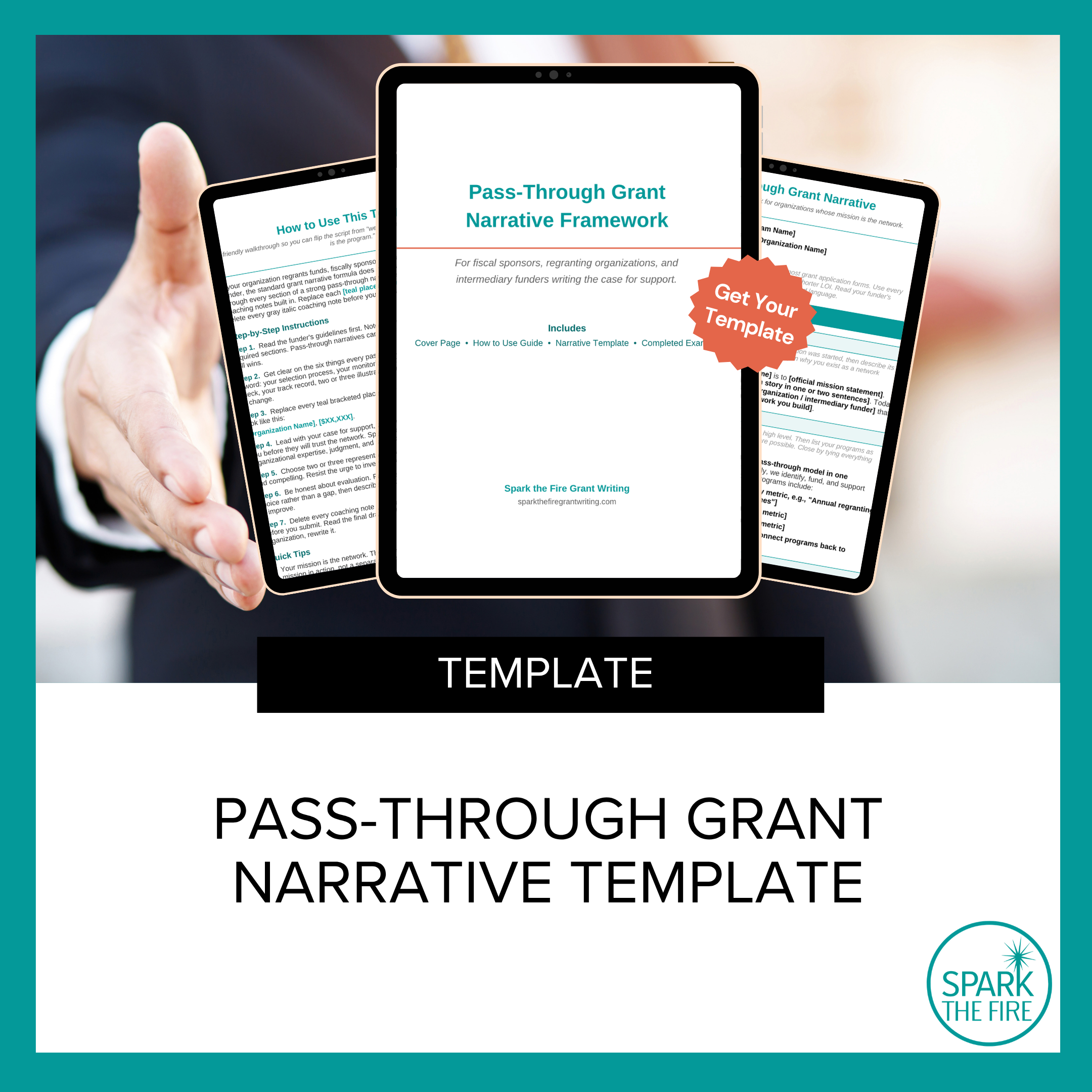
If you want a head start on structuring your narrative, my Pass-Through Grant Narrative Framework template is in the shop. It walks you through each section with placeholder language and coaching notes tailored to organizations in intermediary funding roles — so you're not starting from a blank page.
Have questions about a specific pass-through situation you're navigating? Drop them in the comments below.
Allison is a grant writing educator with 25+ years of experience. She is the founder of Spark the Fire Grant Writing and creator of the Certificate in Grant Writing program.
Tired of staring at a blank grant application wondering how to describe a "program" that lives at thirty different organizations?
If you write grants for a fiscal sponsor, regranting organization, or intermediary funder, you already know the standard formula doesn't fit. Your work happens through a network. Your subgrantees deliver the programs. And every funder application asks you to describe a project that, on paper, you don't really run.
The Pass-Through Grant Narrative Framework flips the script. Built around the five-section structure of a typical grant application form, this template makes the case that your curation, selection, and stewardship is the program. It guides you through every section funders expect, with the pass-through-specific work (theory of change, selection process, representative subgrantee examples, value-add, monitoring approach, and track record) built right into the places they belong.
What's inside (20 pages, Microsoft Word .docx):
Branded cover page
"How to Use This Template" walkthrough with step-by-step instructions and quick tips
Full narrative template covering all 18 questions across five sections, with placeholder language and coaching notes for every answer
A completed example (fictional Coastal Library Futures Fund) showing exactly how the placeholders translate into a real, fundable narrative
Built-in coaching notes in gray italic so you know what to write and why
Easy-to-replace placeholders that match the body text exactly — no reformatting required
Best for: Fiscal sponsors, regranting organizations, intermediary funders, statewide associations that grant to members, arts councils that fund individual artists, and any nonprofit that channels resources to a network rather than delivering programs directly.
Stop trying to force your work into a program-delivery mold. Start telling the story funders actually need to hear.