

One of the questions I'm asked most frequently is: where do you find grant opportunities?
If you're running out of prospects or your searches keep turning up the same handful of funders, here's a startling fact: ninety percent of foundations do not have websites.
That means if you're only searching Google, you're missing out on the vast majority of funding opportunities. This is where grant prospect research databases come in. These specialized tools give you access to hundreds of thousands of grantmaker profiles that you simply cannot find through a standard internet search.
After testing dozens of databases over the years, I've narrowed it down to three tried-and-true leaders plus one newcomer worth your attention in 2026. Let's dig in.
What's in This Article
Criteria We Use to Evaluate Databases
The Best Grant Prospect Research Databases of 2026
Quick Comparison: Which Database Includes What?
Pricing Summary
Pro Tip: Why You Should Rotate Databases
Frequently Asked Questions
Criteria We Use to Evaluate Databases
Not all grant databases are created equal. To determine the best options for 2026, we evaluated each platform against these criteria:
Number of Funder Profiles: How many grantmaker profiles are in the database? Competition is fierce for the best-known funders. Finding lesser-known grantmakers decreases competition and increases your likelihood of success.
Types of Funders Included: Does the database include private foundations only, or does it also cover government grants, corporate giving, clubs and associations, donor-advised funds, or international funders? The broader the coverage, the more opportunities you'll discover.
No Limitations by Grant Amount: Some databases exclude grantmakers who give under a threshold amount, such as $5,000. Small and rural organizations depend on these smaller grants, so we excluded databases with these limitations.
Mapping Features: The ability to plot where grants were given on a map helps you pinpoint the specific locations where funders make grants. Many grantmakers limit their giving to specific geographies, so seeing exactly where grants have been made helps you determine which funders to prioritize.
Email Reminders and Alerts: The best databases send you deadline reminders and new opportunities to review. Remembering to log into a database is far less effective than having opportunities delivered to your inbox.
Grants Management Capabilities: Can you track the grants you have submitted and plan to submit within the database? Some platforms allow you to create task lists, monitor deadlines, and manage your entire pipeline.
AI-Powered Features: New for 2026, we're evaluating whether databases incorporate artificial intelligence to improve prospect matching, provide explanations for why funders align with your organization, or offer personalized recommendations.
The Best Grant Prospect Research Databases of 2026
1. Instrumentl
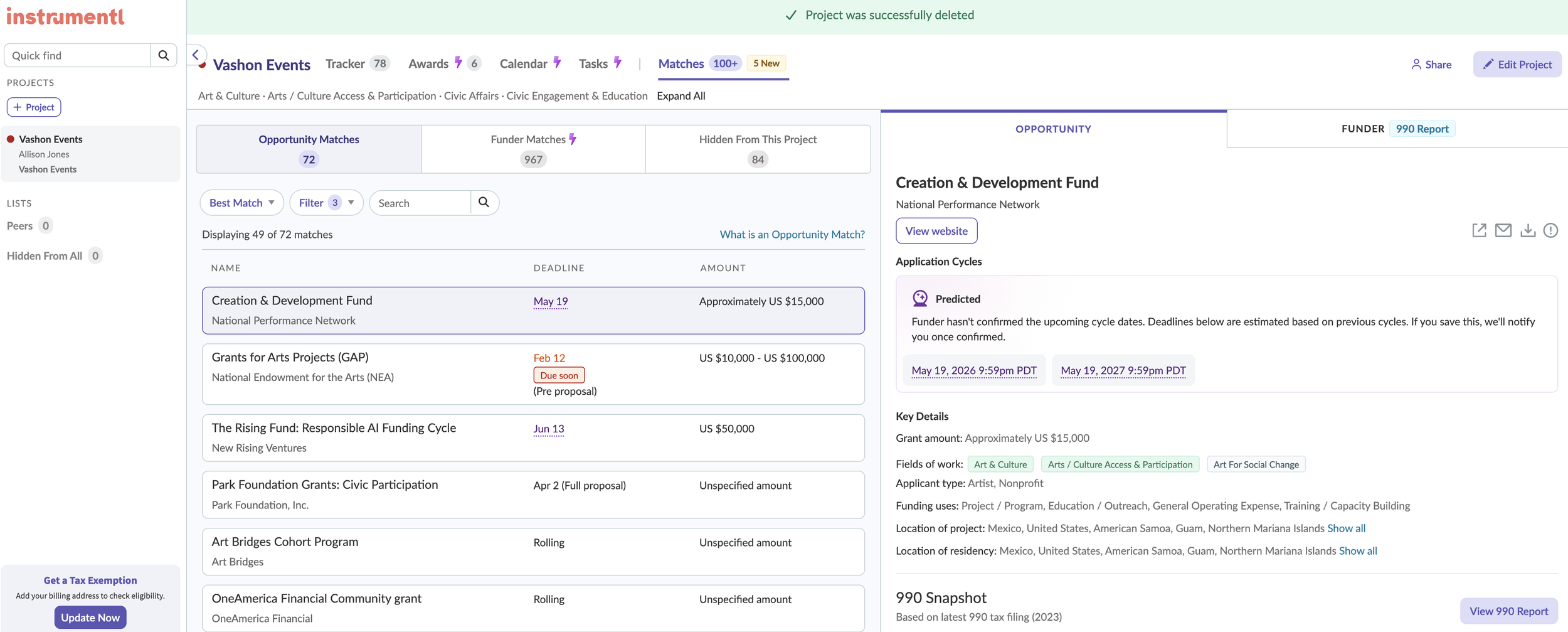
Instrumentl continues to lead the pack with the most comprehensive funder database on the market. What sets Instrumentl apart is how it works behind the scenes for you. Once you set up a project—something you want funding for—the platform keeps doing the research automatically and emails you new matches as they're discovered. You're not just searching once; you have an ongoing research assistant working in the background.
The database accuracy is exceptional. Instrumentl has a large staff constantly updating funder profiles to ensure the information you're seeing is current. Like Candid, Instrumentl also provides AI-powered funder recommendations with explanations for why each funder aligns with your organization—so you're not just getting a list, you're getting context.
The platform combines prospecting with pipeline management, allowing you to track prospects through the entire grant lifecycle from identification to submission to award.
One unique feature worth noting: Instrumentl includes donor-advised funds (DAFs) in their database. DAFs are notoriously difficult to research because they don't file their own 990s, so having them searchable here is a significant advantage.
INSTRUMENTL AT A GLANCE
Funder Profiles: 410,000 (the largest)
Funder Types: Private foundations, corporate funders, federal & state government, community foundations, clubs & societies, donor-advised funds
Pricing (monthly, with annual subscription):
Basic: $179/month
Core: $299/month
Pro Consultant: $499/month
Free Trial: Yes — Spark the Fire readers get a three-week free trial (instead of the standard two weeks) plus $50 off with code SPARKTHEFIRE50
Standout Features: Automated ongoing research, AI-powered funder matching with explanations, DAF inclusion, and excellent grants management
Best For: Organizations wanting prospecting and pipeline management unified in one powerful system with ongoing automated research
2. Candid
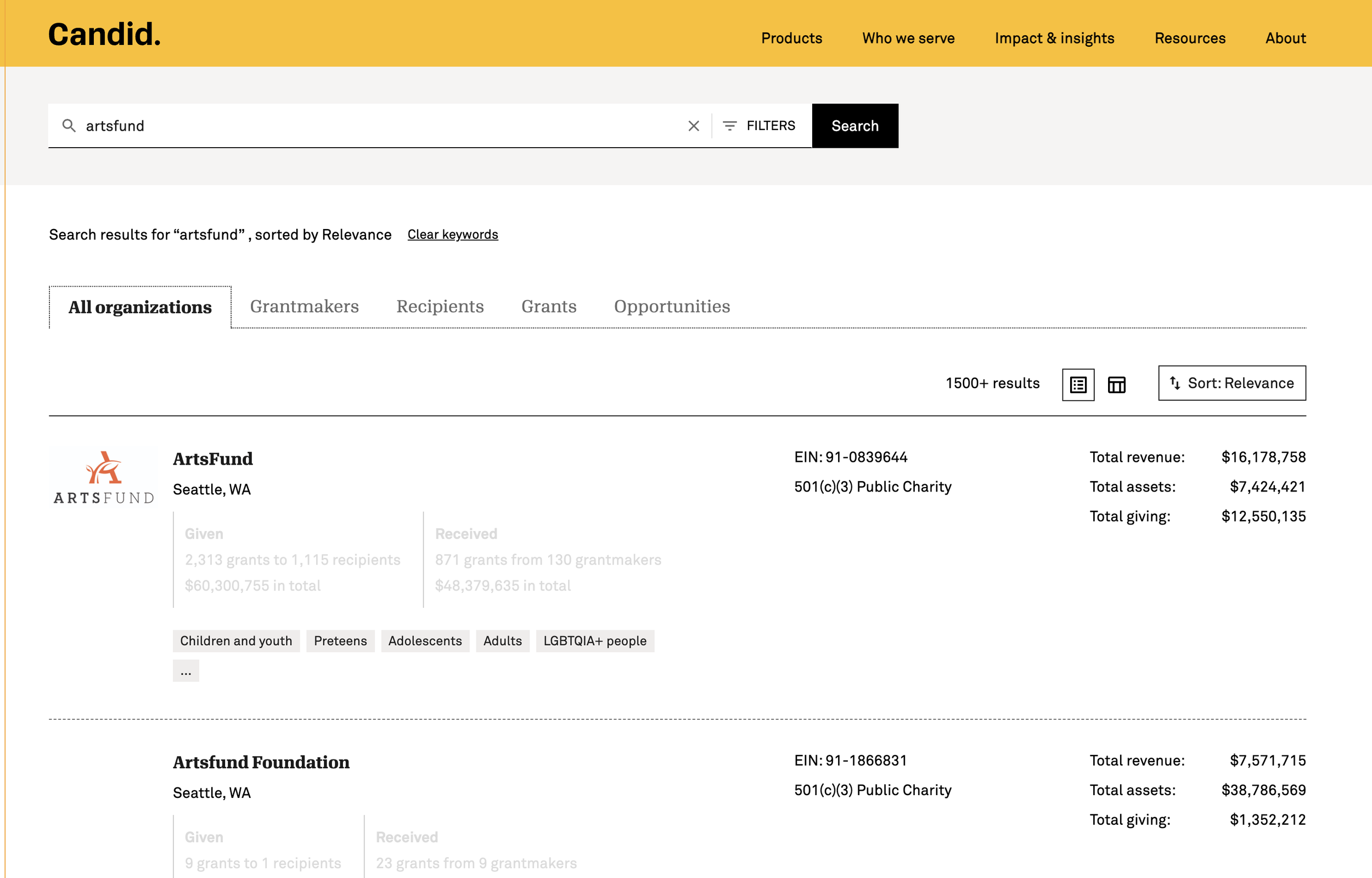
Big news for 2026: Candid Search officially launched on January 15, 2026, finally merging GuideStar and Foundation Directory data into a single platform. This is the culmination of the 2019 merger, and it's been worth the wait.
The new platform consolidates 1.9 million organizations, 3 million annual grant transactions, and $180 billion in annual grant dollars in one place. No more switching between sites to access nonprofit and funder data.
Candid has long set the industry standard for geographic mapping—you can pinpoint where a foundation makes grants down to the city, county, or even legislative district. This level of granularity saves significant research time. The new platform adds AI-powered funder recommendations with explanations for why each funder aligns with your organization, plus personalized dashboards that learn from your searches.
Here's something remarkable: The pricing dropped from approximately $299/month to around $100/month for Premium. That's a 66% decrease for the industry-standard research tool.
And here's something exciting for small nonprofits: Organizations with under $1 million in revenue or operating expenses can get Candid Premium for FREE when they earn a Gold Seal of Transparency. If you haven't claimed your Candid profile yet, now is the time. (Stay tuned—I'm working on a guide to help you earn your Gold Seal.)
CANDID AT A GLANCE
Funder Profiles: 304,000
Funder Types: Private & independent foundations, corporate foundations, public charities, U.S. federal funders (new with 2026 platform), international foundations
Pricing (monthly, with annual subscription): Approximately $100/month for Premium (down from $299!)
Free Access: Small nonprofits under $1M revenue get Premium FREE with a Gold Seal of Transparency
Free Trial: No
Standout Features: Best-in-class geographic mapping (down to legislative district), merged GuideStar + Foundation Directory data, AI-powered recommendations, data visualization coming soon
Best For: Deep researchers who want industry-standard data and small nonprofits who can access Premium for free through the Gold Seal program
3. GrantStation
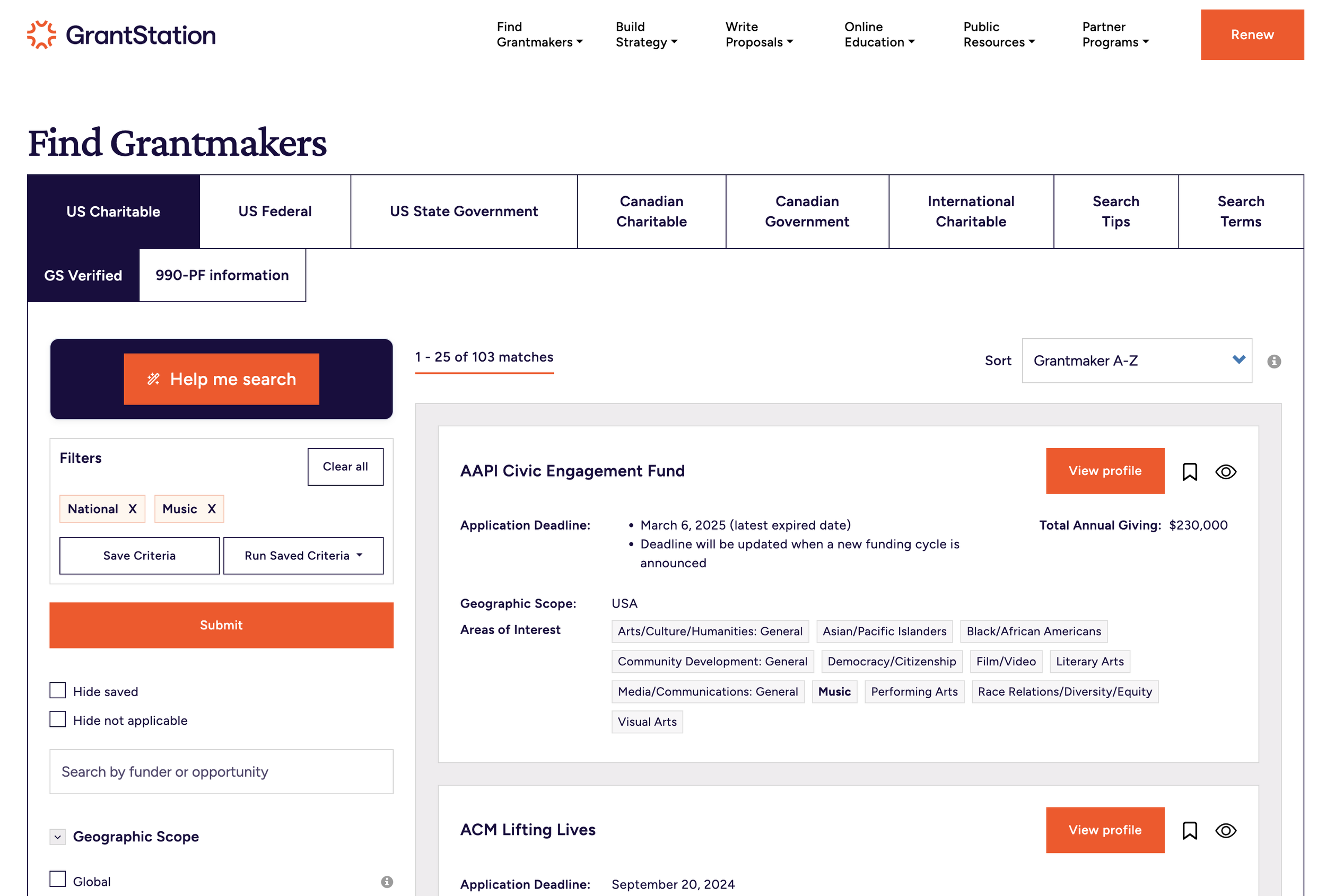
GrantStation was acquired by Elios Media Group in September 2024 and launched a refreshed dashboard in May 2025. The platform continues to offer comprehensive filter-based prospect research with an intuitive, easy-to-understand taxonomy.
What I appreciate about GrantStation is its accessibility and breadth of funder types. The interface is clean and straightforward—you don't need extensive training to start finding prospects.
GrantStation has two unique features you won't find elsewhere:
First, it's the only database that includes a specific filter for clubs and associations—think Rotary, Lions Club, Kiwanis, Elks, and similar organizations. If you're a smaller nonprofit looking for community-based funders, this is a significant advantage.
Second, GrantStation includes giving circles—groups of individuals who pool their money and decide together where to give. These funders are nearly impossible to find through other databases.
The platform also separates U.S., Canadian, and international funders into distinct search engines, making it easier to focus your research geographically. You can search U.S. charitable, federal, and state funders, plus Canadian charitable and government funders, plus international charitable funders—all through dedicated search tools.
GRANTSTATION AT A GLANCE
Funder Profiles: 150,000
Funder Types: Private foundations, corporate foundations, community foundations, corporate giving programs, faith-based funders, clubs & associations (Rotary, Lions, etc.), giving circles, U.S. federal & state government, Canadian government, international funders
Pricing (monthly, with annual subscription): $58/month ($699/year) regular price, or $12/month ($140/year) with the Spark the Fire discount code
Free Trial: No, but at this price point, the risk is minimal
Standout Features: Only database with clubs/associations filter, includes giving circles, broadest funder type coverage, separate search engines for U.S./Canadian/international
Best For: Organizations new to prospect research, those on tight budgets, or anyone seeking clubs, associations, and giving circles as funders
Email me at allison@sparkthefiregrantwriting.com to request the discount code.
4. Grant Frog — The Newcomer
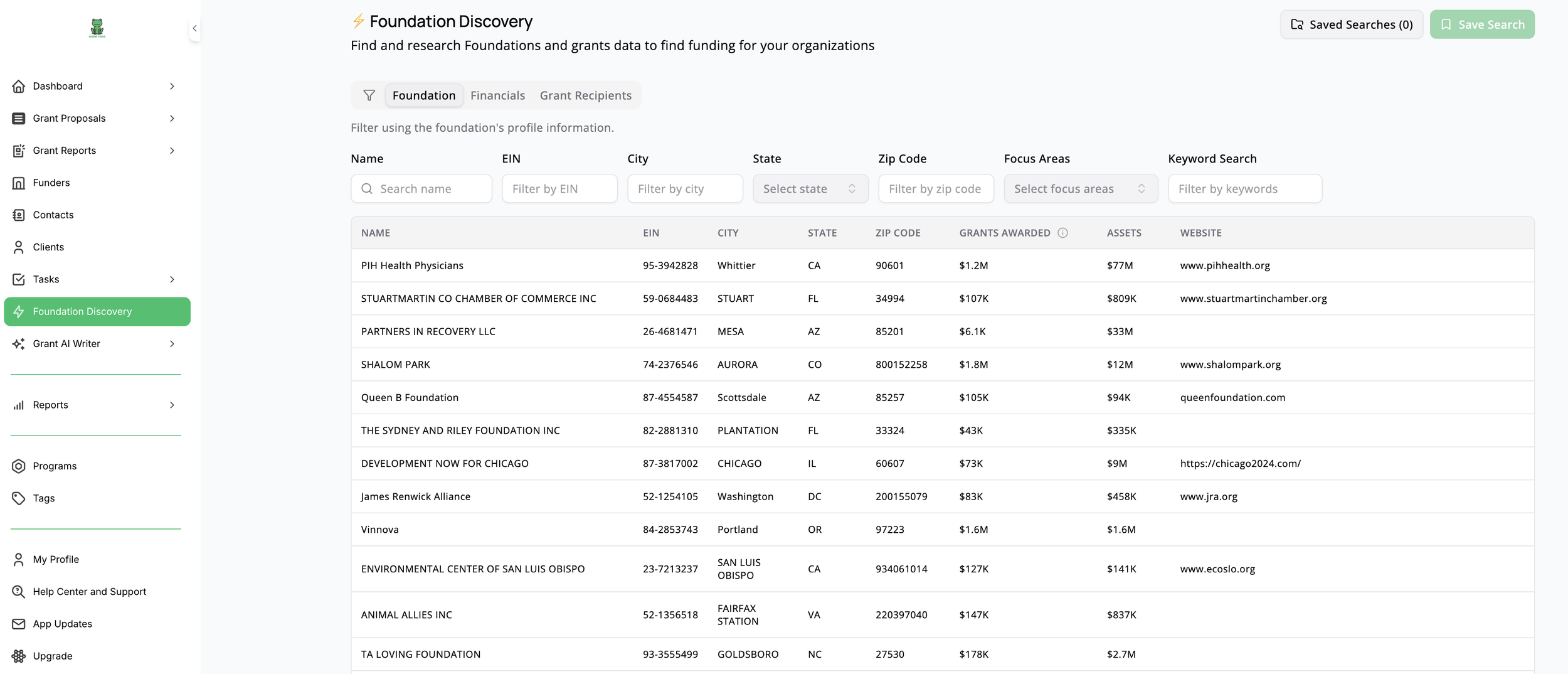
Grant Frog started as a grants management platform and has expanded into prospect research—and they've done it well. Their Foundation and Grant Discovery Database now includes 190,000 funders, pulled directly from IRS 990 forms.
What makes Grant Frog interesting is that it was built from the ground up for grants management by a working grant professional. If your primary need is tracking proposals, reports, deadlines, and funder relationships—and you also want solid prospecting built in—Grant Frog offers both in one affordable package.
The platform includes team collaboration features, automated email reminders, and task tracking. It's designed for organizations that want to run a structured grants program without juggling multiple tools.
One limitation to note: Because Grant Frog pulls data from 990 forms, the database includes foundations as well as some clubs, associations, and corporations. If you need government funding, you'll want to pair Grant Frog with Grants.gov.
GRANT FROG AT A GLANCE
Funder Profiles: 190,000
Funder Types: Private foundations (data sourced from IRS 990 forms; does not include government grants)
Pricing (monthly, with annual subscription):
Essentials: $99/month (2 users, 200 proposals)
Professional: $149/month (4 users, 1,000 proposals)
Premium: $349/month (10 users, 3,000 proposals)
Free Trial: Yes, 14 days with no credit card required
Standout Features: Excellent grants management, team collaboration, built by a grant writer for grant writers, 990 data visualization
Best For: Teams wanting solid prospecting with built-in grants management and collaboration features
Quick Comparison: Which Database Includes What?
Looking for federal or state government grants? ✓ Instrumentl ✓ GrantStation ✓ Candid (new with 2026 platform) ✗ Grant Frog
Looking for clubs and associations (Rotary, Lions, Kiwanis)? ✓ GrantStation (dedicated filter — unique!) ✓ Instrumentl ✗ Candid ✗ Grant Frog
Looking for giving circles? ✓ GrantStation (unique!) ✗ Others
Looking for donor-advised funds (DAFs)? ✓ Instrumentl (unique!) ✗ Others
Looking for international funders? ✓ GrantStation (dedicated search engine) ✓ Candid ✓ Instrumentl ✗ Grant Frog
Need excellent grants management built in? ✓ Instrumentl (excellent) ✓ Grant Frog (excellent) ○ Candid (basic) ○ GrantStation (basic)
Need AI-powered features? ✓ Instrumentl ✓ Candid ✗ GrantStation ○ Grant Frog (limited)
Best geographic mapping? Candid leads (down to city, county, legislative district), followed by Instrumentl
Pricing Summary
All prices shown as monthly rate with annual subscription
Instrumentl
Basic: $179/month
Core: $299/month
Pro Consultant: $499/month
Free 3-week trial + $50 off with code SPARKTHEFIRE50
Candid
Premium: ~$100/month (down from $299!)
FREE for small nonprofits (under $1M revenue) with Gold Seal of Transparency
GrantStation
Regular: $58/month ($699/year)
With Spark the Fire code: $12/month ($140/year)
Email allison@sparkthefiregrantwriting.com for discount code
Grant Frog
Essentials: $99/month
Professional: $149/month
Premium: $349/month
14-day free trial available
Pro Tip: Why You Should Rotate Databases
Here's something I've discovered after years of prospect research: you can find a grantmaker in one database, cross-reference it in another, and it's not there.
This is true across all of them. Each database has different data sources, different update schedules, and different inclusion criteria. A foundation that appears in Instrumentl might not show up in Candid, and vice versa.
My recommendation? Don't marry yourself to one database forever. Consider rotating your subscription every year or two to discover fresh prospects. The funders you find in your second year with a new database might be completely different from what you found before—and that means less competition and new opportunities for your organization.
A Note on Affiliate Links
Did you know? Spark the Fire offers scholarships for our grant writing courses, funded by affiliate commissions from Instrumentl and GrantStation. This scholarship fund supports Native American grant professionals, in honor of my great-grandfather, who was Native American.
When you use our affiliate links, you're not just getting a great deal—you're helping make grant writing education accessible to those who might not otherwise afford it.
Frequently Asked Questions
What is a grant prospect research database?
A grant prospect research database (sometimes called a grants database or funder database) is a specialized tool that compiles information on foundations, corporations, and government agencies that provide grant funding. These databases include grantmaker profiles, giving histories, application guidelines, and contact information that you cannot easily find through internet searches. Remember: 90% of foundations don't have websites, so these databases are essential for comprehensive prospect research.
Which database is best for small nonprofits?
For small nonprofits on tight budgets, I recommend starting with GrantStation at $140/year with our discount code. If your organization has under $1 million in revenue, you can also get Candid Premium for free by earning a Gold Seal of Transparency—that's an incredible deal for the industry-standard research tool.
Which database has the most funders?
Instrumentl leads with 410,000 funder profiles, followed by Candid (304,000), Grant Frog (190,000), and GrantStation (150,000). However, more isn't always better—the types of funders matter too. GrantStation has the broadest variety of funder types, while Grant Frog focuses exclusively on foundations.
Can I use more than one database?
Absolutely, and many larger organizations do. Each database has different strengths and different funder coverage. However, for most small to mid-sized organizations, one database at a time is sufficient—just consider rotating which one you use every year or two to find fresh prospects.
Where can I find clubs and associations like Rotary or Lions Club?
GrantStation is the only database with a dedicated filter for clubs and associations. They also include giving circles, which are nearly impossible to find elsewhere. Check your local newspaper or the yellow pages for clubs and association meetings near you.
Where can I research donor-advised funds (DAFs)?
Instrumentl includes donor-advised funds in their database—a unique feature since DAFs don't file their own 990s and are notoriously difficult to research.
Do any databases offer free trials?
Instrumentl offers a three-week free trial for Spark the Fire readers (use our link). Grant Frog offers a 14-day free trial with no credit card required. Candid and GrantStation do not currently offer free trials.
What's new in grant databases for 2026?
The biggest developments are the Candid merger going live and AI-powered features across platforms. Candid Search launched January 15, 2026, finally combining GuideStar and Foundation Directory data—and dropped prices from $299 to $100/month. Instrumentl's AI now explains why funders match your organization, not just that they exist. The field is evolving rapidly.
What about AI writing tools for grant proposals?
Great question—that's a topic for another article! AI writing assistants are becoming increasingly sophisticated, and several of these databases are adding AI writing features. Stay tuned for our upcoming comparison of AI grant writing tools.
Conclusion
There's no single "best" grant prospect research database—it depends on your organization's needs, budget, and workflow. But you can't go wrong with any of these four options in 2026:
Instrumentl for the most comprehensive database, automated ongoing research, and best-in-class pipeline management—plus unique access to donor-advised funds
Candid for industry-standard research depth, unmatched geographic mapping, and free access for qualifying small nonprofits through the Gold Seal program
GrantStation for budget-friendly simplicity and the widest variety of funder types—including the only dedicated filters for clubs, associations, and giving circles
Grant Frog for teams who need prospecting and grants management in one platform, built by a grant writer who understands your workflow
The field is evolving fast. Whichever you choose, remember that these tools are designed to save you time and surface opportunities you'd never find on your own. That 90% of foundations without websites? Now you know how to find them.
About the Author
Allison Jones, CEO and Founder of Spark the Fire Grant Writing Classes, LLC, built one of the highest-rated grant writing education programs in the world, recognized for four consecutive years. She holds the Grant Professional Certified (GPC) credential, is one of only 30 nationally approved trainers by the Grant Professionals Certification Institute, and has trained over 5,000 grant writers. Her book Meaningful Work is forthcoming in 2026.
Your Turn! Reply and Comment
👉 What databases do you use? I'd love to hear from you in the comments.
Want more grant writing tips delivered to your inbox? Subscribe to the Spark the Fire Newsletter.