
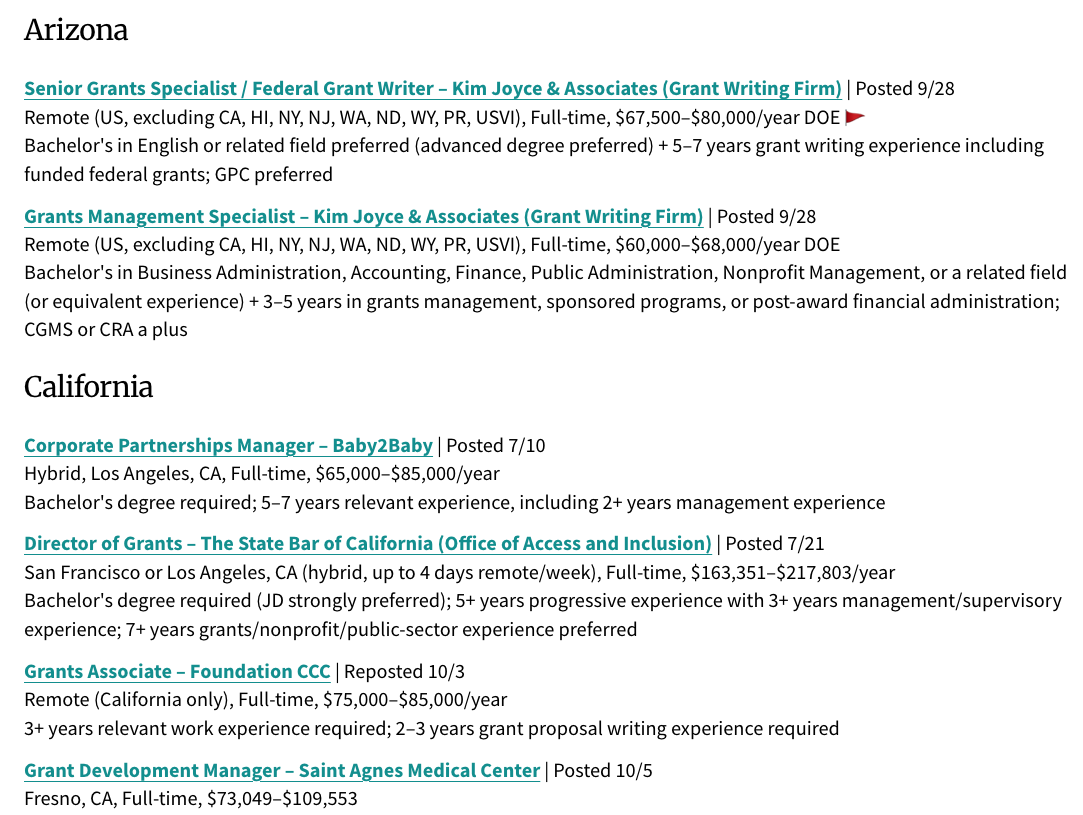
Screenshot of Spark the Fire Grant Writer Job Board
Our job board doesn't post grant writing jobs without pay. About four listings a week come to us with no pay information. When a listing includes contact information, we email the organization and ask for the range. Often there's no contact information at all, so the listing never goes up.
The Spark the Fire job board is a curated list of grant writing and grants management jobs. We don't list every fundraising role that mentions grants. A director of development position, for example, only goes on the board if the job is primarily grant writing. The board has more than 30 active grant writing jobs at any given time, gets more than 675 searches a month, and lists a salary or wage for every job.
Every listing gets formatted by our team before it goes up. We pull out the pay, hours, location, and qualifications so job seekers can compare roles side by side. After formatting a lot of listings, we kept flagging the same problems. We also started to see what the strong listings had in common.
A job description is the first piece of writing you see from a future employer. It shows how that organization plans, budgets, and communicates, and it often previews what the job will be like once you're in it. Use this list to filter listings faster and to prepare interview questions.
Table of Contents
Red flags in grant writing job descriptions
1. No pay listed
This is the most common reason a listing never makes it onto our board. Leaving out pay usually means the organization hasn't budgeted for the role, plans to offer as little as it can, or wants applicants to name a number first so it can hire below what it was willing to pay.
Phrases like "competitive salary" and "DOE" (depending on experience) count as no pay. They don't give you anything to compare against other offers, and they leave you guessing about whether an application is worth your time.

LinkedIn listed the salary; the organizational website did not.
A recent grants manager listing shows how this plays out. On the organization's own careers page, the benefits section runs to more than 20 items, down to the names of five staff committees. Under financial wellbeing, it lists "Competitive Compensation Packages," with no number. The same job posted on LinkedIn lists $55,000 a year.
When pay is missing from one posting, check the others. Employers often post the same job on several sites, and the pay can show up in one place and not another. In this case, the number matters. The job covers the full grant life cycle: funding research, federal proposals, budget development with Finance, post-award compliance, tracking subrecipient obligations and closeout, with a minimum of two years of experience required. Once you have the figure, you can weigh it against that scope, which is exactly what a listing without pay keeps you from doing.
Even well-written listings leave pay out. A recent grants specialist listing we came across had a lot going for it. The duties were specific, two years of experience fit the level of the role, and the benefits section named a 401(k) match and health coverage. It also had a full section titled "What You Bring Spiritually," covering faith commitment, alignment with the organization's statement of faith and personal spiritual growth. For a faith-based organization, being upfront about that is fair, and it saves everyone time. That listing knew exactly what it wanted from candidates, down to their spiritual lives. It never said what it would pay them.
Grant writers spend their careers asking funders for specific dollar amounts, backed by a budget that shows where every dollar goes. No funder would accept a request for "an amount to be determined." An employer who can't put a number on this position is showing you how transparent they'll be with you once you're on staff.
A growing number of states and cities, including Colorado, California, Washington, and New York, now require pay ranges in job postings. A listing based in one of those places that leaves out pay may not be following the law.
2. Pay that doesn't match the qualifications
This is the gap our red flag icon marks on the board. Some listings want a master's degree, 5+ years of experience, a proven funding track record, and a GPC, then offer $20/hour.

We flag listings in which the compensation does not match the qualifications.
That gap tells you the organization doesn't understand what grant work involves or what it's worth. Someone who meets every one of those qualifications is managing funder relationships, building project budgets, tracking outcomes for reports and hitting hard deadlines, often for several funders at once. Paying entry-level wages for that work often predicts other unrealistic expectations, like a funding goal set without looking at the organization's track record or which funders fit its work.
Flagging these listings isn't always comfortable. Grant writing is a small field, and sometimes the listing that earns the flag comes from a colleague we know and respect. We list it and flag it anyway. Job seekers need the same information about every role, no matter who posted it.
The flag doesn't mean a job isn't worth applying for. Some people take a lower-paying role for the experience, the location or the mission. The flag means the pay is below what those qualifications usually earn, so you can go in informed and negotiate accordingly.
3. Vague or shifting hours

Watch for phrases like "flexible hours," "as needed" or "part-time with potential for full-time" with no numbers attached. You can't judge whether the pay is fair if you don't know how many hours you're signing up for.
The risk is especially high for contract roles. Grant work is uneven. Deadlines cluster, and a federal application can take many times the hours of a foundation letter of interest. A contract that says "as needed" can mean ten hours one month and sixty the next, with no way to plan your other clients or income around it. Strong contract listings give an estimate per grant proposal or per month, or they state a project fee.
"Part-time with potential for full-time" deserves a direct question in the interview: what would need to happen for the role to become full-time, and when? If nobody can answer, the potential may not exist yet.
4. A "remote" job that isn't fully remote
Some listings say "remote" and later require you to live in one state, come in for regular meetings, or travel to sites. That's why our job board notes geographic limits, like Remote (Texas). Without that detail, job seekers lose time applying to jobs they were never eligible for.
These limits are legitimate. Employers have to register for payroll taxes in each state where staff live, and some state-funded positions require in-state staff. A limit is fine. Burying it in the last paragraph of the listing is where the trouble starts.
A clear remote listing covers where you need to live, how often you need to be on site, whether travel is reimbursed, and which time zone you're expected to work in. When those details only show up in the interview, it's fair to wonder what else the listing left out.
5. Missing or confusing qualifications
Some listings don't say what experience or education the job requires. Others contradict themselves, calling the job "entry-level" while asking for 7 years of experience.

Contradictions like these usually happen when a listing is pieced together from older job descriptions, or when several people added their wish lists without agreeing on what the role is.
A quieter version shows up when the title and the qualifications point to different jobs. A recent foundation grant development manager listing from a health system is a good example. The title says foundation grants. The skills that set strong candidates apart are almost all government work: complex federal, state, and county applications, government funding requirements, and grant portals. Foundation and government grant work overlap, but they aren't the same job. A writer who has spent years building foundation relationships and one who has managed federal applications would read that listing very differently. The same listing is labeled remote while naming a single city, and it doesn't list pay.
In each of these cases, the hiring manager hasn't worked out what the job is. A role that's unclear on paper is likely to stay unclear once you're in it, and unclear roles make it hard to show success at review time.
Listings that separate required qualifications from preferred ones are easier to read and usually come from more organized searches. When a listing doesn't, a good interview question is: "What would success in this role look like after six months?" The answer will tell you more than the qualifications section did.
6. Duplicate and reposted listings
When the same job shows up again and again, or keeps getting reposted with a new date, it can point to high turnover, a failed search or a job that's always posted but never filled.
A repost doesn't always mean something is wrong. A search can fall through, a budget can be approved late, or a top candidate can turn down the offer. Still, a grant writing job reposted several times in a year is worth looking into. Searching the organization's name on job sites can show how often it has hired for the role.
In the interview, ask how long the position has been open and what led to the opening. Turnover in a grant role costs an organization more than a hiring search. Funder relationships are built over years, and every time a grant writer leaves, some of that history leaves too.
7. Several jobs folded into one title
Watch for one role that covers grant writer, development director, events coordinator, communications manager and database administrator. It's a sign the organization is understaffed and hoping one person will fill every gap.

Watch out for job descriptions that include the kitchen sink.
This is also where our scope decisions happen. We list grant writing and grants management jobs, so a listing that's mostly events or major gifts, with grants as one line item, doesn't go on the board.
When a role is mostly grant writing but has everything else piled on, the grant work tends to get pushed aside. Events have fixed dates, and the newsletter has to go out. Grant proposals need long stretches of focused time, and they end up squeezed into whatever's left of the week. Look at the order the duties are listed in, and ask in the interview what share of the week goes to grants.
8. Commission-based or percentage-of-award pay
I was once offered a grant writing role at a VA hospital that paid on commission. I turned it down and told them that working on commission was unethical. Their response was that they'd find someone who would.
Some listings offer to pay a grant writer a percentage of the funds awarded, or to pay only when a grant comes through. The Grant Professionals Association prohibits this. Section 19 of the GPA Code of Ethics says members "shall not accept or pay a finder's fee, commission, or percentage compensation based on grants and shall take care to discourage organizations from making such payments."
Funding decisions depend on many things outside a grant writer's control, including the funder's budget, its priorities that cycle and the other requests in the pool. Commission pay shifts all of that risk onto the writer. It also ties the writer's paycheck to winning, which creates pressure to overpromise outcomes the organization can't deliver.
Some employers offering this arrangement don't know the profession's ethical standards. Others, like that hospital, hear the objection and go looking for someone who will say yes anyway.
Green flags in grant writing job descriptions
9. A clear, realistic pay range
A posted range like $35–$37/hr or $62,000–$70,000 shows that the organization has budgeted for the role, respects your time and hires in good faith. When the range fits the experience they're asking for, that's even better.
The range also needs to be narrow enough to mean something. A listing that posts $50,000 to $100,000 isn't really listing a salary range. It's hedging its bets. A spread that wide could describe an entry-level coordinator or a seasoned director, and it leaves you about where a listing with no pay does: guessing.
Strong listings often go further and name the benefits, such as health insurance, retirement contributions and paid time off. For part-time roles, it helps to know whether benefits apply at all, since that can change what the hourly rate is worth.
10. Specific hours and a clear work arrangement

Clear job descriptions point to an organized and well-managed organization.
Look for details like "10–15 hours/week," "full-time, hybrid (2 days in office)" or "fully remote, U.S.-based." Listings this specific come from employers who know what they need, and that clarity usually carries over into the job itself.
The best listings also say how the hours work around deadlines. A note like "occasional evening work during federal deadline periods" is honest about the job. It lets you decide up front whether the rhythm fits your life, instead of finding out in your first busy season.
For contract roles, a clear arrangement names how you'll be paid (hourly with an estimate, or a set fee per grant proposal) and how often you'll invoice. That tells you the organization has worked with contractors before and has a process for paying them on time.
11. Qualifications that fit the level of the job
A coordinator role that asks for 1–2 years of experience, or a director role that asks for 5+ years plus a track record of leading teams, shows the organization understands how grant careers progress.
Good listings are also specific about the kind of grant work involved. A listing that names federal, state, foundation or corporate funders tells you what your days will look like. A listing that mentions post-award work, like reporting and compliance, tells you the organization sees grants management as part of the job and not an afterthought.
"GPC preferred" is a good sign too. It means the employer recognizes professional credentials without making them a barrier for strong writers who are still building toward the exam.
12. Clear dates and a defined timeline
A posted date, a stated closing date and an outline of the hiring process point to an organized search. That matters, because grant work runs on deadlines, and an organization that can manage a hiring timeline is more likely to manage a grant calendar.
An outlined process also tells you how much time the application will take. If the process includes a writing exercise, the listing should say so. A short, defined exercise is a reasonable way to assess writing. A request to write a full grant proposal for free, before an offer, is unpaid work, and it's fair to ask about it before you agree.
13. Room to grow
Look for phrases like "potential for growth," an explained career path or support for professional development, such as conference fees, GPA membership, GPC exam prep or a training budget. These suggest the organization plans to keep and invest in its grant staff.
Growth matters to the organization as much as to you. Funders get to know the people they work with, and a grant writer who stays for years carries that relationship history. An employer who sees its grant writer as a one-off hire is more likely to see that person burn out and leave, and to start over with its funders each time.
Turning red flags into interview questions

A listing with a gap isn't always a dealbreaker. The interview is where you can fill in what the job description left out. Questions like these are a normal part of hiring:
What is the budgeted pay range for this role?
How many hours a week do you expect, and does that change around deadlines?
Are there location, in-office or travel requirements?
How long has this position been open, and what led to the opening?
Which of the listed duties take up most of the week, and what share of the week goes to grants?
What would success in this role look like after six months?
Grant writers ask funders for clarity as part of the job. Asking a future employer for the same clarity is reasonable, and how they answer is useful information.
Frequently asked questions
What jobs are listed on the Spark the Fire job board?
Grant writing and grants management jobs only. We don't list general fundraising or development roles unless the position is primarily grant writing. Every job on the board lists a salary or wage, and listings with red flags, like pay that doesn't match the qualifications, are marked so you can see them before you apply.
Should I skip grant writing jobs that don't list pay?
Not necessarily. A missing range is a reason to ask early, before you put hours into an application or interview. If the organization still won't share a range once you ask, that answer tells you something too.
Is it ethical for a grant writer to be paid a percentage of the grant award?
No. Section 19 of the GPA Code of Ethics prohibits finder's fees, commissions and percentage compensation based on grants. Hourly rates, flat project fees and salaries are the standard ways grant professionals are paid.
Do grant writing jobs require the GPC?
Many listings name the GPC (Grant Professional Certified) credential as preferred rather than required. When it shows up as preferred, the employer values professional standards while leaving the door open to strong candidates who haven't sat for the exam yet.
What does "Remote (Texas)" mean on a job listing?
The job is remote, but the employer will only hire someone who lives in Texas. Employers set limits like this for reasons such as payroll registration or state contract requirements. We note these limits on our job board so you can skip roles you aren't eligible for.
Is a reposted job listing always a bad sign?
No. Searches fall through, budgets get approved late, and good candidates sometimes turn down offers. A listing that has been reposted several times is simply worth a question during the interview.
Our Certificate in Grant Writing walks through the full grant proposal process, and graduates keep lifetime access to the course materials and our community.
Cheering you on,
Allison