The Art of the Grant Letter of Support (And Why You Should Write It Yourself)
What Is a Letter of Support (and Why Should You Care)?
If you've ever submitted a grant proposal, you've probably seen the line buried somewhere in the application guidelines: "Please include letters of support from partnering organizations." Sometimes it's required. Sometimes it's listed as optional. And sometimes there's no mention of it at all — which is exactly when a well-placed letter of support can set your proposal apart from the stack.
So what exactly is a letter of support? At its core, it's a document from an external organization, agency, or individual that says, "We believe in this project, and here's why." It demonstrates that your work doesn't exist in a vacuum — that your community, your partners, and your stakeholders are invested in what you're proposing to do.
Think of letters of support as the credibility section of your proposal that someone else writes on your behalf. They tell the reviewer that real people and real organizations have enough confidence in your project to put their name on it.
Here's the thing most grant writers miss: even when letters of support aren't explicitly required, including them is almost always a good idea. They add weight to your proposal. They show that you've done the legwork of building relationships. And in a competitive funding environment — which, let's be honest, is every funding environment right now — they can be the difference between a proposal that reads like a wish list and one that reads like a community-backed plan of action.
But here's the catch: not all letters of support are created equal. And most of them? They're not very good.
Letter of Support vs. Letter of Commitment: Know the Difference
Before we go further, let's clear up something that trips up a lot of grant writers: letters of support and letters of commitment are not the same thing, and some funders care very much about the distinction.
A letter of support is an endorsement. It says, "We believe in this project, and we think it's important." It demonstrates goodwill, community backing, and alignment with the project's goals. But it doesn't necessarily promise that the writer will contribute resources or participate directly.
A letter of commitment, on the other hand, is a promise. It says, "We are committing specific resources to this project — here's exactly what we'll provide." That might be funding, staff time, facility access, equipment, or services. It's a binding pledge that the funder can hold you and your partner accountable for.
Some funding opportunities ask for one or the other. Some ask for both. Some don't distinguish between them at all. Read your guidelines carefully. When in doubt, err on the side of being more specific — a letter that includes concrete commitments is always stronger than one that's purely endorsement. And if the funder asks for letters of commitment, make sure your partners understand they're making a real promise, not just offering moral support.
The Golden Rule: Write It Yourself
I'm going to share something that might sound counterintuitive: the best way to get a great letter of support is to write it yourself.
I learned this the hard way. Early in my career, I was working on a federal grant application with a tight deadline — as if there's any other kind. I had sent out requests for letters of support to several partner organizations weeks in advance. I was organized. I was proactive. I was feeling good about my timeline.
And then the deadline started creeping closer. And closer. And I hadn't heard back from half of my partners. The ones who did respond? Let's just say the letters were... underwhelming. Generic. The kind of letter that says, "We support this project" without ever mentioning what the project actually is. One of them had spelling errors. Another addressed it to the wrong organization.
That was the last time I left letters of support in someone else's hands.
Here's what I do now, and what I recommend to every grant writer I teach: you write the letter, and then you ask your partner to review it, add their own personal touch, and sign it on their letterhead.
Why does this work so much better? Because you know the details of the grant. You know the project name, the applicant organization, the funder, the goals, and the timeline. You know what the reviewer needs to see. Your partners — no matter how supportive they are — don't have that information at their fingertips, and they certainly don't have time to dig through an RFP to figure out what to emphasize.
When you draft the letter, you control the quality. When you hand it to your partner for their edits, you give them ownership. It's a win-win.
Every letter of support you draft should include:
The full name of the project or program
The name of the applicant organization
The name of the funder (yes, specifically — not "Dear Grant Committee")
A clear statement of the relationship between the partner and the applicant
Specific details about what the partner will contribute or how they're involved
Contact information for the person signing the letter
That last point matters more than you think. A letter signed by the executive director with their direct phone number and email tells the reviewer this is a real relationship, not a favor someone did over lunch.
A note on who signs the letter: Get the highest-ranking person you reasonably can. A letter signed by an executive director or CEO carries significantly more weight than one from a program coordinator. It signals that the organization's leadership — not just one enthusiastic staff member — has endorsed and authorized this commitment. If the ED can't write the letter, that's fine. But they should be the ones signing it.
A note on length: Keep it to one page. Two pages maximum if the partnership is complex and the details warrant it. Reviewers are reading dozens of proposals. A concise, meaty one-pager will always outperform a rambling two-pager. Every sentence should earn its place.
Community Support Letters vs. Working Partnership Letters
Not all letters of support serve the same purpose, and recognizing the difference will make your proposal stronger.
Community Support Letters
These are your broad endorsement letters. They come from organizations, leaders, or stakeholders in your community who believe in the work you're doing and want to go on record saying so. A community support letter might come from a local United Way chapter, a school district superintendent, a faith-based organization, or a neighborhood association.
Community support letters demonstrate that your project has buy-in beyond your own four walls. They tell the reviewer, "This isn't just one organization's idea — the community wants this."
Even these letters should be specific. They should name the project, reference the community need, and explain why the letter writer believes this particular approach will make a difference. A letter that says "We wholeheartedly support Organization X's important work in our community" is a puff piece. A letter that says "We have seen firsthand the gap in after-school programming for middle school students in the Eastside corridor, and Organization X's proposed STEM mentoring initiative directly addresses a need our families have identified for the past three years" — now that's a letter that does some heavy lifting.
Working Partnership Letters
This is where letters of support become truly powerful — and where most people drop the ball.
If you have a working partnership with another organization on the proposed project, the letter of support needs to spell out exactly how that partnership functions. This is not the place to be vague. Reviewers want to see that you've actually thought through the logistics, not just exchanged pleasantries at a networking event.
A strong working partnership letter should address:
The specific role each partner plays. Who does what? What services does the partner provide? What does the applicant provide? How do the pieces fit together?
How money moves. If there's a financial component to the partnership, the letter should outline it clearly. Is the partner receiving a subaward? How much? For what services? Spell it out.
Subcontractor responsibilities. If a partner is serving as a subcontractor, the letter should acknowledge joint responsibility for reporting and deliverables. This tells the reviewer that both organizations understand their obligations — not just the applicant.
Timeline and coordination. How often will the partners communicate? Who is the point of contact? Is there a shared governance structure?
In-kind contributions with dollar values. If a partner is providing space, staff time, equipment, or expertise rather than cash, don't just mention it — quantify it. "We will dedicate 200 square feet of classroom space for weekly programming, valued at $12,000 annually" is infinitely more persuasive than "We will provide space for the program." Funders want to see that both parties understand the real value of what's being contributed.
The partner's qualifications and track record. Why is this the right partner for this work? A brief statement about the partner organization's relevant experience and expertise tells the reviewer this isn't a random collaboration — it's a strategic one. "As the region's largest provider of workforce development services, having served over 3,000 job seekers in the past five years, we are uniquely positioned to support participant recruitment and career placement for this initiative."
What the partner gets out of it. Reviewers are smart. They know that the strongest partnerships are mutually beneficial, not one-sided favors. The letter should articulate how this project aligns with the partner's own mission or strategic plan. When a reviewer can see that both organizations have skin in the game, the partnership reads as sustainable, not transactional.
Population access and referral commitments. If the partner is referring clients, recruiting participants, or providing access to a target population, spell out the specifics. How many people? Through what channels? On what timeline? "We will refer a minimum of 50 eligible families per quarter through our intake process and existing case management relationships" gives the reviewer confidence that your participant numbers aren't wishful thinking.
Sustainability beyond the grant period. This is the one that separates good letters from great ones. Any indication that the partnership will continue after the funding ends tells the reviewer that this project has legs. Maybe the partner commits to continuing referrals. Maybe they'll absorb a program component into their existing services. Even a sentence about long-term intentions signals that this isn't a one-and-done collaboration.
Think of it this way: if a reviewer reads your partnership letter and still has questions about how the collaboration actually works, the letter didn't do its job.
The Legislator Play
Here's a move that not enough grant writers are making: asking your elected officials for letters of support.
Yes, you can do this. And yes, it's worth the effort.
A letter of support from a state legislator, a member of Congress, or even a city council member adds a layer of credibility that few other letters can match. It signals to the funder that your project has visibility and support at the policy level — and for federal grants especially, that kind of endorsement carries weight.
But here's the thing: legislator offices are busy. They get hundreds of requests. If you send a vague email asking your state senator to "write a letter supporting our grant," you're going to get one of two things: silence, or a form letter so generic it might as well be addressed "To Whom It May Concern."
So apply the same golden rule: write the letter for them.
Draft a letter that includes all the relevant project details, explains why the project matters to their constituents, and connects the work to issues the legislator cares about. Then send it to their office with a clear, polite request: "We've drafted a letter for your review and would welcome any edits. We'd love the opportunity to brief you or your staff on the project."
That briefing is the key. Don't skip it. Whether you get five minutes with a legislative aide or a phone call with the legislator themselves, take the time to walk them through what you're doing and why it matters. This accomplishes two things:
First, it makes the letter authentic. A legislator who actually understands your project can add a sentence or two in their own voice that transforms a drafted letter into a genuine endorsement.
Second — and this is the long game — it puts your project on their radar. Legislators who understand and support your work today may become advocates for your funding tomorrow. That conversation could lead to a future appropriation, a mention in a committee hearing, or ongoing support that extends well beyond a single grant cycle.
After You Hit Submit: Thank Your Letter Writers
This one is quick but important: after you submit the proposal, circle back to every person and organization that provided a letter of support. Send a thank-you. Let them know the proposal went in. And when you hear back from the funder — win or lose — let them know the outcome.
This isn't just good manners (though it is). It's strategic. The people who write letters for you today are the same people you'll need letters from next year. Keeping them in the loop builds trust, strengthens the relationship, and makes them far more likely to say yes the next time you ask. Nobody wants to write a letter and then never hear what happened.
A quick email is all it takes. Something like: "Thank you for your letter of support for our XYZ proposal to the ABC Foundation. We submitted on time and expect to hear back in three months. I'll keep you posted — and I appreciate your partnership."
That's it. Thirty seconds of your time. A lifetime of goodwill.
FAQ
How many letters of support should I include in a grant proposal?
If the application specifies a number, follow it. If it doesn't, aim for quality over quantity. Three strong, specific letters will serve you better than five generic ones. Match your letters to the story your proposal is telling — community letters for broad support, partnership letters for collaborative projects, and legislator letters when policy-level credibility matters.
What if my partner changes the letter I drafted and I don't like their edits?
This happens, and it's a judgment call. If the edits are stylistic, let them go — it's their letter now, and their voice makes it more authentic. If they've removed critical details (like the project name or their specific role), gently explain why those details matter for the reviewer and ask if you can work together on a version that feels right to both of you.
Should letters of support be addressed to the funder or "To Whom It May Concern"?
Always address the letter to the specific funder when possible. "Dear [Program Officer Name]" or "Dear [Foundation Name] Review Committee" tells the reviewer this letter was written for this proposal, not pulled from a filing cabinet. It's a small detail that signals intentionality.
Can I use the same letter of support for multiple grant applications?
You can reuse the relationship, but not the letter. Each letter should reference the specific grant, the specific funder, and the specific project. Reviewers can spot a recycled letter instantly, and it undermines the credibility you're trying to build.
When should I ask for letters of support — at the beginning of the grant process or closer to the deadline?
Start early. As soon as you know you're applying, reach out to your partners and begin drafting. Give them at least two to three weeks to review and sign — more if you're working with a legislator's office. Chasing letters the week before a deadline is a stress you don't need.
What's the difference between a letter of support and a letter of commitment?
A letter of support is an endorsement — it says the writer believes in your project. A letter of commitment goes further — it pledges specific resources like funding, staff time, or facilities. Some funders require one or the other, so read your guidelines carefully. When in doubt, include concrete commitments in your letters; a letter that promises something specific is always stronger than one that just cheers from the sidelines.
And if you're tired of scrambling for letters at the last minute, download my Letter of Support Template— it's a plug-and-play framework you can customize for community partners, working partnerships, and legislator offices.
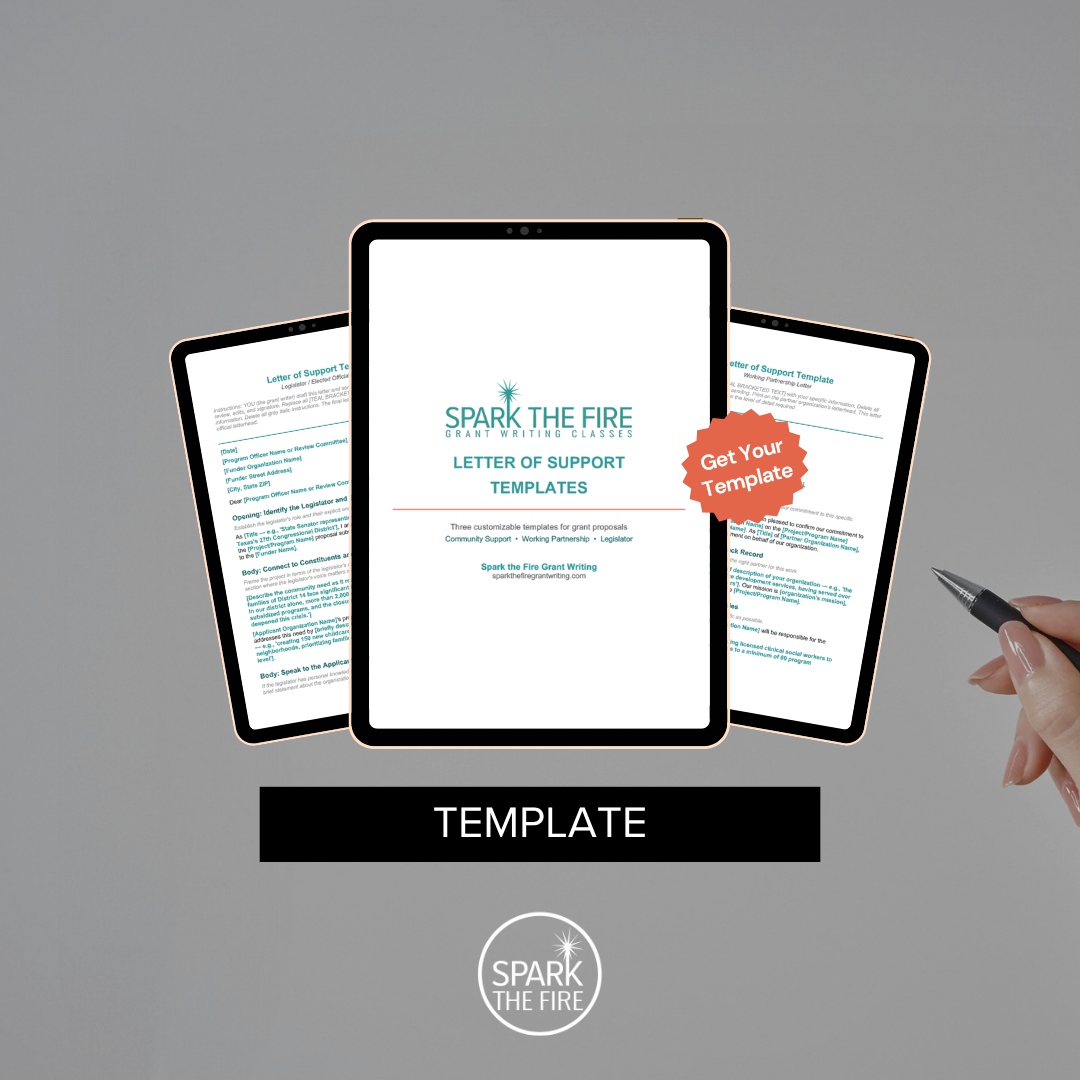
If you've ever sent a letter of support request to a partner and gotten back something so generic it could've been written for any grant on the planet, these templates are for you.
Letters of support can be one of the most powerful parts of your grant proposal, but most are vague, impersonal, and forgettable. The secret is to write them yourself, then hand them to your partners to personalize and sign. These templates make that process fast, easy, and foolproof.
What's inside:
• Community Support Letter, for organizations, leaders, or community stakeholders endorsing your project
• Working Partnership Letter, the most detailed template in the pack, for active collaborators with specific roles, financial arrangements, and in-kind contributions
• Legislator / Elected Official Letter, designed for you to draft on behalf of an elected official and send to their office for review and signature
• Fill-in-the-blank prompts in bold teal
• Gray italic coaching notes (delete before sending)
• A "How to Use These Templates" instruction page
• Quick tips on length, who should sign, and when to start collecting letters
Designed for grant writers, nonprofit development staff, program managers, and anyone who's ever chased down a letter of support the week before a deadline. Downloadable Word Doc (.docx), fully editable for any grant, partner, or project. Built by a grant writer, for grant writers.
Want more grant writing tips delivered to your inbox? Subscribe to the Spark the Fire Newsletter.