Can You Include In-Kind in Your Grant Budget? Here's What I Tell My Clients

Table of Contents
One of the questions I get from clients — and from grant writers helping their clients — is some version of this: "We have a lot of in-kind support. Can we include it in our budget?"
The short answer is almost always yes. But the longer answer, which is the one that actually helps your organization, involves understanding which budget you're talking about, how in-kind is valued and documented, and what funders are actually looking for when they set those minimum budget thresholds.
Let me walk you through what I've seen in 25+ years of this work, including some examples that still stick with me.
What Is In-Kind, Anyway?
In-kind contributions are non-cash donations of goods or services that have a measurable dollar value. They can take a lot of forms:
Space and facilities — donated office space, warehouse use, meeting rooms, performance venues
Equipment and supplies — donated computers, instruments, vehicles, materials
Personnel and volunteer time — board members donating professional services, volunteers providing skilled labor
Professional services — donated legal, accounting, marketing, or consulting services
Other goods — donated food, clothing, furniture, printing, technology
Two of my favorite examples illustrate just how significant in-kind can be for a nonprofit. The Starlight Children's Foundation once operated out of a warehouse donated by Nintendo — that's not a small line item. And at St. Francis House, the Executive Director was a nun who, by her vow of poverty, did not accept a salary. The leadership of the entire organization was, in essence, an in-kind contribution.
Both are real. Both are meaningful. And both need to be handled carefully when it comes to grant budgets.
In-Kind in Your Project Budget vs. Your Organizational Budget
This is the distinction that trips up most clients — and honestly, a lot of grant writers too. These are two different things.
Your project budget is what you submit with a specific grant application. It shows the costs of the particular program or project the funder would be supporting, and how those costs will be covered. Including in-kind here is common, expected, and often encouraged. It demonstrates that your community is invested in this work and that grant dollars will be leveraged by additional support.
If you're running a performance program and a supplier donates piano rentals for every show, that belongs in your project budget. If a board member who is a composer is contributing their creative work to the project at no charge, that has value and it belongs in the budget too — clearly labeled as in-kind.
Your organizational budget is a different animal. This is your overall annual operating budget — the number that appears on your IRS Form 990. It reflects your organization's total financial activity for the year.
When clients ask me about adding in-kind to their organizational budget specifically to reach a funder's minimum budget threshold, I have to pump the brakes. That's a different conversation.
The Funder Threshold Question
Budget thresholds exist because funders use them as a quick proxy for organizational size and stability. "We only fund nonprofits with an annual budget of $250,000 or more" is shorthand for: we want to know you have the infrastructure to manage this money responsibly.
Here's where I always advise clients to start: confirm with the funder exactly what they mean.
Most funders who set a budget threshold are looking at your 990 — specifically the total revenue or total expenses line. But not all of them specify. Before assuming your in-kind contributions will or won't count toward their definition, reach out and ask. I've seen funders say "organizational budget excluding in-kind revenue" right in their application guidelines. I've also seen funders who are happy to count documented in-kind if it's consistent with how you file.
The worst thing you can do is make an assumption, inflate a number, and then have it not match your financial statements when they ask for documentation. That's not a conversation you want to have.
Why Organizational Capacity Still Matters
Even if a funder does allow you to count in-kind in your organizational budget, I want my clients to think carefully about what that budget actually communicates.
Funders set minimum budgets because they want to know you have the capacity to manage a grant. That means paid staff, financial systems, reporting processes, and administrative infrastructure. A $100,000 organizational budget that is mostly in-kind contributions — donated space, donated leadership, donated services — may technically hit a $100k threshold but still leave a funder wondering: who is doing the day-to-day operations work? Who is filing the reports? Who is answering the phone?
This doesn't mean in-kind devalues your organization. It absolutely doesn't. The Starlight Children's Foundation example shows how in-kind support from a major corporate partner can represent serious community investment. But if a funder's concern is organizational stability, a budget built primarily on in-kind contributions tells a different story than one built on earned revenue, individual donations, and diverse grant funding.
My advice to clients in this situation: use in-kind to tell the story of your community partnerships and support. Be transparent and proud of it. But also work on diversifying your revenue base so that the organizational budget thresholds become a non-issue over time.
The CPA Conversation You Need to Have
This is the piece clients most often skip, and it's the one that can create the most problems down the road.
How you value, document, and report in-kind contributions has IRS implications. Your accountant needs to know how you're currently booking in-kind donations — and if you're not booking them at all, that's a conversation you need to have before you start including them in grant budgets.
A few things to sort out with your CPA or financial advisor:
How are in-kind donations currently recorded in your financial statements?
How is value determined? Fair market value rules apply, and they vary by the type of contribution.
What documentation do you have from donors? For services and goods, you typically need written acknowledgment from the donor with a description and value.
Are in-kind contributions reflected on your 990? If you're reporting in-kind in your grant budgets but they're not showing up on your financial statements, that inconsistency will raise flags.
Consistent documentation and accounting for in-kind doesn't just protect you with grant funders — it also strengthens your organization's credibility with auditors and donors overall.
How to Present In-Kind Compellingly
Once you've confirmed that in-kind is appropriate to include and you have your documentation in order, here's how to make it work for you in a grant budget — not just satisfy a requirement, but actually strengthen your application.
Be transparent and specific. Don't lump in-kind into a vague line. Name the contributor, describe the contribution, and provide the valuation method. "Donated warehouse space — Nintendo Corporation — 12 months at fair market rate of $X/month" tells a much more compelling story than "donated space — $X."
Show the match. Many funders love to see that their dollars are being leveraged by community support. In-kind contributions are one of the best ways to demonstrate that your organization has buy-in beyond the grant check.
A "match" — sometimes called a cost share — is the portion of your project's total cost that your organization covers with non-grant funds. When a funder requires a 1:1 match, for example, they're asking you to bring an equal amount to the table: a $50,000 grant requires $50,000 in matching funds. When in-kind contributions can count toward that match, they become a powerful tool for demonstrating community investment — proof that grant dollars are being leveraged by support that already exists in your ecosystem.
One useful resource for quantifying volunteer involvement: the Independent Sector publishes an annual value of volunteer time that can help you put a dollar figure on general volunteer contributions for grant narrative or supplemental budget purposes: Value of Volunteer Time – Independent Sector. That said — and this is important — using this rate to describe or tell the story of your volunteer base is not the same as counting general volunteer time as in-kind on your financial statements. The IRS standard for reporting in-kind contributions on your 990 requires skilled or professional services, not general labor. So by all means, use the Independent Sector rate as a storytelling and quantification tool. Just don't treat it as an accounting entry.
Separate columns, not separate budgets. In a grant project budget, consider showing a column for "cash" and a column for "in-kind" so reviewers can immediately see both the total project cost and how it's being covered. This kind of transparency builds trust.
Educate your client. If you're a grant writer working with a nonprofit, take the time to explain not just what in-kind is, but why it matters — to funders, to their 990, and to their long-term financial health. The CPA conversation I mentioned? You might be the one who prompts them to have it.
Frequently Asked Questions About In-Kind in Grant Budgets
Can volunteer time be counted as in-kind in a grant budget?
Yes — but only for skilled volunteer services. The IRS distinguishes between skilled volunteer time (an attorney donating legal advice, a composer donating creative work) and general volunteer time (stuffing envelopes). Skilled services can be valued at the professional rate. General volunteer time is typically not reported as in-kind on financial statements, though some grant applications may ask you to quantify it separately.
Does in-kind count toward matching requirements?
Often yes — but always check the funder's guidelines. Many federal and foundation funders explicitly allow in-kind contributions to satisfy match requirements. Others require cash match only. This is a question worth asking before you invest time in an application.
What if a funder asks for an organizational budget that excludes in-kind?
Follow the instructions exactly. Some funders — particularly those using a standardized common grant application — will specify whether they want the budget with or without in-kind. When in doubt, ask. They'd rather answer a quick question than receive an application that doesn't meet their criteria.
How do I value donated space?
Use fair market value — what it would cost to rent comparable space in the same geographic market. Get a letter or documentation from the donor confirming the donation and the fair market value they're assigning to it.
My client wants to include in-kind in their org budget to reach a funder threshold. Is that okay?
This is one of the most common situations I walk clients through, and the answer has a few layers.
First, check the funder's guidelines carefully for how they define "organizational budget." Some funders specify the exact line from the 990 they want (total revenue, total expenses), and some explicitly state whether in-kind counts. If it's not clear, contact the funder and ask before you invest time in the application. Most program officers would rather answer a quick question than receive a submission that doesn't meet their criteria.
Second — and this is the part clients often don't think about until it's too late — the in-kind needs to already be reflected in your financial statements. You can't include in-kind in a grant budget to hit a threshold if it's not actually being documented and recorded in your organization's books. If the funder asks for financial statements or a 990 as backup documentation (and many do), the numbers need to match. In-kind that shows up in your grant application but not in your financials raises an immediate red flag.
So the real question isn't just "does the funder allow it?" It's also: "Is this in-kind properly documented and consistently reported in our financial statements?" If the answer to the second question is no, that's the problem to solve first — with your client and their CPA — before worrying about whether it will satisfy a threshold.
Understanding in-kind is one of those topics that sounds straightforward until you're actually in the middle of a client situation — staring at a $100,000 organizational budget, a $250,000 funder threshold, and a client asking if donated piano rentals can close the gap. The answer, as always in grant writing, starts with: it depends — and then gets a lot more interesting from there.
If you want to make sure you're building grant project budgets that handle in-kind correctly and clearly, check out my Grant Project Budget Template in the shop. It includes a dedicated in-kind column and coaching notes to help you present your budget with confidence. And if your organization needs a system for tracking in-kind donations throughout the year, the In-Kind Donation Tracking Logand the In-Kind Contributions Reporting Template are the tools you've been missing.
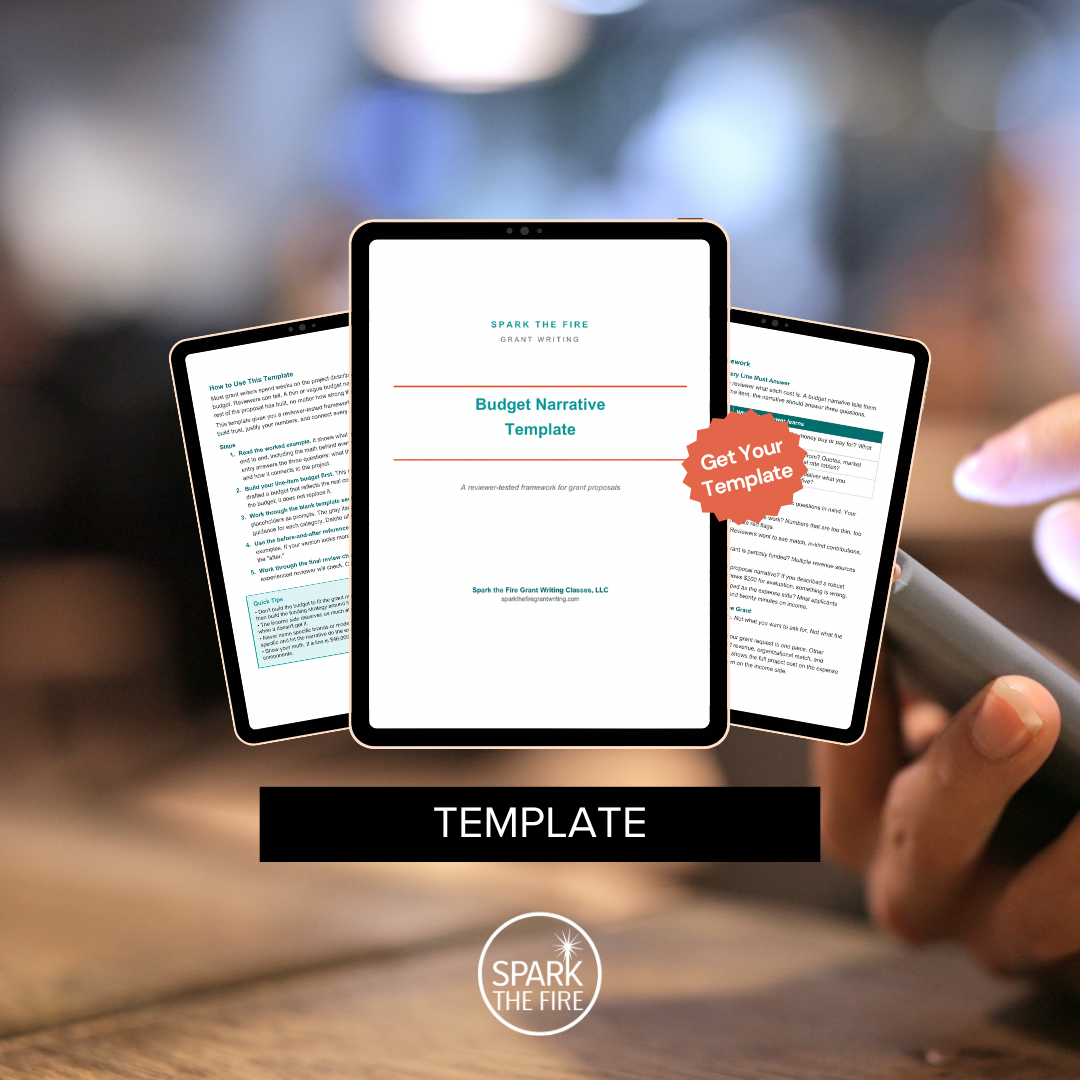
You spent three weeks on the project narrative. Then you sat down to write the budget narrative the night before the deadline. You restated the line items in sentence form, padded a few entries with vague justifications, and hoped the reviewer wouldn't look too closely.
They will. And they can tell.
The budget narrative is one of the quietest places in a proposal where reviewers decide whether to trust you. Numbers without explanations, round figures with no sourcing, line items that exactly match the grant maximum: every one of these signals to an experienced reviewer that the budget was assembled to fit the funder rather than to fund the work. No matter how strong the project description is, a thin budget narrative undermines it.
The Budget Narrative Template is a reviewer-tested framework for writing budget narratives that actually justify your numbers and connect every cost to the project. Built by a former grant reviewer and trainer of 5,000+ grant writers, it walks you through the same questions reviewers ask when they read your budget, then shows you exactly how to answer them.
What's inside (15 pages):
A complete worked example: the full budget narrative for a two-day music festival applying for a state tourism grant, with the math shown explicitly for every line item
A section-by-section blank template with fill-in prompts for personnel, contractors, equipment, supplies, travel, marketing, evaluation, indirect costs, and every income source
Ten before-and-after entries from real proposals, showing exactly how to transform a weak line into one a reviewer will trust
The three questions every line of your narrative must answer, and how to answer them in 2-3 sentences
A final review checklist covering expense side, income side, and cross-check with the project narrative
Guidance on the "generally specific" trade-off, equipment scrutiny, in-kind contributions, and what to do when your real costs exceed the grant maximum
Whether you're writing your first budget narrative or your fiftieth, this template gives you the structure, language, and reviewer perspective to write one that holds up under scrutiny. Downloadable Word Doc (.docx). Built by a grant writer, for grant writers.
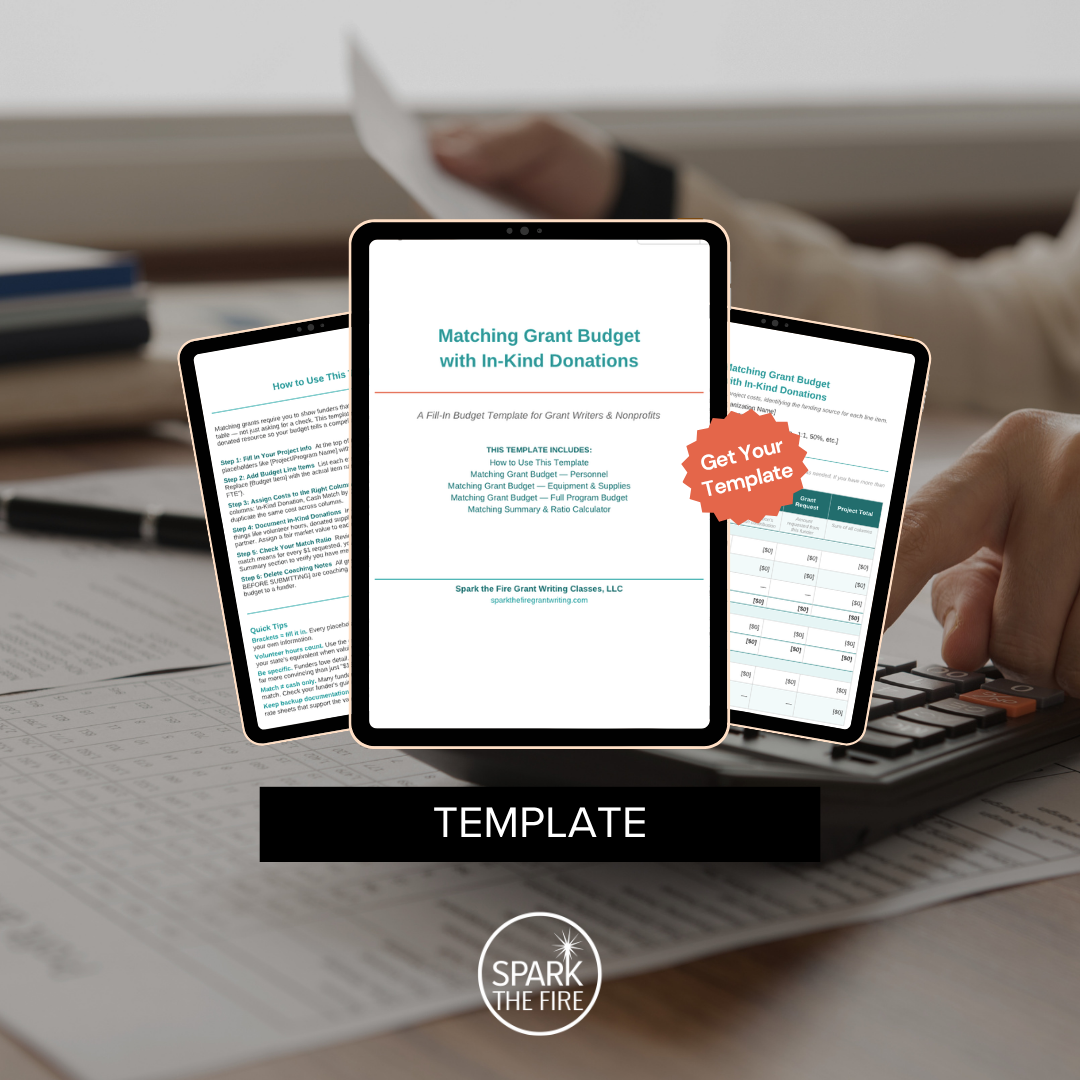
Matching grants sound great, until you're staring at a blank budget trying to figure out what counts as match, how to value donated volunteer time, and whether your numbers actually add up to the right ratio.
This fill-in budget template takes the guesswork out of matching grant budgets, built specifically for nonprofits and grant writers who need to show a funder that they're bringing real resources to the table, not just asking for a check.
What's inside:
• How to Use This Template, including how to document in-kind donations and verify your match ratio
• Full Program Budget Table organized by category (Personnel, Fringe Benefits, Equipment, Supplies, Contractual, Travel, Other Direct Costs, and Indirect Costs), with columns for In-Kind Donations, Cash Match, and Grant Request
• Matching Summary Table, breaking out each funding source as a dollar amount and percentage of total project cost
• Match Ratio Check, a simple fill-in section to confirm you've met the funder's requirement before you hit submit
Every placeholder is in plain brackets, with coaching notes in gray italic to guide you through each section. Works in Microsoft Word. Download, fill in, done. Built by a grant writer, for grant writers.

You've got volunteers logging hours, donors dropping off supplies, and a local business offering their conference room for free, and somewhere in your grant agreement, it says all of that counts toward your required match. The only problem is you have to prove it.
These two ready-to-use Word document templates make in-kind reporting fast, clean, and funder-ready, so you can stop stressing about documentation and get back to actually running your programs.
What's inside:
• Form 1, Individual In-Kind Contribution Form: one form per contributor, tracking hours by activity type plus donated goods, equipment, supplies, and mileage, with a certification signature block
• Form 2, Organizational In-Kind Report: your master funder summary, rolling up all services, goods, and facilities into one document with a grand total box and approval signatures
• Pre-labeled activity categories
• Built-in reference notes for volunteer hourly and mileage rates
• Signature and certification blocks for compliance
• Step-by-step instructions
• Gray coaching notes (delete before submitting)
Designed for nonprofit staff, grant writers, and program managers who are done reinventing the wheel every reporting cycle. Downloadable Word Doc (.docx), editable on PC and Mac. Built by a grant writer, for grant writers.